Last updated: August 2026
Key Takeaways
- A futsal goal is 3 m wide and 2 m high, measured on the inside of the posts.
- The posts and crossbar are 8 cm wide and deep — the same width as the court lines they stand on.
- That is exactly the same size as a handball goal, which is why a single sports hall serves both games.
- The goal must have a stabilising system that stops it overturning. Portable goals are only legal if they have one.
Futsal is played on a handball court with a handball-sized goal and a size 4 ball, and the whole character of the game follows from those three facts. A goal that is 3 m by 2 m — less than a third of the area of an eleven-a-side goal — is why futsal goalkeepers block rather than dive, and why shooting accuracy matters more than power.
Here are the official dimensions from the FIFA Futsal Laws of the Game, plus everything else marked on the court around them.
«People assume the small goal makes scoring hard. It makes long-range shooting pointless, which is a different thing. Everything moves closer, and suddenly the game is about the last five metres.» — Anthony Molina, FOOTBOLNO.COM
The Official Goal Dimensions
| Measurement | Futsal |
|---|---|
| Width (inside the posts) | 3 m |
| Height (ground to underside of crossbar) | 2 m |
| Post and crossbar width and depth | 8 cm |
| Goal area behind the line | Net attached to the back of posts and crossbar |
The Laws are specific about more than the numbers:
- Posts and crossbar must be wood, metal or other approved material, and square, rectangular, round or elliptical in shape
- They must be a different colour from the pitch
- Nets may be hemp, jute, nylon or another approved material, attached to the back of the posts and crossbar, properly supported, and must not interfere with the goalkeeper
- Every goal must have a stabilising system that prevents it from overturning — and portable goals may only be used if they satisfy that requirement
That last point is not decorative. A 3 m goal is light enough to tip, which is precisely why the Laws single it out.
Futsal, Soccer and Handball Compared
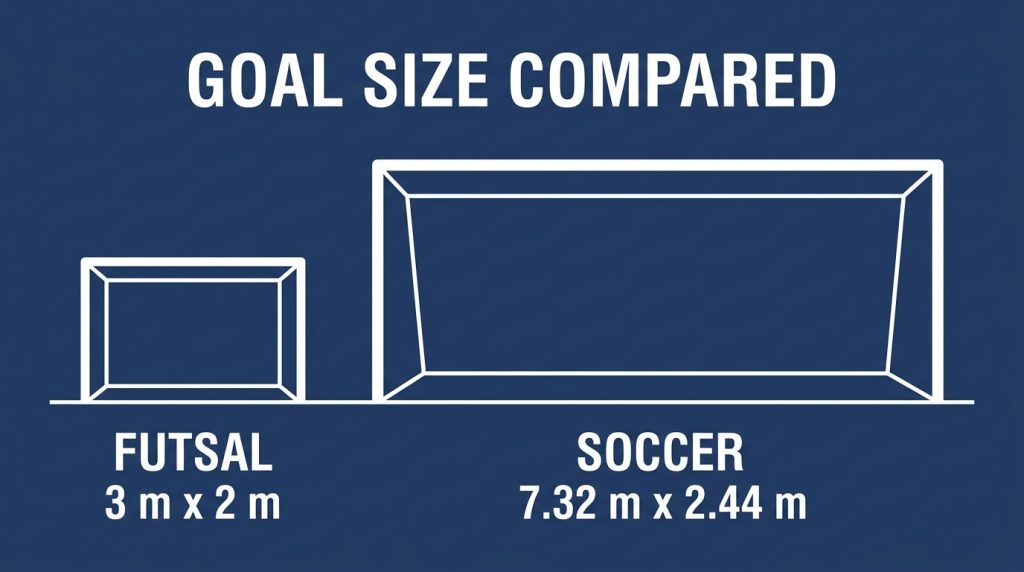
| Goal | Width | Height | Opening area |
|---|---|---|---|
| Futsal | 3 m | 2 m | 6 m² |
| Handball | 3 m | 2 m | 6 m² |
| Eleven-a-side soccer | 7.32 m | 2.44 m | ≈17.9 m² |
The futsal goal and the handball goal are identical: the International Handball Federation specifies an interior height of 2 metres and a width of 3 metres, exactly as futsal does. That is not a coincidence — futsal was designed to be played in existing indoor halls, and it inherited both the court and the goal.
Against an eleven-a-side goal, the futsal target is about a third of the area. A goalkeeper who is 1.85 m tall can reach the crossbar of a futsal goal standing flat-footed, which changes what a keeper is for: covering angles and blocking shots from close range rather than covering a frame too big to reach.
The Court Around the Goal
The goal is one number among several, and the rest of the markings scale with it.
| Marking | Dimension |
|---|---|
| Court length (touch line) | 25–42 m; international 38–42 m |
| Court width (goal line) | 16–25 m; international 20–25 m |
| Penalty area | Quarter circles of radius 6 m from the outside of each post, joined by a 3.16 m line parallel to the goal line |
| Penalty mark | 6 m from the midpoint between the posts |
| Second penalty mark | 10 m from the midpoint between the posts |
| Centre circle radius | 3 m |
| Corner arc radius | 25 cm |
| Line width | 8 cm throughout |
The penalty area is the marking most people get wrong. It is not a rectangle. It is built from two quarter circles of 6 m radius, one from the outside of each post, joined across the front by a straight line of 3.16 m — which is the goal width plus the two 8 cm posts. The result is the D-shape that makes a futsal court recognisable at a glance.
There is also no six-yard box. Futsal has one area at each end and nothing inside it, because the goal clearance is thrown from anywhere in that area rather than taken from a smaller box.
Buying a Futsal Goal
If you are equipping a hall rather than reading the Laws, three things decide whether a goal is usable.
Official size or not. «Futsal goal» is used loosely by retailers for anything from a 3 × 2 m frame down to a 1.5 m junior product. Only 3 m × 2 m is match legal.
Stability. Freestanding goals need weights or a counterbalanced frame; socketed goals need floor sockets in the hall. Anything that can tip in normal use is not compliant.
Post profile. Aluminium is standard, and 8 cm is the specified width and depth. A heavier steel goal is harder to move between sessions but more stable when it is in place.
For a court that also hosts handball, the same goal works for both, which is usually the cheapest way to run a multi-sport hall.
Why the Small Goal Changes the Game
Three consequences follow from 3 m by 2 m, and they explain most of what futsal looks like.
Shooting is a placement problem, not a power problem. A keeper can reach almost the whole frame, so a hard shot at a reachable height is saved. Futsal players shoot low and into corners, and the toe-poke exists precisely because it is the quickest way to get a shot away in a crowded area.
Goalkeepers block rather than dive. With the crossbar within reach, spreading the body to cover as much of the 6 m² as possible beats committing to one side.
Play concentrates near the area. With no value in shooting from 20 m, teams work the ball into the last few metres, which is why futsal produces so much close control and so many one-touch combinations. The rules around what the keeper may do in that space are covered in our futsal goalkeeper rules, and the free kicks that come with the sixth foul are in the futsal penalty rules.
Common Questions
What size is a futsal goal? Three metres wide and two metres high, measured inside the posts, with posts and crossbar 8 cm wide and deep.
Is a futsal goal the same as a handball goal? Yes. Both are 3 m by 2 m on the inside, which is why the same goals are used in multi-sport halls.
How does a futsal goal compare to a soccer goal? An eleven-a-side goal is 7.32 m by 2.44 m. The futsal goal is roughly a third of the opening area.
What is the futsal penalty area? Two quarter circles of 6 m radius drawn from the outside of each goalpost, joined by a 3.16 m line parallel to the goal line. It is a D-shape, not a rectangle.
How far is the penalty spot in futsal? Six metres from the midpoint between the posts. There is a second penalty mark at 10 metres, used from the sixth accumulated foul.
How big is a futsal court? Between 25 and 42 m long and 16 to 25 m wide. For international matches the range narrows to 38–42 m by 20–25 m.
Do futsal goals need to be fixed down? They need a stabilising system that prevents them overturning. Portable goals are permitted only if they have one.
Is there a six-yard box in futsal? No. Futsal has a single penalty area at each end, and the goal clearance is thrown from anywhere inside it.
Anthony Molina writes about soccer technique, gear and coaching at FOOTBOLNO.