Last updated: August 2026
Key Takeaways
- Dribbling is a series of small taps, not a series of small kicks. If the ball travels more than a stride ahead of you, you’ve kicked it.
- Three contact points do almost all the work: the inside of the foot for control, the outside for changing direction, and the laces for running with the ball at speed.
- Keep your head up. A player who can only dribble while staring at the ball isn’t dribbling — they’re escorting it.
- The hardest part isn’t the technique. It’s knowing when not to dribble, and most young players learn that far too late.
Watch a beginner and a good player dribble the same soccer ball down the same touchline and the difference isn’t speed. It’s distance. The beginner’s ball keeps getting away — a metre ahead, two metres, then a defender takes it. The good player’s ball never leaves a small invisible box around their feet.
That’s the whole skill, really. Everything below is about keeping the ball inside that box while still moving forward, and then knowing what to do when someone comes to take it.
«I can teach the mechanics of dribbling in ten minutes. What takes years is the judgement — knowing that this is a moment to take someone on, and that one is a moment to lay it off and run. Most players get the feet before they get the head.» — Anthony Molina, FOOTBOLNO.COM
What Dribbling Actually Is
Dribbling a soccer ball means moving with it under control while it stays close enough that you could stop it instantly. That’s the test. If you couldn’t stop the ball dead with one touch right now, it’s too far away.
There are two distinct versions and they need different technique:
Close control — tight spaces, defenders nearby, small frequent touches. The ball almost never leaves your foot.
Speed dribbling — open space ahead, running into it, bigger touches with the laces. The ball goes further with each touch because you’re covering ground.
Beginners tend to learn one and use it everywhere. Learning to switch between them, mid-run, is what makes a soccer player look comfortable on the ball.
The Three Contact Points
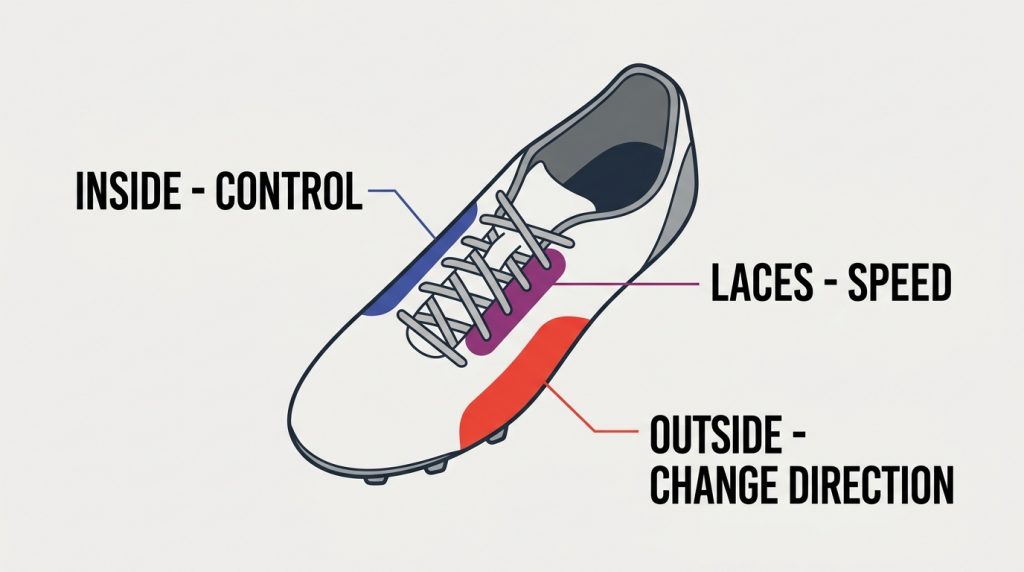
Almost all dribbling happens on three surfaces of the foot. Learn which does what and half the problem disappears.
| Surface | What it’s for | Typical use |
|---|---|---|
| Inside of the foot | Maximum control, changing direction inward | Tight spaces, shielding, cutting past a defender |
| Outside of the foot | Pushing the ball away from your body, disguised changes of direction | Running wide, turning away from pressure |
| Laces (instep) | Covering ground quickly | Speed dribbling into open space |
The toes get used occasionally to poke the ball forward under pressure, but they give you almost no control and you shouldn’t build a habit on them.
If this table looks familiar, it’s because the same three surfaces do the work when you strike the ball — the difference is force. Dribbling uses the same contact points at maybe five percent of the power you’d use to shoot with the laces.
Five Steps to Better Dribbling
Step 1: Tap, Don’t Kick
The most common beginner mistake, and it’s the one that sends the ball three metres ahead where a defender collects it.
A dribbling touch is a nudge. The foot barely swings — the movement comes from the ankle and the lower leg, not from a backswing. Think of pushing the ball rather than striking it.
A useful rule while learning: the ball should never travel further than one of your strides. If it does, your touch was too hard.
Step 2: Small Touches, Many of Them
Count your touches on the soccer ball over ten metres. A beginner does three or four. A comfortable player does eight or ten.
More touches means more control, because the ball spends less time out of contact with your foot — and every moment it’s out of contact is a moment someone can take it. It feels inefficient at first. It isn’t.
Step 3: Get Your Head Up
Dribbling with your eyes locked on the ball is the single biggest limitation on a young player, because it means you can’t see the defender, the pass or the space.
The fix is progressive, and it takes weeks rather than days:
You’ll lose the ball constantly during stage three. That’s the stage working.
Step 4: Body Position
Stay low. Knees bent, weight slightly forward, arms out for balance. A tall upright stance makes turning slow and makes you easy to knock off the ball.
Your body also protects the ball. Keep it between the ball and the defender and there is nothing they can legally do — this is shielding, and it’s half of what good dribblers actually do in traffic.
Step 5: Change Speed and Direction
Constant speed is easy to defend. Defenders read your pace and simply match it.
The moment you change — slow down then explode, or push the ball one way and go the other — you break their rhythm. Most successful dribbles at any level come from a change of pace, not from raw speed.
Practise this specifically: dribble ten metres slow, ten metres fast, ten metres slow. It feels artificial. It builds the habit.
Drills You Can Do Alone
None of these need a partner, a coach, or a full pitch. A soccer ball and a bit of grass will do.
Cone weave, slow. Set six cones two metres apart. Weave through using only the inside of the foot. Speed doesn’t matter — clean touches do. When you can do it without looking down, halve the spacing.
Cone weave, alternating feet. Same setup, but inside of the right foot, then inside of the left, alternating. This is much harder than it sounds and it’s the fastest way to build a usable weak foot.
Figure of eight. Two cones, five metres apart, dribble a figure of eight around them. Forces constant direction changes with both feet.
Wall of touches. Stand still and tap the ball between your feet, inside to inside, as fast as you can hold it. Sixty seconds. It builds the feel that makes everything else possible.
Speed dribble with a stop. Twenty metres at full pace, then stop the ball dead on a marker. Teaches you that speed dribbling still ends in control.
Head-up dribbling. Dribble around a space with a friend or parent standing to one side holding up fingers. Call out the number. If you can’t, you’re looking down.
For a broader session that mixes dribbling with passing and control work, our essential soccer ball drills guide covers a full routine.
Mistakes That Cost You the Ball
Kicking instead of tapping. Covered above, and worth repeating because it’s responsible for most turnovers at beginner level.
Only using your strong foot. A one-footed dribbler is easy to defend — the defender simply shows you onto your weak side and waits. Fixing this is boring and takes months of deliberate weak-foot repetition.
Standing upright. Slows every turn and makes you easy to shoulder off the ball.
Dribbling into crowds. Taking on one defender is a decision. Dribbling into three is a donation.
Never lifting the head. Already covered, but it’s worth saying that this limitation caps how far a player can go more than any physical attribute.
Trying skill moves before mastering basic control. Step-overs look great and achieve nothing if your first touch is loose. Get the basic soccer skills solid first, then add tricks.
When You Should Not Dribble
This is the part almost no dribbling guide covers, and it’s the part coaches care about most.
Pass instead when:
- A teammate is in a better position and unmarked — the pass is faster than any dribble
- You’re in your own defensive third, where losing the ball is dangerous
- You’re outnumbered — two defenders closing means the odds are against you
- A teammate is making a run that will be wasted if you delay
Dribble when:
- You’re one-on-one in the attacking third and beating your player creates a chance
- You have space ahead and nobody to pass to
- Holding the ball buys time for teammates to get forward
- The defender is off balance or backing away
A useful way to think about it: dribbling is a tool for beating a specific opponent, not a way of moving the ball around the pitch. Moving the ball is what パッシング is for, and it’s almost always faster.
Where you play changes the balance too. Wingers dribble constantly because their job is to beat a full-back one-on-one; centre-backs dribble rarely because the risk outweighs the reward. If you’re unsure where you fit, our position self-assessment walks through it.
Teaching a Child to Dribble a Soccer Ball
If you’re a parent or a youth coach, the order matters more than the content.
Start with a stationary soccer ball and no pressure. Let them tap it between their feet standing still until the contact feels normal. Skipping this and going straight to cone weaves produces kids who can complete the drill and still lose the ball in a game.
Use a smaller ball or a softer one. A size 3 soccer ball for under-8s isn’t a compromise, it’s the correct equipment — a full-size ball is genuinely harder to control with small feet.
Make it a game, not a drill. “Keep it away from me for thirty seconds” teaches shielding, close control and head-up awareness at once, and children will do it repeatedly without being told to.
Don’t shout “kick it”. This is how the kicking-instead-of-tapping habit starts, and it takes years to unpick. If they need to move it forward, the instruction is “push it”.
Expect the head to stay down for a long time. Looking up while dribbling a soccer ball is a genuinely advanced skill and pushing a seven-year-old to do it just makes them anxious.
How Long Does It Take?
The mechanics — tapping instead of kicking, using three contact points — you can understand today and feel improvement within a couple of sessions.
Head-up dribbling takes weeks of deliberate practice, and it will get worse before it gets better because you’re trading control for vision.
The judgement of when to dribble takes seasons, and it comes from playing matches rather than doing drills. That’s not a reason to skip drills; it’s a reason not to expect drills alone to make you a good dribbler.
Common Questions
How do I dribble a soccer ball faster? Use the laces rather than the inside of the foot, push the ball further ahead with each touch, and run normally rather than shuffling. But only in open space — at speed you’re trading control for ground, so it doesn’t work in traffic.
How do I stop the ball getting away from me? Your touches are too hard. Cut the force in half and count your touches over ten metres — aim for eight or more. Almost every loose-touch problem is a force problem, not a technique problem.
Should beginners learn skill moves like step-overs? Not until basic control is reliable. A step-over with a loose first touch just gives the ball away with extra steps. Learn to keep the ball close, then add moves.
Which foot should I dribble with? Both, and you’ll hate practising the weak one. Devote a fixed part of every session to it — a quarter is a reasonable target. One-footed players get shown onto their weak side and defended easily.
How do I dribble past a defender? Change speed or direction at the moment they commit their weight. The technique matters less than the timing — most successful take-ons happen because the defender was moving the wrong way, not because the dribbler was faster.
Can I practise dribbling without cones? Yes. Shoes, water bottles, sticks, patches of worn grass — anything that marks a spot works. Cones are convenient, not necessary.
Is dribbling more important than passing? No. Passing moves the ball faster and loses it less often, and most goals come from passing sequences rather than solo runs. Dribbling matters in specific moments — mostly one-on-one in the final third.
Anthony Molina writes about soccer technique, gear and coaching at FOOTBOLNO.