Last updated: August 2026
Key Takeaways
- The longest penalty shootout in history is 56 kicks — F.C. Dimona beat Shimshon Tel Aviv 23-22 in an Israeli third-tier promotion play-off on 20 May 2024. Each side took 28 penalties.
- The previous record, 54 kicks, was set in March 2022 by two 10th-tier English clubs in front of a crowd of 40.
- Before that the record stood for 17 years: 48 kicks in the 2005 Namibian Cup final.
- The men’s World Cup record is only 12 penalties. The longest shootout at any World Cup, men’s or women’s, is 20 — Australia 7-6 France in 2023.
Penalty shootouts are supposed to end quickly. Five kicks each, one team blinks, everyone goes home. What actually happens when nobody blinks is that the goalkeepers end up taking penalties, the substitutes have long since run out, and the players who were nervous at kick three are numb by kick twenty.
These are the shootouts that refused to end, with the scores, the dates and the competitions — and the reason the format allows them to run this long in the first place.
«The thing nobody tells you about a long shootout is that it stops being about pressure. After about fifteen each, everyone is just tired, and the misses start coming from legs rather than nerves.» — Anthony Molina, FOOTBOLNO.COM
The Record: 56 Penalties, Dimona 23-22 Shimshon Tel Aviv
On Monday 20 May 2024, in the desert city of Dimona in Israel’s Negev, F.C. Dimona and Shimshon Tel Aviv played out a 2-2 draw in a promotion play-off in Liga Alef, the Israeli third tier. Then they took 56 penalties.
Each side took 28 of them. Dimona won 23-22. It is the longest penalty shootout in history and the highest score recorded in a first-class match.
The Record Before That: 54 Penalties in Sunderland
On Wednesday 9 March 2022, Washington and Bedlington — both Northern League Division Two clubs, the 10th tier of English football — met in a first-round tie in the Ernest Armstrong Memorial Cup at the Ford Quarry Football Hub in Sunderland.
The 90 minutes finished 3-3, with a stoppage-time penalty from Washington’s Bradley Chisholm completing his hat-trick to force the draw. The shootout that followed took 54 kicks, of which 49 were scored. Washington won it 25-24.
The crowd that night was 40 people. There were more penalties than spectators.
The 2005 Namibian Cup Final That Stood for 17 Years
Before Sunderland, the Guinness World Record was 48 penalties, set in the 2005 Namibian Cup final. KK Palace and Civics drew 2-2 in normal time, could not be separated in extra time, and then went 24 kicks each. KK Palace won 17-16.
That record lasted until 2022 — longer than most players’ careers.
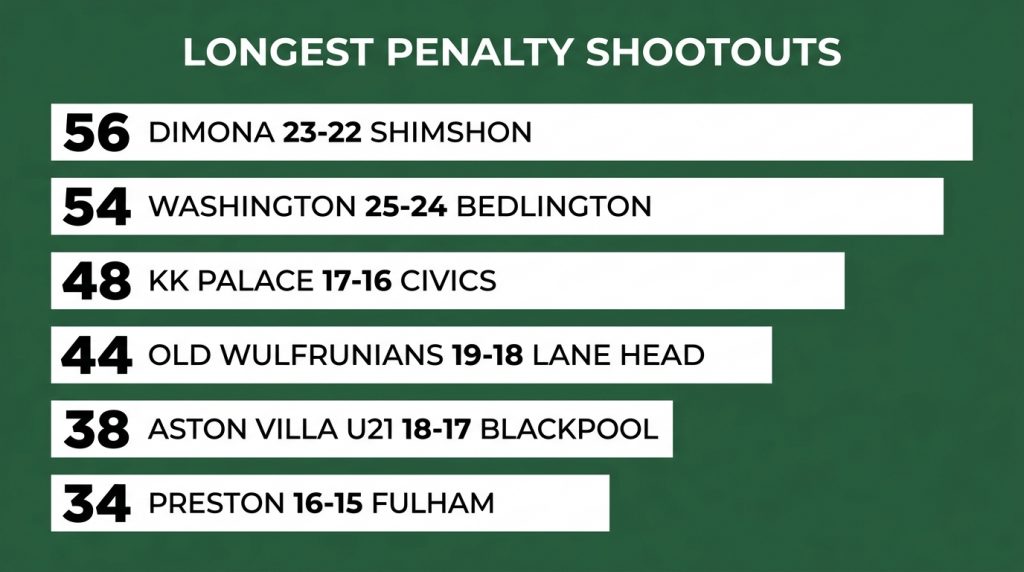
The Longest Shootouts on Record
| Kicks | Result | Competition | Date |
|---|---|---|---|
| 56 | Dimona 23-22 Shimshon Tel Aviv | Liga Alef play-off, Israel | 20 May 2024 |
| 54 | Washington 25-24 Bedlington | Ernest Armstrong Memorial Cup, England | 9 Mar 2022 |
| 48 | KK Palace 17-16 Civics | Namibian Cup final | 2005 |
| 44 | Old Wulfrunians 19-18 Lane Head | English amateur football | 2021 |
| 38 | Aston Villa U21 18-17 Blackpool | EFL Trophy | 17 Dec 2024 |
| 34 | Preston 16-15 Fulham | League Cup, third round | 17 Sep 2024 |
| 32 | Netherlands U21 13-12 England U21 | Euro U21 semi-final | 2007 |
| 30 | Liverpool 14-13 Middlesbrough | League Cup | 23 Sep 2014 |
The 44-kick tie between Old Wulfrunians and Lane Head, two amateur clubs from the Wolverhampton area, was the English record until Washington and Bedlington broke it. It lasted close to half an hour.
The World Cup Record Is Much Shorter
For all the reputation World Cups have for penalty drama, the men’s tournament has never produced a marathon.
The men’s record is 12 penalties, set by West Germany and France in Seville on 8 July 1982 and matched by Sweden and Romania in 1994. Twelve kicks means the shootout got two rounds into sudden death — dramatic, but nothing close to the club records above.
The longest shootout at any FIFA World Cup, men’s or women’s, came at the 2023 Women’s World Cup, where Australia beat France 7-6 after 20 penalties in the quarter-final.
The reason is simple: at a World Cup you have eleven of the best penalty takers your country produces on one side and eleven on the other, and elite takers convert. Long shootouts need misses, and they need them to happen in matching pairs.
Records in Other Competitions
UEFA: 32 penalties, Netherlands under-21s 13-12 England under-21s in the 2007 European Under-21 Championship semi-final — the longest shootout in a UEFA competition.
English professional football: 38 spot-kicks, Aston Villa’s under-21 side beating Blackpool 18-17 in the EFL Trophy on 17 December 2024.
League Cup: 34 penalties, Preston North End 16-15 Fulham in the third round on 17 September 2024, with 31 of the 34 scored. Preston, a Championship side, knocked out Premier League opposition.
Africa Cup of Nations: the 2006 quarter-final between Ivory Coast and Cameroon needed 24 penalties, Ivory Coast winning 12-11 — and Samuel Eto’o’s second attempt was the only miss of the entire shootout. Ivory Coast were also involved in the longest shootout in a final, beating Ghana 11-10 in the 1992 Africa Cup of Nations, the first final of a major international tournament in which every player on the pitch took a penalty.
Consecutive shootout wins: Bradford City won nine in a row between 2009 and December 2012, beating Arsenal and Huddersfield Town along the way.
At the other end of the scale, the shortest possible shootout is three kicks each: Chile beat Portugal 3-0 in the 2017 Confederations Cup semi-final, and Portugal did the same to Slovenia at Euro 2024.
Why the Records Come From Small Clubs
Almost every marathon shootout on record comes from cup football well below the elite level, and the pattern is not a coincidence.
At elite level a squad contains several designated penalty takers, and they convert. A shootout between two Champions League sides usually ends inside twelve kicks because someone eventually hits a corner the goalkeeper cannot reach. Lower down, nobody on either side is a specialist. Kicks four to eleven are taken by defenders and midfielders who practise penalties occasionally, if at all, and the conversion rate drops for both teams at the same time — which is exactly the condition a long shootout needs.
Fatigue does the rest. Washington and Bedlington had already played 90 minutes and drawn 3-3; the shootout that followed asked each side for 27 penalties, every one of them taken knowing a miss could end the tie. Legs go before nerves do, and a tired standing leg produces the scuffed, saveable kick that keeps the round alive.
That is also why the goalkeepers matter so much in these ties. Once both sides have worked through all eleven players, the keepers have taken a penalty each and are back on the line for the second lap — this time against opponents who have already shown them where they shoot.
Why They Run So Long
The format is what makes it possible.
Each side takes five kicks, alternating. If the score is level after that, the shootout goes to sudden death: one kick each, and it only ends when one team scores and the other misses in the same round. A miss on its own decides nothing if the other side misses too.
Then there is the rule that stretches these ties past thirty kicks. Every eligible player on the pitch, goalkeepers included, must take a penalty before anyone takes a second. With eleven players a side, that guarantees up to 22 kicks before the best taker gets another turn — and by then you have centre-backs and goalkeepers stepping up, which is where the misses come from.
Once both teams have been all the way through their list, they start again. Dimona and Shimshon Tel Aviv went through theirs nearly three times.
For what actually happens on each of those kicks — the technique, the choice between placement and power, and the decision that has to be made before the run-up — see our guide to taking a penalty. The laws governing when a penalty is awarded and how a shootout is run are in the penalty rules guide.
Common Questions
What is the longest penalty shootout in history? Fifty-six penalties: F.C. Dimona beat Shimshon Tel Aviv 23-22 in an Israeli Liga Alef promotion play-off on 20 May 2024, with each side taking 28 kicks.
What was the record before that? Fifty-four penalties, in the Ernest Armstrong Memorial Cup tie between Washington and Bedlington in Sunderland on 9 March 2022. Washington won 25-24 after a 3-3 draw.
What is the longest penalty shootout at the World Cup? Twelve penalties in the men’s tournament — West Germany against France in 1982, matched by Sweden against Romania in 1994. Counting the women’s tournament, the longest is 20, in Australia’s 7-6 win over France in 2023.
How many penalties can a shootout have? There is no limit. After five kicks each it becomes sudden death and continues until one team scores in a round where the other misses.
Does every player have to take a penalty? Yes, before anyone takes a second one. Every eligible player on the pitch at the end of extra time, including the goalkeeper, must take a kick before the order repeats.
Can a goalkeeper take a penalty in a shootout? Yes, and in long shootouts they always end up doing so, because everyone else has already taken theirs.
What is the shortest a shootout can be? Three kicks each — one team scores all three, the other misses all three. Chile beat Portugal 3-0 that way in the 2017 Confederations Cup semi-final.
Which club has the best shootout record? Bradford City won nine consecutive penalty shootouts between 2009 and December 2012, including one against Arsenal, which remains the record run.
Why do lower-league shootouts last longer than top-flight ones? Because neither side has specialist takers. When defenders and goalkeepers are taking kicks eight, nine and ten, both teams miss at similar rates, and the shootout keeps resetting instead of ending.
Do shootout goals count in a player’s records? No. A shootout is recorded separately from the match, which still goes down as a draw, and the penalties are not added to a player’s goal tally.
Anthony Molina writes about soccer technique, gear and coaching at FOOTBOLNO.