Last updated: August 2026
Key Takeaways
- Construction cost is driven by surface type and square footage. Industry figures from the Sports Field Management Association run from $0.60–1.50 per sq ft for grass on existing native soil to $6.00–10.25 per sq ft for a synthetic infill system.
- A full-size field of roughly 80,000 sq ft in synthetic turf is commonly quoted at $480,000 to over $1,200,000, and a fully loaded project can reach around $2,000,000.
- A small-sided modular pitch is an order of magnitude cheaper — one US supplier lists a 50 × 80 ft pitch at $110,000, or $140,000 with lights.
- Turf is not maintenance-free, and the carpet has to be replaced. Budget the ten-year cost, not the build cost.
«How much does it cost to build a soccer field» has no single answer, because a field can be a levelled patch of grass behind a school or a sand-drained, floodlit, fenced synthetic surface with its own irrigation system. The gap between those two is a factor of ten.
What does exist is reliable per-square-foot pricing by surface type, and once you know the square footage you want, the arithmetic is straightforward. All figures below are US, and all of them come from industry sources rather than estimates.
«Everyone budgets for the surface and forgets the ground under it. The grading, the base and the drainage are usually the biggest line on the invoice, and they are the part you cannot cut without ruining the field.» — Anthony Molina, FOOTBOLNO.COM
Cost per Square Foot by Surface
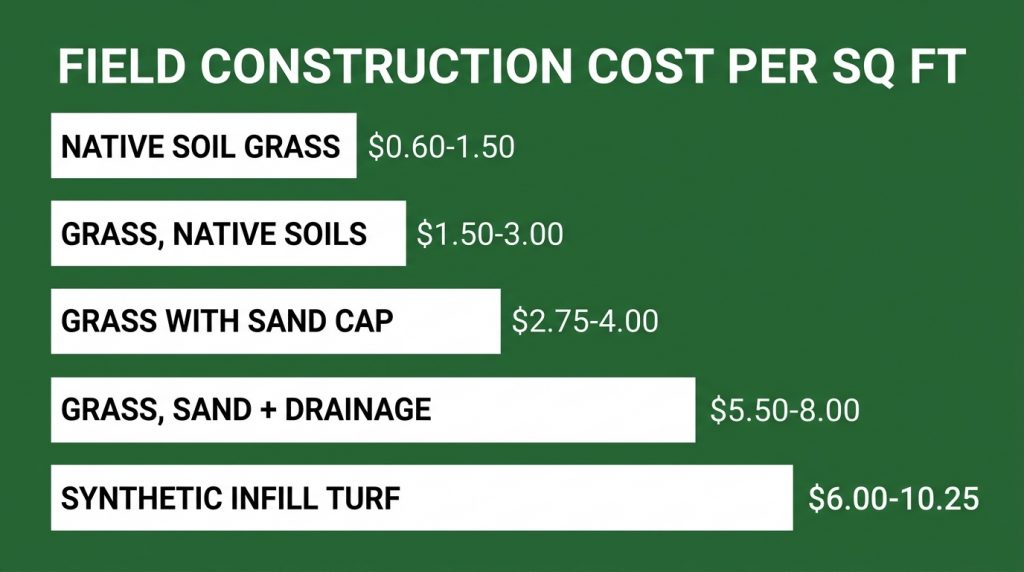
The Sports Field Management Association publishes construction cost ranges by surface build-up. These are the numbers to start from.
| Surface | Construction cost per sq ft |
|---|---|
| Natural grass on existing native soil, no added topsoil or sod | $0.60 – $1.50 |
| Natural turfgrass with native soils | $1.50 – $3.00 |
| Natural grass with sand cap | $2.75 – $4.00 |
| Natural grass with sand and drainage | $5.50 – $8.00 |
| Synthetic infill system (carpet, infill and base) | $6.00 – $10.25 |
Two things jump out. First, a properly drained natural grass field costs roughly the same as a synthetic one to build — the cheap grass number applies only when you are working with the soil that is already there. Second, the range within each row is wide, and where a project lands depends almost entirely on the site.
What a Full-Size Field Actually Costs
Industry sources size a full-size field at approximately 80,000 square feet, and price it accordingly.
Keystone Sports Construction puts installed synthetic turf at $6 to $15 per square foot, which for a regulation field works out at $480,000 to over $1,200,000, including base preparation and installation. Drainage, by their figures, adds another $1 to $4 per square foot.
The Motz Group quotes $5–10 per square foot for a field replacement 和 $7–14 per square foot for a conversion from grass to turf, and notes that once every component of the installation is included, a total project can reach around $2,000,000.
At the grass end, the same 80,000 sq ft at the SFMA’s native-soil rate of $0.60–1.50 per sq ft comes to roughly $48,000 to $120,000 — but that assumes soil that already drains and a site that is already close to level. Add sand and drainage at $5.50–8.00 per sq ft and you are back at $440,000 to $640,000.
Small-Sided and Modular Pitches
If the goal is a usable playing surface rather than a regulation pitch, the numbers change completely.
Urban Soccer Park, a US supplier of modular small-sided pitches, lists installed prices publicly:
| Pitch | 尺寸 | Installed cost |
|---|---|---|
| Five-a-side | 50 × 80 ft (4,000 sq ft) | $110,000 without lights, $140,000 with |
| Futsal | 60 × 100 ft (6,000 sq ft) | $140,000 without lights, $170,000 with |
| Two-field complex | 140 × 120 ft (16,800 sq ft) | $500,000 depending on options |
Those prices include the turf, drainage tiles, goals, containment boards and netting — a complete facility rather than a surface. The lights, judging by the difference between the two columns, run about $30,000 on a pitch this size.
For a backyard, the arithmetic scales down the same way. A 30 × 50 ft area is 1,500 sq ft; at the SFMA’s native-soil grass rate that is roughly $900 to $2,250 of construction, plus goals. Small-sided formats are also what most youth training actually needs — the futsal rules guide covers court sizes if you are laying out a hard surface instead.
What Actually Drives the Price
The surface is rarely the biggest line item. These are:
Site preparation and grading. Everything depends on what you are building on. A flat, well-drained site with good access costs a fraction of a sloped one that needs earth moved and retaining work.
The base. Under any synthetic system is a compacted stone base, and it has to be built to tolerance. Keystone notes that groundwork — site prep, base construction and drainage base — often makes up the largest portion of the project.
Drainage. $1 to $4 per square foot on a turf project, and the single biggest factor in how many days a year the field is playable.
Lights. Around $30,000 on a small-sided pitch by the numbers above; considerably more for a full-size field with four poles.
Fencing, netting and goals. Usually the last thing budgeted and rarely trivial.
Irrigation. Grass only, and a real ongoing cost as well as a build cost.
How to Bring the Number Down
Every lever that meaningfully reduces the cost of building a soccer field does one of three things: shrinks the square footage, simplifies the build-up, or delays part of the project.
Build smaller. Cost scales almost linearly with area, so a 6,000 sq ft small-sided pitch costs under a tenth of an 80,000 sq ft one at the same rate per square foot. For training and youth football, the smaller surface is often the better one anyway.
Work with the soil you have. The difference between grass on existing native soil and grass with sand and drainage is $0.60–1.50 against $5.50–8.00 per square foot — a five- to tenfold swing driven entirely by the build-up under the grass. If the site already drains, do not pay to rebuild it.
Phase the lights. Lighting is a self-contained project that can be added later. Ducting can be laid during construction cheaply and the poles fitted when the budget allows.
A replacement is cheaper than a conversion. The Motz Group’s figures put a turf replacement at $5–10 per square foot against $7–14 for a conversion from grass, because a replacement reuses the base that is already there. A field on its second carpet is a substantially cheaper project than a first-time build.
What the Quote Will Not Include
The construction figures above cover the field. A facility is more than a field, and the items that arrive afterwards are the ones that catch first-time projects out: parking and access, changing rooms or a container solution, spectator space, storage for equipment, water supply for irrigation, and the permits and drawings needed before anyone breaks ground.
None of those have a per-square-foot rate, because they depend entirely on the site and the local authority. What they reliably do is add a line to the budget after the field has been priced — which is why the sensible approach is to price the field first, then treat everything around it as a separate project with its own number.
The Ten-Year Number
This is where most projects get their maths wrong.
Turf is often sold as maintenance-free. It is not. Keystone budgets $5,000 to $15,000 a year for routine synthetic field maintenance. A Michigan State University certified sports turf manager, cited by Safe Healthy Playing Fields, reported annual maintenance of $13,720–$39,220 for synthetic fields against $8,133–$48,960 for natural grass — overlapping ranges, not the clean win the sales pitch implies.
Then there is the carpet. A synthetic surface has a finite life and the carpet must be replaced roughly every eight to ten years, at a cost cited around $500,000. That single line changes the comparison entirely.
The Motz Group frames it as cost per year of use: a $1,000,000 installation with $5,000 a year in maintenance over a ten-year life works out at $105,000 per year. Grass, by contrast, has no replacement cliff — the SFMA suggests annual inputs of $20,000 to $30,000 per field go a long way towards keeping a natural surface safe and playable.
The honest summary: turf wins on hours of use per year, grass wins on lifetime cost, and anyone quoting you one number without the other is selling something.
Indoor Fields
Indoor costs are a different category, because you are building a building. The playing surface is the small part; the structure, roof, heating, lighting and floor drainage are the project.
The modular pitch prices above are the closest usable benchmark for the surface itself — an indoor five-a-side surface is the same product as an outdoor one. What you cannot benchmark from field pricing is the shell, which varies with local construction costs more than with anything to do with soccer.
Common Questions
How much does it cost to build a full-size soccer field? For synthetic turf on a roughly 80,000 sq ft field, industry quotes run from about $480,000 to over $1,200,000, and a fully loaded project can reach around $2,000,000. Natural grass on existing native soil can be as low as $48,000–$120,000 if the site already drains.
Is turf or grass cheaper to build? On paper grass, but only if you use the soil that is already there. A sand-capped, drained grass field costs $5.50–8.00 per square foot against $6.00–10.25 for a synthetic infill system — effectively the same.
How much does a backyard soccer field cost? At native-soil grass rates, a 30 × 50 ft area is roughly $900–$2,250 of ground work plus goals. A modular turf pitch at that scale is a different product entirely and prices in the tens of thousands.
How much does a small-sided pitch cost? One US supplier lists a 50 × 80 ft five-a-side pitch at $110,000 installed, or $140,000 with lights, including goals, boards and netting.
What does turf field maintenance cost per year? Between $5,000 and $15,000 by one contractor’s budget, and $13,720–$39,220 by a university turf manager’s figures. The variation is mostly down to how heavily the field is used.
How long does artificial turf last? Roughly eight to ten years before the carpet needs replacing, at a cost cited around $500,000 for a full-size field. That replacement should be in the original budget, not discovered later.
What is the biggest hidden cost? Groundwork. Site preparation, base construction and drainage frequently make up the largest share of the invoice, and they are the parts that decide whether the field is usable in February.
Do I need lights? Only if you need evening use, and they roughly add $30,000 to a small-sided pitch. On a full-size field the figure is much higher, and it is usually the item that decides whether a project happens at all. If you are building for a club rather than a school, the guide to becoming a coach covers the organisational side that tends to arrive with the facility.
Anthony Molina writes about soccer technique, gear and coaching at FOOTBOLNO.