Last updated: May 2026
«You can tell a lot about how seriously a club takes player development just by checking what ball the U8s are training with. Put an adult-weight ball at a 6-year-old’s feet, and you’re not developing technique — you’re building bad habits and risking strain on joints that aren’t ready for that load.» — Anthony Molina, FOOTBOLNO.COM
Every parent who’s walked into a sporting goods store with a kid in tow knows the feeling: wall of balls, zero clarity. Which size? Which weight? Does it actually matter? The short answer is yes — it matters a lot more than most people think. The slightly longer answer is what this guide is for.
The weight of a soccer ball isn’t a marketing spec. It’s a regulatory standard set by the International Football Association Board (IFAB) — the body that writes and maintains the Laws of the Game worldwide. These rules cover everything from how the ball is made to what it should weigh at the exact moment a match kicks off. And they’ve been largely consistent since 1937.
So whether you’re shopping for a 6-year-old who just joined a Saturday league, picking a ball for high school tryouts, or just curious what a professional match ball actually weighs — this is the definitive breakdown.
Die wichtigsten Erkenntnisse
- Ball weight directly affects technique and player safety: a ball that’s too heavy for a young child builds bad habits and can strain joints that aren’t ready for that kind of load.
- The official adult ball (size 5) must weigh 410–450 grams with a circumference of 68–70 cm — an IFAB standard that’s been in place since 1937.
- For players aged 8–12, size 4 is the right call: 350–390 grams, 63.5–66 cm circumference, sized to support ball control and technical development.
- The move from size 4 to size 5 should be gradual — give players 4–6 weeks to adjust to the added weight and circumference before going all-in.
- Pressure (0.6–1.1 atm) affects how the ball plays and should be checked before every session. A pump gauge is cheap. Use one.
Key Numbers at a Glance
Before diving into the full breakdown, here’s a quick-reference summary for everything covered in this guide:
- Size 5 (adults, 12+): 410–450 g | 68–70 cm circumference | 0.6–1.1 atm pressure
- Size 4 (youth, ages 8–12): 350–390 g | 63.5–66 cm circumference
- Size 3 (under 8): 270–340 g | 56–61 cm circumference
- Size 1 (skills/training): 140–220 g | 40–43 cm circumference
- Futsal ball (size 4): 400–440 g | 62–64 cm | first bounce 50–65 cm from 2 m drop
All weights apply to a fully inflated ball measured at the start of a match. The sections below explain what those numbers mean, why they exist, and how to use them.
What is the Official Weight of a Professional (Size 5) Soccer Ball?
A professional soccer ball — size 5 — must weigh between 410 and 450 grams (14 to 16 ounces) at the start of a match. That’s the official standard, and it hasn’t changed in any meaningful way since IFAB codified it in 1937.
This isn’t a loose recommendation. IFAB’s Law 2 — “The Ball” — is the regulatory document that governs every official match on the planet, from your local high school field to the World Cup final. Here’s the exact wording:
«All balls must be spherical, made of suitable material, have a circumference of 68 cm (27 ins) to 70 cm (28 ins), weigh from 410 g to 450 g at the start of the match, and have a pressure of 0.6–1.1 bar (600–1,100 g/cm²; 8.5–15.6 psi) at sea level.» — The International Football Association Board, Laws of the Game 2025/2026, Law 2: The Ball
To be more precise, IFAB specifies that a legal match ball must be: spherical; made of leather or other suitable material; of a circumference of not more than 70 cm (28 ins) and not less than 68 cm (27 ins); not more than 450 g (16 oz) and not less than 410 g (14 oz) in weight at the start of the match; and of a pressure equal to 0.6–1.1 atmosphere (600–1,100 g/cm²) at sea level.
— The International Football Association Board, Laws of the Game 2025
Three numbers to remember: 410 g minimum, 450 g maximum, 68–70 cm circumference. Weight is always measured at the start of the match — not mid-game, when the ball may have absorbed moisture or lost a little pressure.
Why a range instead of a fixed number? Manufacturing tolerances. Different bladder materials, panel constructions, and outer coverings all contribute to the final weight. The 40-gram window lets manufacturers produce high-quality balls across different price points while still meeting the standard. A match ball from Adidas and a training ball from a regional brand can both legally be used in an official game — as long as they fall within that range and carry the appropriate FIFA certification mark.
As IFAB’s own technical guidance explains: «The specifications for the ball are critical for ensuring fair play and consistency across all levels of football. The weight range of 410–450 g ensures proper flight characteristics and player safety while maintaining the traditional feel of the game.» — The International Football Association Board Technical Inspection Report: Football Equipment Standards 2025
Pressure matters more than people realize. The 0.6–1.1 atmosphere range at sea level is wide by design. At altitude — say, Mexico City or Johannesburg — air pressure changes affect both how you inflate the ball and how it behaves in flight. A ball at the lower end of the pressure range feels slightly softer and bounces lower. A ball at the upper end feels firmer and responds more crisply. Both are legal, but they play differently. For most training sessions at sea level, a pressure of 0.8–1.0 atm (roughly 11.5–14.5 psi) is a solid middle-ground target. Re-check with a pump gauge before every session.
The FIFA Quality Programme adds another layer of certification on top of IFAB’s baseline. A ball marked FIFA Quality Pro — the highest level, required for top professional competitions — passes seven laboratory tests: weight, circumference, roundness, bounce, water absorption, pressure loss, and shape retention, all under demanding conditions. A ball marked FIFA Quality passes the same tests at standard thresholds. If you’re buying a ball for serious training, look for one of these marks on the FIFA Quality Programme page. The IFAB specification is the floor; FIFA certification is the ceiling.
A 40-gram weight window isn’t a loophole — it’s a precision standard that accounts for real manufacturing variation while keeping the game fair at every level.
The weight standard for size 5 has been in place since 1937. Not because nobody thought to update it, but because it works. The physics of the game — how far a properly struck ball travels, how it bends in the air, how it feels on the instep — were essentially dialed in at that weight range long before modern materials even existed.
«The weight standard for size 5 balls has remained unchanged since 1937, with only minor adjustments to material specifications.» — The International Football Association Board, Laws of the Game 2025
Soccer Ball Weight and Size Chart by Age
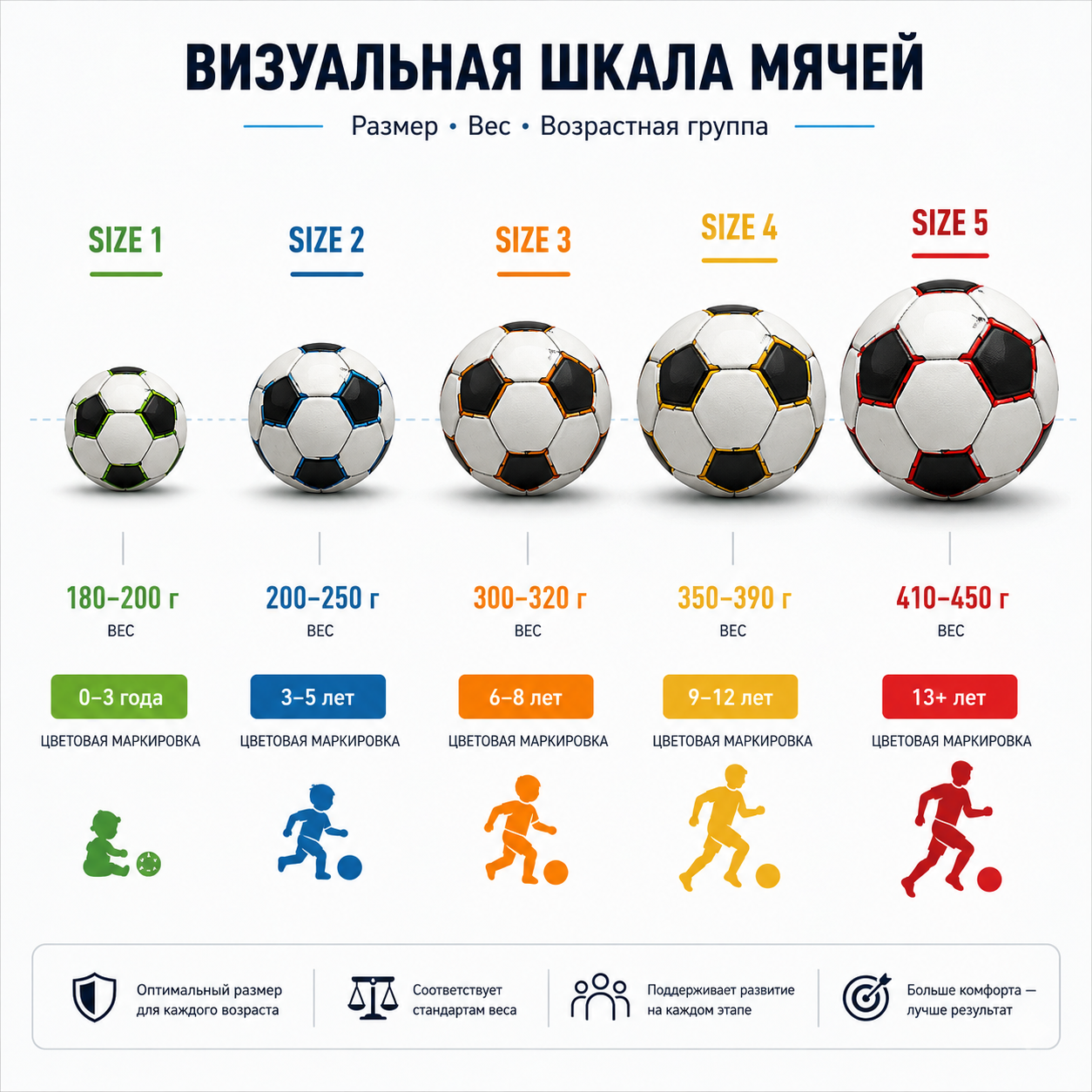
Ball size and weight aren’t one-size-fits-all. IFAB governs the size 5 match ball; smaller sizes are specified through federation guidelines and association standards, including those from US Youth Soccer. Here’s the full breakdown:
| Größe | Official Weight | Circumference | Recommended Age |
|---|---|---|---|
| 5 | 410–450 g (14–16 oz) | 68–70 cm (27–28 in) | 12+ / Adults |
| 4 | 350–390 g (12.3–13.8 oz) | 63.5–66 cm (25–26 in) | Ages 8–12 |
| 3 | 270–340 g (9.5–12.0 oz) | 56–61 cm (22–24 in) | Under 8 |
| 1 | 140–220 g (5–7.8 oz) | 40–43 cm (16–17 in) | Skill training / any age |
Sources: IFAB Laws of the Game 2025/2026, Law 2; US Youth Soccer Player Development Initiatives guidelines.
For youth football, appropriate ball sizes are established to ensure player development and safety: Size 5 (410–450 g) for players aged 12 and above; Size 4 (350–390 g) for players aged 8–12; Size 3 (300–320 g) for players under 8 years.
— The International Football Association Board, Laws of the Game 2025
A few things worth noting. Size 1 — sometimes called a “skills ball” — has no official IFAB match standard; it’s a training tool designed for footwork development and can be used by players of any age. Size 3 and size 4 specifications come from federation and association guidelines rather than IFAB match law, which technically only governs the size 5 match ball. The age recommendations for size 3 and 4 are consistent across US Youth Soccer, FIFA development materials, and most national associations — but they’re guidelines, not hard legal requirements.
Size 5: The Standard for Adults and Youth Players Aged 12+
Size 5 is the ball. Every professional league on the planet uses it. Every FIFA-sanctioned competition uses it. In the United States, that means MLS, the NWSL, NCAA soccer, and every state high school association running 11v11 play. US Youth Soccer transitions players to size 5 at U13.
The official weight range is 410–450 grams (14–16 ounces), with a circumference of 68–70 cm. If you’re buying a ball for a player aged 12 or older — or for yourself — this is the spec you need to match.
Within that range, there’s meaningful variation in how different balls feel and perform. A FIFA Quality Pro-certified match ball (the kind used in MLS or the Champions League) is engineered to perform consistently across the full weight window, with tight manufacturing tolerances. A training ball sold at retail might land anywhere in the legal range and feel noticeably different from one to the next. That’s not a flaw in the standard — it’s just the reality of different price points.
For players transitioning from size 4 to size 5 — typically around age 11–12 — the jump is real. The ball is heavier, larger in circumference, and requires more leg strength to generate pace on passes and shots. Most coaches recommend a gradual introduction: some training sessions with size 4, increasing size 5 time over a 4–6 week window. The adjustment is faster than it sounds.
Size 4: The Bridge for Youth Players Aged 8–12
Size 4 weighs 350–390 grams (12.3–13.8 oz) with a circumference of 63.5–66 cm. That’s roughly 60–90 grams lighter than a size 5 — a difference that’s immediately noticeable when you pick up both balls.
US Youth Soccer assigns size 4 to the U8 through U12 age bands, and for good reason. The lighter, smaller ball is far easier for an 8-year-old to control with their foot, strike cleanly, and work through dribbling sequences. The physical demands are matched to the player’s actual strength and coordination level.
Federation coaching materials consistently point to size 4 as the right tool for developing ball mastery, passing accuracy, and dribbling technique in this age group. The logic is straightforward: if the ball is too heavy to control comfortably, players adapt by developing compensatory movement patterns that become harder to correct later. You end up with a 14-year-old who toe-punches because that was the only way they could generate pace with an oversized ball at age 9. Fixing that takes months.
«Selecting the right ball size for youth players is fundamental — it shapes their technique, confidence, and long-term enjoyment of the game.» — Anthony Molina, FOOTBOLNO.COM
The difference between size 4 and size 5 goes beyond weight. Size 4 has a noticeably smaller circumference — up to 6.5 cm less than a size 5. For a player with smaller hands and feet, that smaller contact surface makes first touches cleaner, ball control easier, and heading (where appropriate) less physically jarring.
Size 4 vs. Size 5 at a glance:
| Spec | Size 4 | Size 5 |
|---|---|---|
| Gewicht | 350–390 g | 410–450 g |
| Circumference | 63.5–66 cm | 68–70 cm |
| Recommended age | 8–12 | 12+ |
| Standard use | Youth U8–U12 | Adult, professional, U13+ |
Size 3: The Starting Point for Young Children Under 8
Size 3 weighs 270–340 grams (9.5–12.0 oz) with a circumference of 56–61 cm. This is the ball for kids under 8 — U6 and U8 leagues, Saturday morning kickabouts, backyard first touches.
At around 300 grams, a size 3 is roughly a third lighter than a professional match ball. That’s not an arbitrary design choice. A child aged 5–7 has significantly less leg strength, coordination, and spatial awareness than an adult player. A ball that weighs 450 grams at their feet isn’t a developmental tool — it’s a hazard. It’s too heavy to control properly, too large to strike cleanly, and puts disproportionate strain on developing joints and tendons when headed or struck firmly.
Pediatric and early-childhood soccer guides are consistent on this point: size 3 is specifically engineered for the physical capabilities and developmental needs of young children. The goal at this age isn’t tactical formation work — it’s building a positive relationship with the ball. Comfort, confidence, basic coordination. A size 3 makes that possible in a way that a size 4 or 5 simply can’t.
US Youth Soccer doesn’t currently publish a specific joint-injury rate comparing size 3 versus size 5 use in U6 players. No peer-reviewed study in the available data specifically quantifies that injury risk for soccer. However, the broader sports medicine literature consistently supports the principle of load-appropriate equipment for developing athletes. The American Academy of Pediatrics recommends that youth sport equipment be scaled to a child’s physical maturity precisely to reduce cumulative impact stress on developing musculoskeletal structures. The developmental and safety rationale behind age-appropriate ball sizing is aligned with those principles across federation guidelines, coaching manuals, and pediatric sport organizations.
Checklist: The Right Ball for Your Child
Hake Gegenstände ab, wenn du sie fertigstellst
Why Does Using the Correct Ball Weight Matter?
Wrong ball weight means wrong technique, higher injury risk, and a game that doesn’t feel or play the way it should. Here’s why each of those things is worth taking seriously.
Technique development is weight-dependent. This is probably the biggest argument for getting ball sizing right at the youth level. When a ball matches the player’s physical capabilities, they can strike it correctly — planting foot positioned, striking surface clean, follow-through natural. When the ball is too heavy, the player compensates. They lean back to generate more force. They strike with the toe instead of the instep. They shorten the follow-through. These compensations become habits. Habits become deeply ingrained movement patterns. A coach working with a 14-year-old who spent three years playing with an overweight ball faces a rehabilitation project, not a development task.
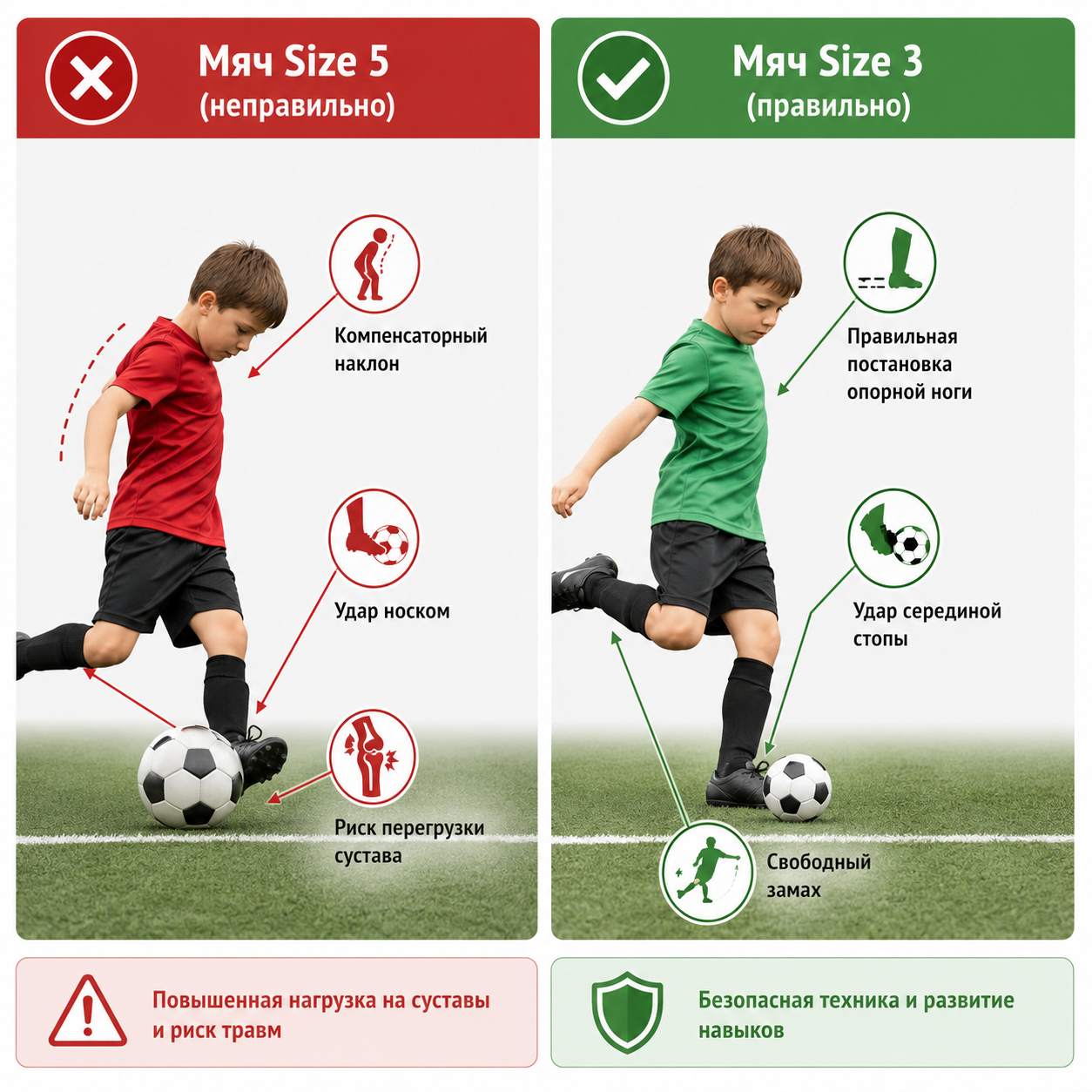
Joint load and injury risk. There’s no large-scale peer-reviewed trial comparing injury rates across ball sizes in youth soccer — the data simply doesn’t exist at that level of specificity yet. What does exist is a clear technical rationale from IFAB, FIFA’s ball quality program, and the sports medicine framework: a lighter ball produces lower impact load per strike. For a 6-year-old kicking a ball 30 times in a training session, the cumulative difference in load between a size 3 and a size 5 is significant. The AMFR technical note on youth football equipment explicitly links lighter ball formats for 8–11-year-olds to protection from injury and easier acquisition of technical skills.
«Consistent equipment standards aren’t just about fairness — they’re a safeguard against preventable injuries, especially for young athletes still developing physically.» — Anthony Molina, FOOTBOLNO.COM
Flight characteristics and game physics. A regulation size 5 ball at 410–450 g travels with predictable physics. Players and goalkeepers rely on that predictability — tracking a shot, timing a header, reading the flight off a corner kick. An underinflated ball behaves erratically. An overweight ball drops faster and moves slower. An underweight ball can be carried by wind in ways that make the game genuinely unpredictable rather than skillfully complex. The weight standard exists partly to ensure that the game plays consistently regardless of where it’s being played or who manufactured the ball.
Fair play and standardization. When every ball in every official match weighs within the same 40-gram range, the game is fair. Players and teams aren’t disadvantaged by equipment variation. This sounds obvious, but it’s the entire point of Law 2. Before standardized specifications, leather balls could absorb water and more than double in effective weight over the course of a wet match — a problem that made the game increasingly arduous and unpredictable as conditions deteriorated.
«The specifications for the ball are critical for ensuring fair play and consistency across all levels of football. The weight range of 410–450 g ensures proper flight characteristics and player safety while maintaining the traditional feel of the game.» — The International Football Association Board Technical Inspection Report: Football Equipment Standards 2025
The IFAB’s 2025 Technical Inspection Report noted that 99.7% of balls used in official competitions across 54 national associations complied with weight specifications during the 2024–2025 season. Near-universal compliance. The system works.
Disclaimer: The information in this section is general in nature and does not replace consultation with a qualified sports medicine or pediatric health professional. For specific concerns about youth athlete safety and equipment, consult a licensed specialist.
When you hit the pitch for training, which ball size is your go-to?
Wählen Sie Ihre Antwort
How to Check Your Ball’s Weight and Pressure at Home
Knowing the spec is only useful if you can verify it. Here’s a straightforward process to confirm your ball meets standard before a session or match.
What you’ll need:
- A digital kitchen scale (accurate to 1–2 grams)
- A ball pump with a pressure gauge (analog or digital)
- A flexible tape measure
Steps:
- Check the label. Look for the size, recommended pressure range, and any FIFA certification mark (FIFA Quality or FIFA Quality Pro) printed on the ball’s surface or inner bladder label. This confirms the ball’s intended spec.
- Weigh the ball. Place the fully inflated ball on the kitchen scale. For a size 5, the reading should fall between 410 g and 450 g. For size 4: 350–390 g. For size 3: 270–340 g. If the ball is outside that range and feels flat, check pressure first.
- Measure circumference. Wrap the tape measure around the widest point of the ball. A size 5 should read 68–70 cm; size 4, 63.5–66 cm; size 3, 56–61 cm.
- Check and adjust pressure. Connect the pump gauge to the valve. For most size 5 balls at sea level, a reading of 0.8–1.0 atm (approximately 11.5–14.5 psi) is a reliable practical target within the legal 0.6–1.1 atm range. Add or release air accordingly.
- Re-weigh after inflation adjustment. If the ball was significantly underinflated, re-check weight on the scale after inflating to target pressure. Weight should remain within the legal range.
- Repeat before each session. Temperature drops overnight can reduce pressure by 1–2 psi. Always re-check before you play, not after.
A ball that falls outside the weight range when fully inflated to spec is either defective or not manufactured to standard — and should be replaced for any official or structured training use.
Frequently Asked Questions About Soccer Ball Weight
How much does a Futsal ball weigh compared to a soccer ball?
A futsal ball is size 4 with a weight of 400–440 grams and a circumference of 62–64 cm. Compare that to a standard size 5 soccer ball at 410–450 grams with a 68–70 cm circumference. On weight alone, the futsal ball is not heavier than a standard soccer ball — its maximum weight is actually 10 grams lighter than the size 5 ceiling.
The real difference isn’t weight. It’s bounce.
FIFA futsal rules specify a first-bounce height of 50–65 cm when dropped from 2 meters. A standard outdoor soccer ball bounces significantly higher from the same drop height. The futsal ball achieves this reduced rebound through a combination of lower air pressure (0.6–0.9 atm versus 0.6–1.1 atm for a standard ball) and internal construction — often a foam insert or denser bladder — that absorbs energy rather than returning it.
Why? Because futsal is played on hard indoor surfaces (typically hardwood or compressed rubber), and a ball with standard rebound characteristics on those surfaces would be genuinely unmanageable. The reduced bounce keeps the ball close to the ground, rewards technical ground play, and makes the game faster and more precise. It’s a design choice driven entirely by the demands of the playing surface, not by weight considerations.
If you’re a youth player or coach curious about using a futsal ball for outdoor training — it’s actually a useful development tool. The lower rebound forces players to control the ball actively rather than waiting for it to settle. Plenty of elite academies incorporate futsal training into their technical development programs for exactly this reason.
Is a World Cup ball heavier than a standard professional ball?
No. World Cup match balls meet the exact same IFAB size 5 specification: 410–450 grams, 68–70 cm circumference, 0.6–1.1 atm pressure. There is no separate FIFA World Cup weight standard — the Laws of the Game apply universally to all FIFA-sanctioned competitions, including the World Cup.
What changes from tournament to tournament is the technology inside and on the surface of the ball, not the mass. The Al Rihla — Adidas’s official ball for the 2022 World Cup in Qatar — became well-known for its behavior in flight. Goalkeepers complained about it. Scientists studied it. The discussion was always about aerodynamics, not weight.
The Al Rihla featured a textured panel surface and a specific panel shape designed to reduce drag and stabilize flight. It also incorporated a “Connected Ball” sensor — a small chip inside the ball that communicated with the semi-automated offside technology used for the first time at Qatar 2022. That sensor had to fit within the weight budget of the existing specification. FIFA and Adidas don’t get to add 30 grams of electronics and call it legal; the ball still had to weigh between 410 and 450 grams at kickoff.
The aerodynamic behavior of modern match balls — how they dip, curve, and flutter — comes from panel geometry, surface texture, and seam design. None of those factors push the ball outside the legal weight range. They just change how air flows around it.
For the 2026 World Cup (hosted across the United States, Canada, and Mexico), the official match ball will similarly comply with standard size 5 specifications. Any reports of unusual ball behavior will, as always, be about aerodynamics rather than mass.
How much does a soccer ball weigh in grams — for all sizes?
Here’s the direct breakdown:
- Size 5: 410–450 grams (14–16 oz)
- Size 4: 350–390 grams (12.3–13.8 oz)
- Size 3: 270–340 grams (9.5–12.0 oz)
- Size 1: 140–220 grams (5–7.8 oz) — not an IFAB match standard; training use only
All weights are measured at the start of a match on a fully inflated ball. Over the course of a wet match, balls can absorb water and become measurably heavier — one of the reasons modern synthetic balls have largely replaced traditional leather construction. Old leather match balls, particularly in heavy rain, could absorb enough water to increase their effective weight substantially over 90 minutes. There’s no reliable peer-reviewed figure in the available data for exactly how much weight a pre-synthetic leather ball gained during a wet match, but historical accounts from players who competed in the 1940s–60s consistently describe the difference as dramatic and physically taxing.
How much did a leather soccer ball weigh, and how did it change the game?
The current size 5 weight standard — 410–450 grams — was codified in 1937 and can be traced through the evolution of the official soccer ball as documented in IFAB’s historical records. Prior to standardization, match balls varied considerably. Early leather balls were stitched around rubber or leather bladders, and their weight depended heavily on the quality of materials and the skill of the cobbler making them.
The critical problem with traditional leather was water absorption. A dry leather ball might start a match within what we’d now consider a reasonable weight range. By the second half of a heavy November game on a muddy English pitch, that same ball could weigh significantly more — some historical accounts suggest weights approaching 550–600 grams, though reliable pre-modern measurement data is limited.
What this meant practically: heading a wet leather ball was physically punishing. Players complained of headaches and neck pain after matches, and heading technique was quite different from what’s taught today — you didn’t attack the ball, you braced against it. The physical impact was significant enough that heading was approached with real caution in bad conditions.
Modern synthetic balls — polyurethane outer panels, synthetic bladders, sealed internal construction — are engineered specifically to resist water absorption. A ball used in a monsoon-condition match today will weigh essentially the same at the final whistle as it did at kickoff. That’s not incidental; it’s a deliberate design feature that makes the game safer, more consistent, and more predictable.
What is the weight of a soccer ball at the start vs. end of a match?
IFAB Law 2 specifies weight at the start of the match — and that’s deliberate. Even modern synthetic balls can lose small amounts of pressure during play (through micro-valve leakage, temperature changes, or impact stress), and on wet surfaces they can absorb trace amounts of water. The start-of-match measurement creates a clear, enforceable standard that referees can verify before kickoff.
In practice, a properly inflated and high-quality match ball will remain within its legal weight range throughout a 90-minute match under normal conditions. If a ball becomes defective during play — loses significant pressure, develops a bulge, or becomes noticeably misshapen — the referee can order it replaced. Law 2 is clear on this: the ball may not be changed during a match without the referee’s permission, but the referee has full authority to authorize a replacement if needed.
What does "FIFA Quality Pro" mean for ball weight?
FIFA Quality Pro is the highest certification level in FIFA’s Quality Programme for Footballs, introduced in 1996. A ball bearing this mark has passed seven laboratory tests — weight, circumference, roundness, bounce, water absorption, pressure loss, and shape/size retention — under the most demanding testing conditions FIFA applies.
For weight specifically, a FIFA Quality Pro ball must land within the 410–450 gram range and maintain that range after the water absorption test. The certification ensures the ball doesn’t start legal and then absorb enough moisture to become noticeably heavier during a wet match.
FIFA Quality Pro certification is required for balls used in FIFA-sanctioned competitions at the top level. MLS, the NWSL, and NCAA competitions typically require balls certified to this standard or an equivalent national association specification. When you see a ball marketed as “match quality” or “pro-level,” the FIFA Quality Pro marking is the one certification that actually backs that claim up with independent testing.
A quick summary of the numbers that matter:
- Size 5 professional ball: 410–450 g | 68–70 cm circumference | 0.6–1.1 atm pressure
- Size 4 youth ball (8–12): 350–390 g | 63.5–66 cm circumference
- Size 3 youth ball (under 8): 270–340 g | 56–61 cm circumference
- Futsal ball (size 4): 400–440 g | 62–64 cm | 50–65 cm bounce from 2 m drop
Get the weight right. It’s one of the simplest things you can control — and it has a genuine impact on how players develop, how the game feels, and how safe training is at every age.