Stand: Juni 2026
«People ask me this all the time — usually right before they try to tell me I’m wrong. Eleven players, one goalkeeper, twenty-two total on the pitch. That’s the game. Everything else is just tactics and paperwork.» — Anthony Molina, FOOTBOLNO.COM
Here’s the short answer: each team puts 11 players on the field during a standard soccer match. One of those 11 is the goalkeeper. Two teams, 22 players total. That’s it.
But if that were the whole story, this would be a very short article.
The moment you step outside a professional stadium — into a youth league, a futsal court, or a recreational 7v7 setup — the numbers shift. Substitution rules change depending on the tournament. Rosters balloon to 25 or 26 players in top leagues, even though only 11 start. There’s a whole layer of official regulations most people never think about until something unusual happens mid-match.
I’ve watched games at every level, from World Cup qualifiers to Saturday morning U8 scrimmages in a park, and the question of how many people belong on that field matters more than it seems. Get it wrong as a coach or a referee and you’ve got chaos. Get it right and everything else starts to make sense.
Let’s break it all down, from the basics to the edge cases.
Die wichtigsten Erkenntnisse
- In a standard soccer match, each team fields 11 players including a mandatory goalkeeper — 22 players total on the pitch.
- The minimum number of players required to start or continue a match is 7 per team; below that, the game stops.
- Professional club rosters typically carry around 25–26 players, with a starting lineup and substitutes named for each matchday.
- Youth soccer scales the format to the age group: 4v4 for U8 and under, 7v7 for U9–U10, 9v9 for U11–U12, and 11v11 from U13 onward.
- Bench size and substitution limits are governed separately — in the Premier League, for example, up to 9 substitutes are listed but only 5 may actually enter the game.
Quick Reference
| What you want to know | Answer |
|---|---|
| Players per team on field | 11 |
| Total on pitch (both teams) | 22 |
| Goalkeeper included in 11? | Yes — mandatory |
| Minimum players to play | 7 pro Team |
| Standard substitutions (pro) | 5 pro Team |
| Youth progression | 4v4 → 7v7 → 9v9 → 11v11 |
How Many Players Are on the Field During a Standard Match?
The standard answer: 11 players per team on the field at the same time, giving you 22 players total across both sides. This includes the goalkeeper, who counts as one of the 11 — not a bonus player, not a separate position outside the limit. One of eleven.
This isn’t a convention or a tradition someone quietly agreed on. It’s written law.
«A match is played by two teams, each consisting of not more than 11 players, one of whom must be a goalkeeper. A match may not start or continue if either team has fewer than seven players.» — IFAB Laws of the Game 2025/2026, Law 3
So the number 11 is hardcoded into the rulebook. It’s been that way for well over a century, and the International Football Association Board — the body that governs the Laws of the Game — hasn’t budged on it.
Why 11 specifically? When soccer’s rules started taking formal shape in 1863 England, teams experimented with different sizes. Eleven emerged as the practical sweet spot: enough players to cover the length and width of a full-sized pitch, but not so many that the game turned into a crowded mess. That balance has held through every tactical revolution the sport has seen — from the original 2-3-5 pyramid to the modern 4-3-3 and beyond.
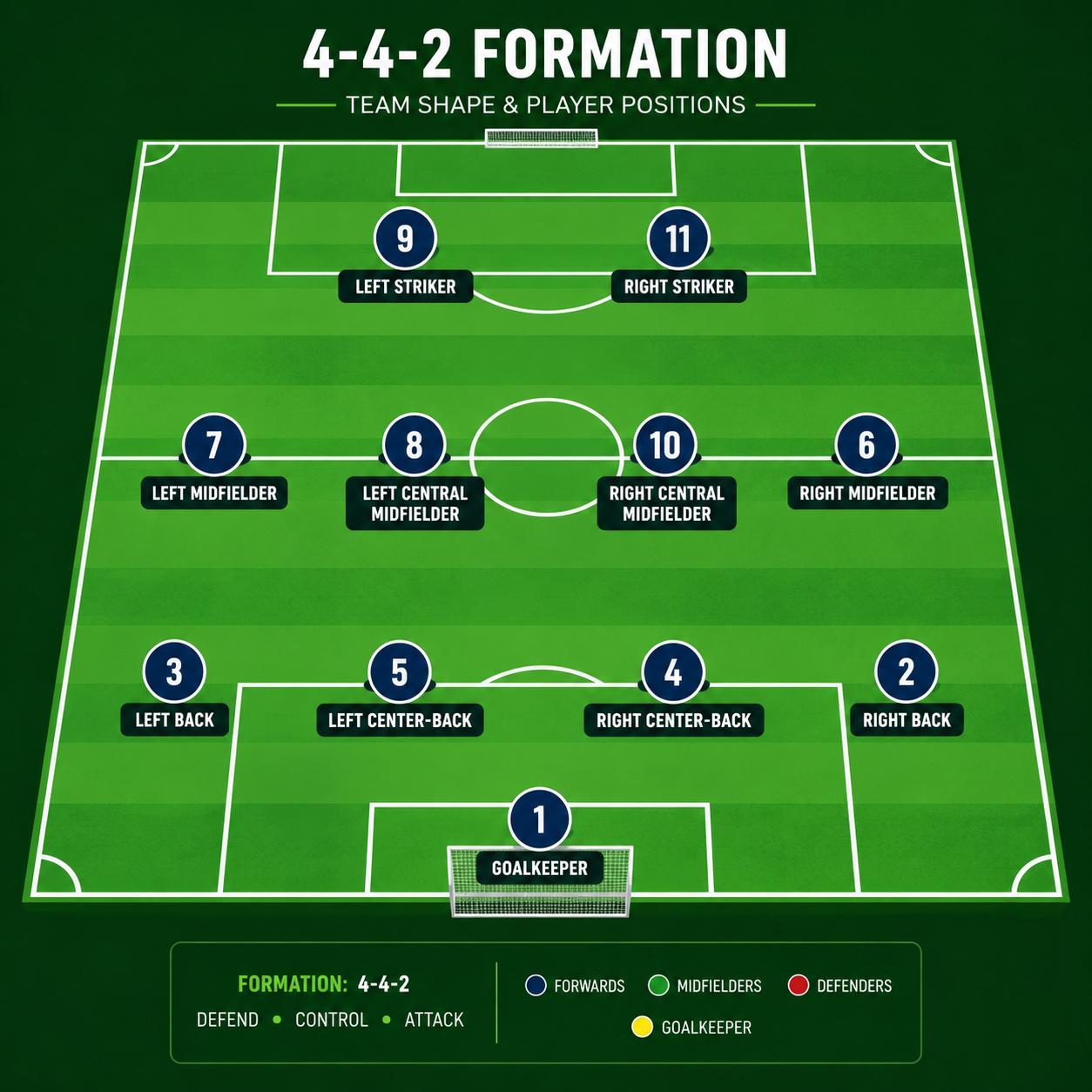
The 4-4-2 in that diagram is just one example. Teams line up in 4-3-3, 3-5-2, 4-2-3-1, and plenty of variations. The formation changes. The total of 11 never does.
For context:
- 11 players per team on the field
- 22 players total across both teams simultaneously
- 1 of the 11 must be the goalkeeper
- Minimum 7 players required for a match to start or continue
That 7-player floor matters in real situations — red cards, injuries, players being sent off. The FAQ section later in this article covers those edge cases in detail. For now, the headline number is clear: 11 per team, 22 on the pitch.
Eleven players per team isn’t a tradition — it’s codified law. The number hasn’t changed in over a century, and every formation ever invented works within that same constraint.
What Is the Difference Between Players on the Field and a Full Team Roster?
The 11 starters are only part of the picture. A full professional soccer team carries far more than 11 players — and understanding that gap between the starting lineup and the complete squad tells you a lot about how the game actually operates at the top level.
The starting 11 vs. the full roster — these are two completely different things.
The players who take the field at kickoff are the starting lineup. Everyone else sits on the bench as substitutes or occupies a spot on the wider squad that doesn’t even make the matchday list. In professional soccer, a club’s full registered roster is significantly larger than what you see during a single match.
Beyond the Starting 11 — The Bench
On a given matchday in a top professional league, a team typically brings a bench of 7 to 9 substitute players. These are the players available to come on during the match. In the Premier League, for example, teams can list up to 9 substitutes on the matchday bench, though only a limited number can actually be used — more on the substitution rules in the next section.
It’s worth separating bench size from the number of substitutions permitted, because people mix these up constantly. Having 9 players on the bench doesn’t mean all 9 can enter the game. In the Premier League, 9 substitutes are listed but only 5 may be used. The UEFA Champions League similarly allows up to 12 players on the bench in some rounds but still caps usage at 5, plus a potential sixth in extra time.
That bench is just one slice of the full squad. Behind those substitutes are players training at the club who aren’t even included in the matchday 18 or 20 — injured players, players out of form, players kept for rotation throughout a long season.
Squad Sizes in Pro Leagues
Here’s how the numbers look across the major competitions in 2025–2026:
| Wettbewerb | Registered Squad Limit | Hinweise |
|---|---|---|
| Premier League | 25 players | Max 17 non-home-grown; per Premier League Rules |
| UEFA Champions League | 25 players (List A) | Plus List B youth players, no cap; per UEFA Regulations on Club Competitions |
| FIFA World Cup 2026 | 26 players | Final squad per national team; per FIFA 2026 Tournament Regulations |
| La Liga | ~25 players | Registration-based system |
| Bundesliga | Typically 26–28 | Club-managed; check DFL registration rules for current season |
| Ligue 1 | ~20 players | Registration limits vary; verify with LFP squad rules |
The Premier League’s 25-player registration limit is a hard cap — clubs submit that list after the summer transfer window closes and can only modify it during designated windows. Within those 25, no more than 17 can be non-home-grown players. Academy graduates under 21 can be added to the matchday squad beyond that limit.
For FIFA World Cup 2026, each national team brings a 26-player squad. That expanded from 23 players at the 2022 World Cup in Qatar — FIFA made the change partly as a response to player welfare concerns and the compressed schedule of modern football.
The UEFA Champions League uses a two-list system. List A holds up to 25 registered players, while List B is an open category for locally trained players under 22. This means a club like Manchester City or Real Madrid can technically have a much larger pool of players eligible to appear in European competition.
The starting 11 is what fans see. The full squad is what coaches actually manage — and those two things operate on completely different logic.
From my experience watching squad management at different levels, the gap between a team’s best 11 and their full registered group creates some of the most interesting tactical decisions of the season. A squad of 25 sounds like luxury, but factor in injuries, international call-ups, and cup competitions running simultaneously with league play, and that depth disappears fast.
«Managing a full squad is a constant balancing act — injuries, form, and fixture congestion mean depth is never as comfortable as it looks on paper.» — Anthony Molina, FOOTBOLNO.COM
Test Your Knowledge: How well do you know soccer squad rules? Test your knowledge about roster sizes, substitution limits, and matchday regulations across different leagues and tournaments.
What was the maximum squad size allowed for national teams participating in the FIFA World Cup 2022?
How many substitutions are allowed per team in a standard Premier League match during normal time?
What is the maximum number of players allowed on the bench (named substitutes) for a UEFA Champions League group stage match?
In the FA Cup, if a match goes to extra time, how many additional substitutions (beyond the regular number) can a team make?
What is the maximum number of players that can be included in a matchday squad (starting XI + substitutes) for a La Liga match?
Select an option — the correct answer will highlight
One thing worth noting for anyone new to the game: squad size also varies at youth and amateur level in ways that don’t mirror professional rules at all. Youth leagues often operate with smaller rosters and different policies around how many players can dress for a match — a product of the formats themselves, which we’ll dig into next.
Why Do Player Numbers Vary in Youth and Amateur Soccer?
Youth soccer doesn’t use 11v11 across the board — and that’s entirely intentional. The number of players on the field changes based on age group, and the reasoning behind those changes is grounded in player development, not administrative convenience.
The short version: younger kids don’t benefit from playing 11v11 on a full-size pitch. The game is too big, touches are too rare, and the complexity overwhelms basic skill development. Smaller formats fix all three problems.
Youth Soccer: Tailored for Development
US Soccer’s official age-format guidelines — last updated for the 2026–27 seasonal year — set out a progression that scales both the team size and the field with the age of the players:
- U8 and under: 4v4
- U9–U10: 7v7
- U11–U12: 9v9
- U13 and older: 11v11
These are US Soccer guidelines specifically. Other national federations — including The FA in England, Canada Soccer, and others — use similar developmental progressions, but specific age breaks and format names can differ. Always check your country’s governing body for the authoritative format guidelines in your region.
From my own experience watching U9 training sessions, the difference in engagement between a 4v4 and an 11-a-side game for that age group is dramatic. In a 4v4, every kid is constantly involved. In 11v11, the technically advanced players dominate and half the field barely touches the ball.
How Many Players Are Used in Different Soccer Formats and Age Groups?
| Format / Age Group | Players per Team on Field | Approximate Field Size | Primäres Ziel |
|---|---|---|---|
| U6–U8 (4v4) | 4 | 40×25 yards | Basic skills, fun, frequent contact |
| U9–U10 (7v7) | 7 | 55×35 yards | Positional awareness, team concepts |
| U11–U12 (9v9) | 9 | 70×55 yards | Transition to structured team play |
| U13+ (11v11) | 11 | 100×60 yards minimum | Full game, professional format |
| Futsal (5-a-side) | 5 | 40×20 m (indoor court) | Technical precision, fast decisions |
| Indoor 6v6 | 6 | Varies | Recreational, skill under pressure |
The 9v9 format deserves particular attention because it functions as a deliberate bridge. It introduces the offside rule, larger defensive lines, and midfield structure — all concepts that become central in 11v11 — while still keeping the field small enough that players get meaningful touches. US Soccer’s guidance explicitly frames 9v9 as the transitional format for U11–U12 before the step up to full football.
Checklist: Youth Soccer League Evaluation for Age-Appropriate Format
Hake Gegenstände ab, wenn du sie fertigstellst
Outdoor 7v7 and Indoor 6v6 Rules
Amateur and recreational leagues for adults run their own formats, often dictated by facility size and availability. Outdoor 7v7 is probably the most common adult recreational format in the US — it fits on smaller pitches, requires fewer players to fill a roster, and moves faster than 11v11. Most 7v7 leagues use a goalkeeper plus six outfield players, run with modified offside rules or no offside at all, and often allow rolling substitutions, though the exact rules vary by league and organizer.
Indoor soccer — often played on turf in smaller venues — typically runs 5v5 or 6v6 with futsal-style rules or adapted rules specific to the facility. Many indoor leagues apply mercy rules and substitution policies that differ from venue to venue; it’s always worth checking the specific ruleset for the league or facility you’re playing in. The smaller space demands technical precision and quick decisions, which is why indoor soccer has a reputation for accelerating skill development even for older players.
For anyone curious about youth team culture beyond just the format rules, the dynamics of smaller teams — and how to build identity in those groups — is something I’ve seen discussed extensively in youth soccer team mottos and slogans, which gives a sense of how seriously youth programs take team identity at every level.
What's your go-to soccer format, whether you're lacing up your boots or cheering from the stands?
Wählen Sie Ihre Antwort
What Are the Official Rules on Substitutions and Minimum Players?
The official rules on how many players are allowed on the field — and what happens when that number drops — come from a single authoritative source. All of this is governed by the IFAB Laws of the Game, specifically Law 3: The Players.
Note: The information in this section reflects general rules under IFAB Law 3 and common competition frameworks as of June 2026. Specific leagues and cup competitions may apply variations — always consult the official regulations of the relevant governing body before making coaching or officiating decisions.
IFAB, the International Football Association Board, is the body responsible for writing and maintaining the Laws of the Game. Every professional league, national federation, and FIFA-sanctioned competition operates under these rules. When you see the Premier League, La Liga, or MLS all apply the same core structure, it’s because they’re all using the same foundational document.
How Many Players Are Needed to Legally Play a Soccer Match?
According to the IFAB Laws of the Game 2025/2026:
«A match may not start or continue if either team has fewer than seven players.» — IFAB Laws of the Game 2025/2026, Law 3
Seven is the floor. If a team drops below seven players for any reason — red cards, injuries, players leaving the field — the referee stops the match and it cannot resume. That threshold applies regardless of why the team is short-handed. The law doesn’t distinguish between a player sent off for violent conduct and one who left the field injured and couldn’t return.
One technical nuance worth knowing: if a player deliberately leaves the field, the referee isn’t required to stop play immediately. Advantage can be played until the next natural stoppage. But once the ball goes out of play and the count confirms fewer than seven, the match is done.
In practice, reaching that threshold is rare at professional level. I’ve seen matches with teams down to eight or nine players from red cards — ugly, grinding affairs — but dropping to six and triggering the abandonment threshold almost never happens outside extraordinary circumstances.
How Many Substitutes Are Allowed in a Soccer Match?
This is where things get slightly more variable depending on the competition.
«Competitions may determine the number of players permitted to be listed on the team sheet and the maximum number of substitutes permitted to be used (up to a maximum of five substitutes), provided this is declared in advance.» — IFAB Laws of the Game 2025/2026, Law 3
In practice, the five-substitute rule is now standard across the top professional leagues and international competitions. Here’s how it looks in 2026:
| Wettbewerb | Substitutes Allowed | Bench Size | Hinweise |
|---|---|---|---|
| Premier League | 5 | 9 listed | 3 windows + halftime; extra in extra time |
| La Liga | 5 | Up to 9 | Standard format |
| Serie A | 5 | Up to 9 | Standard format |
| Bundesliga | 5 | Up to 9 | Standard format |
| FIFA World Cup 2026 | 5 (+ 1 in extra time) | 15 listed | Sixth sub allowed only in AET |
| Champions League | 5 (+ 1 in extra time) | Up to 12 (varies by round) | Same extra-time provision |
| MLS | 5 | Up to 9 | Standard format |
The five-substitute rule was introduced temporarily during the COVID-19 pandemic to help manage player workload, then retained permanently because the evidence for player welfare benefits was clear. Most top competitions also allow a sixth substitution specifically during extra time — that additional swap doesn’t count against the five used in regular play.
Some competitions also permit temporary additional substitutions for concussion assessment. Where this applies — which is competition-dependent and not universal — a player may leave the field for evaluation without the club being charged a substitution, provided the assessment meets the competition’s protocol. Check the specific competition circular for whether this provision is in effect.
Substitutions are structured into windows in many competitions. In the Premier League, teams can make substitutions in up to three separate windows during regulation time plus halftime. Serie A uses a similar windowed approach. This structure was introduced alongside the five-sub rule to prevent teams from making one sub at a time to waste time — which was a legitimate tactical concern when the rule was first implemented.
Substitutions and Strategy
The five-sub rule has genuinely changed how managers approach a match. With two substitutes, coaches held back changes until late in the game. With five available, the tactical flexibility shifts dramatically — you can respond to injury, change your entire defensive shape at halftime, introduce a specialist for a specific phase of the game, or rotate three or four players at once if the scoreline allows it.
«The five-substitution rule has transformed in-game tactics, giving coaches unprecedented flexibility to adapt and reshape their teams throughout the match.» — Anthony Molina, FOOTBOLNO.COM
Honestly, it’s made top-level soccer more tactically interesting, not less. The second half of a tight Champions League match now often involves near-complete tactical reshaping from both sides, and the substitutes warming up along the touchline carry genuine strategic weight. If you’re interested in how that kind of tactical thinking develops at the coaching level, the process starts well before the professional game — which is something covered in depth in this guide on how to become a soccer coach.
Frequently Asked Questions About Soccer Team Sizes
What are the 11 standard player positions on a soccer field?
Every team on a soccer field organizes its 11 players into four functional groups. The specific names and sub-roles vary by formation, but the four categories are universal.
Goalkeeper (1 player): The only player permitted to handle the ball with their hands — but only within their own penalty area. The goalkeeper’s primary job is preventing the opposition from scoring, but modern keepers also initiate attacks through distribution, organize the defensive line, and often sweep well outside the box. Sub-roles include the traditional shot-stopper and the more modern sweeper-keeper who plays aggressively off the line.
Defenders (typically 3–5 players): The protective layer in front of the goalkeeper. Centre-backs anchor the middle, combining aerial ability with positional discipline. Full-backs operate wide on the left and right, balancing defensive duties with attacking contributions — in modern soccer, full-backs cover enormous ground and often function as auxiliary wingers. Wing-backs are an expanded version of the full-back role used in three-defender systems, pushing even higher up the pitch.
Midfielders (typically 3–5 players): The engine of the team. Defensive midfielders sit deep to shield the back line and win possession. Central midfielders control tempo and link play across the pitch. Attacking midfielders operate between the lines, finding space to create chances. Wide midfielders and wingers stretch the game horizontally, threatening with pace and creativity.
Forwards (typically 1–3 players): The primary scoring threats. Centre-forwards and strikers operate closest to the opposition goal — some rely on physical presence and hold-up play, others use movement and pace. Wide forwards blur the line between winger and striker, often cutting inside onto their dominant foot. The number deployed depends on the formation: a 4-3-3 uses three, a 4-4-2 uses two, and a 4-5-1 uses one.
A quick-reference lineup in a standard 4-3-3:
| # | Position | Role |
|---|---|---|
| 1 | Torwart | Shot-stopping, distribution, organization |
| 2 | Right Back | Wide defense, overlap runs |
| 3 | Left Back | Wide defense, overlap runs |
| 4 | Center Back | Aerial duels, defensive line leadership |
| 5 | Center Back | Cover, positional discipline |
| 6 | Defensive Midfielder | Shield back line, ball recovery |
| 7 | Right Winger | Width, pace, crossing |
| 8 | Central Midfielder | Tempo, linking play |
| 10 | Attacking Midfielder / Left Winger | Creation, pressing high |
| 9 | Stürmer | Goal threat, hold-up play |
| 11 | Left Winger | Cutting inside, direct running |
For a detailed breakdown of every position, role, and tactical abbreviation used in the modern game, this guide to soccer positions and abbreviations covers all of it.
Does the number of players include the goalkeeper?
Yes, unambiguously. The goalkeeper is one of the 11 players. Not an extra. Not a bonus figure outside the count. One of eleven.
The IFAB Laws of the Game are explicit on this point: «each team consists of not more than 11 players, one of whom must be a goalkeeper.» The goalkeeper is a mandatory part of the 11 — a team cannot field 11 outfield players plus a goalkeeper. One position within the 11 must be occupied by the designated keeper.
This matters practically too. When a team is reduced in numbers through red cards or injuries, the goalkeeper counts toward that total. If a goalkeeper is sent off and the team has used all their substitutions, an outfield player must take the gloves. That player becomes the goalkeeper for the remaining minutes — still one of whatever number the team has left, not an additional body.
How many players are on a 5-a-side or Futsal team?
In official FIFA futsal — the most structured and widely played version of indoor small-sided soccer — each team fields 5 players including the goalkeeper. So that’s 4 outfield players plus 1 keeper per side, 10 players total on the court.
FIFA’s official futsal rules state: «each team consists of no more than five players, one of whom is the goalkeeper.» The format also allows unlimited substitutions during play, with a maximum of 7 substitutes on the bench. Substitutions happen on the fly, similar to hockey, without stopping play — which dramatically increases the pace of the game and the physical demands on every player.
The AMF (Amateur Minifootball Federation) futsal rulebook follows the same 5-player structure. This 5-a-side format is the most popular globally for recreational indoor soccer. If you ever sign up for a local futsal league and see «5-a-side» on the registration form, that’s the standard — 5 per team on the court, goalkeeper included.
Can a team play with fewer than 11 players?
Yes — within limits. A team can continue playing with as few as 7 players on the field. Below that threshold, the match must stop.
This situation arises in real games, usually through red cards or injuries when all substitutions have already been used. A team reduced from 11 to 10 after a red card plays the remainder of the match with 10 players — that’s standard. From 10 to 9, still playable. Down to 8, still technically legal. Down to 7, still legal but increasingly desperate.
If any further reduction occurs — the team reaches 6 players on the field — the referee abandons the match. No exceptions under the IFAB rules.
One nuance from Law 3: if a player deliberately leaves the field of play (not due to injury or referee instruction), the referee doesn’t have to stop immediately. Play continues with the advantage principle until the next stoppage, at which point the count is assessed. But once the ball leaves play and the team is at six, that’s it.
From a purely tactical standpoint, playing with 10 men — which every serious coach prepares for — requires reshaping the entire defensive shape and often abandoning attacking ambitions. Nine players is survivable but brutal. Seven players on the field is a scenario that basically means something has gone catastrophically wrong.
What happens in edge cases — too many players, keeper sent off, forfeits?
A few unusual scenarios arise from Law 3 that are worth understanding.
Team fields 12 players by mistake: If a referee discovers an extra player on the field after play has started, the match is stopped at the next opportunity. The additional player is removed and cautioned. The laws do not automatically void any goals scored while 12 were on the field — competition authorities determine any further sanctions. The offending team continues with 11.
Goalkeeper sent off, no substitutions remaining: An outfield player must take over the goalkeeper role. That player wears a different colored jersey if one is available, and play resumes. The team’s player count on the field drops by one (to account for the red card), not two — the outfield player stepping into goal simply changes function, not headcount.
Match abandoned due to player count: If a team falls to 6 players, the referee abandons the match. How the result is recorded — forfeit, replay, null and void — depends on the competition’s own regulations. IFAB Law 3 governs the on-field threshold; what happens administratively afterward is the competition authority’s decision.
How many substitutes are allowed in professional soccer in 2026?
In 2026, the standard across the major professional leagues is 5 substitutions per team per match, with an additional 6th substitution permitted if a match goes to extra time.
This applies across the Premier League, La Liga, Serie A, Bundesliga, MLS, and UEFA club competitions including the Champions League. FIFA World Cup 2026 uses the same structure for group and knockout stage matches in regular time, with the extra-time provision added.
The five-sub rule is not completely universal. Some lower-division leagues and cup competitions in various national federations still operate with 3 or 4 substitutions, particularly where the rule change hasn’t been formally adopted by the governing body. Always worth checking the specific competition regulations if you’re coaching or managing a team in a less prominent league.
The number of substitution windows — the moments at which substitutions can be made — also varies. In the Premier League, teams use up to 3 windows during regulation (plus halftime). This structure was introduced alongside the five-sub rule to prevent time-wasting through excessive one-at-a-time changes.
Frequently Asked Questions
What is the total number of players on a soccer field at once?
There are 22 players total on the field during a standard 11v11 match — 11 from each team. That’s the maximum allowed under IFAB Law 3 and the number you’ll see in every professional match from the Premier League to the World Cup. Both teams field 11 simultaneously, one of whom on each side must be the designated goalkeeper.
How many players make up a full soccer team roster?
A full professional soccer team roster ranges from 23 to 26 players depending on the competition. In the Premier League, clubs register up to 25 players. FIFA World Cup 2026 squads are set at 26. UEFA Champions League List A holds 25 players, with additional youth-eligible players outside that cap. Most top clubs maintain a wider training group of 30 or more, but only the registered players are eligible to compete in official matches.
What is the minimum number of players needed to start a soccer match?
Seven players per team is the minimum required to start or continue a match under IFAB Law 3. If either team cannot field at least 7 players at kickoff, the match cannot begin. If a team drops below 7 during the match — due to red cards, injuries, or any other reason — play is stopped and the match is abandoned.
Are there different player numbers for men’s and women’s soccer?
No. The player count is identical for men’s and women’s soccer at all competitive levels. Both use 11 players per team in the standard format, the same minimum of 7 for matches to proceed, and the same 5-substitute limit in professional competitions. The IFAB Laws of the Game apply to both men’s and women’s football without distinction on player numbers.
How does US Youth Soccer determine what format kids should play?
US Soccer’s age-format matrix — updated for the 2026–27 seasonal year — sets 4v4 for U8 and under, 7v7 for U9–U10, 9v9 for U11–U12, and 11v11 for U13 and older. These guidelines are based on developmental principles: smaller formats mean more ball touches, simpler decisions, and age-appropriate physical demands. The 9v9 format is explicitly designed as a transitional step, introducing structural concepts like the offside rule and midfield organization before players move to the full game. Note that these are US Soccer recommendations; formats and age thresholds vary by federation internationally.
Does it matter what position the goalkeeper plays compared to the other 10?
It matters a lot on the field, but not in terms of the player count. The goalkeeper is functionally and legally distinct from outfield players — they can handle the ball within their penalty area, they wear a different jersey color, and they operate under specific rules around distribution and back-passes. But within the count of 11, the goalkeeper is simply one position among eleven. If a goalkeeper is sent off and no substitutions remain, an outfield player takes over the role — and the team’s total on the field drops by one, not two.
Rules references: IFAB Laws of the Game 2025/2026, Law 3 — theifab.com