Last updated: July 2026
Key Takeaways
- Power comes from technique, not from how strong your legs are. A well-struck ball off a locked ankle travels harder than a wild swing from a bigger player.
- The five things that actually generate pace: your approach angle, where you put your plant foot, how far you take the leg back, which part of the foot meets the ball, and whether you follow through.
- The laces — the bony top of your foot, not the toes — are the power surface. The inside of the foot is the accuracy surface. Learning which to use when is most of the battle.
- Almost every weak shot I watch comes down to the same three faults: a plant foot in the wrong place, a loose ankle at contact, and a swing that stops at the ball instead of going through it.
So you strike the soccer ball as hard as you can, and it still floats gently at the goalkeeper. Meanwhile someone half your size sends the same ball into the top corner of the goal. What are they doing that you aren’t?
«Every player who asks me how to shoot harder is expecting an answer about leg strength. It never is. Fix where the standing foot lands and lock the ankle, and the same player hits the ball harder that afternoon — nothing about their body changed.» — Anthony Molina, FOOTBOLNO.COM
Here’s the short answer: they’re not kicking harder. They’re transferring more of their body into a smaller point of contact, and they’re doing it with a foot that stays rigid at the moment it hits the ball. Leg strength helps at the margins. Technique is what separates a shot that stings the keeper’s palms from one he catches at his chest.
Shooting in soccer is a learnable mechanical skill, not a gift you either have or don’t. Nothing below requires athleticism you don’t already possess.
I’ve watched a lot of players at the amateur and youth level try to solve this problem with effort — bigger run-ups, wilder swings, more grunting. It almost never works. What works is boring, mechanical, and learnable in an afternoon, then refined over months.
Let’s break the shot down into the parts you can actually control.
Why a Soccer Ball Travels Hard (In Plain English)
Three things decide how fast the ball leaves your foot.
How fast your foot is moving. Obvious, but the speed comes from the whole chain — hips rotating, thigh driving forward, lower leg whipping through — not from the knee alone.
How much mass is behind the contact. A foot swinging on its own carries the weight of a leg. A foot swinging while your body weight moves through the ball carries considerably more. This is why leaning back kills a shot: you disconnect your mass from the strike.
How rigid the contact is. This is the part almost nobody explains. If your ankle is loose when the ball arrives, some of the energy goes into bending your foot instead of moving the ball. Lock the ankle and the foot behaves like a solid object. Same swing, noticeably harder shot.
You don’t need to think about any of this while playing. You need to think about it while practising, until the shape of the movement becomes automatic.
The Six Steps of a Powerful Shot
Step 1: Approach at an Angle
Come at the ball from a slight angle rather than straight on — somewhere in the region of thirty to forty-five degrees. A straight-on run-up leaves no room for your kicking leg to swing across the ball, so you end up jabbing at it with your toes.
The angle also lets your hips open and rotate through the strike, and hip rotation is where a surprising amount of your power comes from.
Two or three steps is plenty. Long run-ups feel dramatic and add almost nothing — they mostly make your timing harder.
Step 2: Plant Your Standing Foot Beside the Ball
This is the single most common fault I see, and fixing it alone will add pace to your shot.
Your standing foot — the non-kicking one — should land roughly alongside the ball, about a foot’s width to the side, with the toes pointing at your target. Not behind the ball. Not way out in front.
Plant too far behind, and you’ll be leaning back at contact, which sends the ball skyward. Plant too far ahead, and you’ll be reaching, and the strike loses everything. Point the plant foot in the wrong direction and the shot goes where the foot points, not where you’re looking.
Watch where your standing foot lands for one training session. If your shots have been ballooning over the bar, I’d bet money that’s your problem.
Step 3: Take the Leg Back
Bring your kicking leg back with a bent knee — a real backswing, not a nudge. Your heel should come up towards your backside.
At the same time, your opposite arm swings out. This isn’t decoration; it’s counterbalance. Trying to strike a ball hard with both arms pinned to your sides is like trying to throw a punch while standing to attention.
Step 4: Strike With Your Laces
Contact happens on the instep — the hard, bony surface on the top of your foot where your laces sit. Not the toes, which are inaccurate and painful. Not the inside of the foot, which is for passing and placement.
Point your toes down towards the ground so this flat, hard surface faces the ball. For a driven, low shot, meet the ball slightly above its centre. Meet it below centre and it rises.
Your eyes stay on the ball through contact. Every player who complains about slicing shots wide is looking up at the goal a fraction before they strike.
Step 5: Lock Your Ankle
Tense your ankle so the foot is rigid at the moment of contact and hold that tension through the strike. A floppy ankle absorbs the energy you just spent three steps building.
If you take one thing from this article, make it this one. It’s the least visible part of the technique and the one that changes the most.
Step 6: Follow Through
Don’t stop at the ball. Swing through it, and let the momentum carry you forward — many players land on their kicking foot after a proper strike.
A shot that stops at the point of contact is a shot that’s decelerating as it hits the ball. Everything you built collapses in the last few inches.
Which Part of the Foot to Use
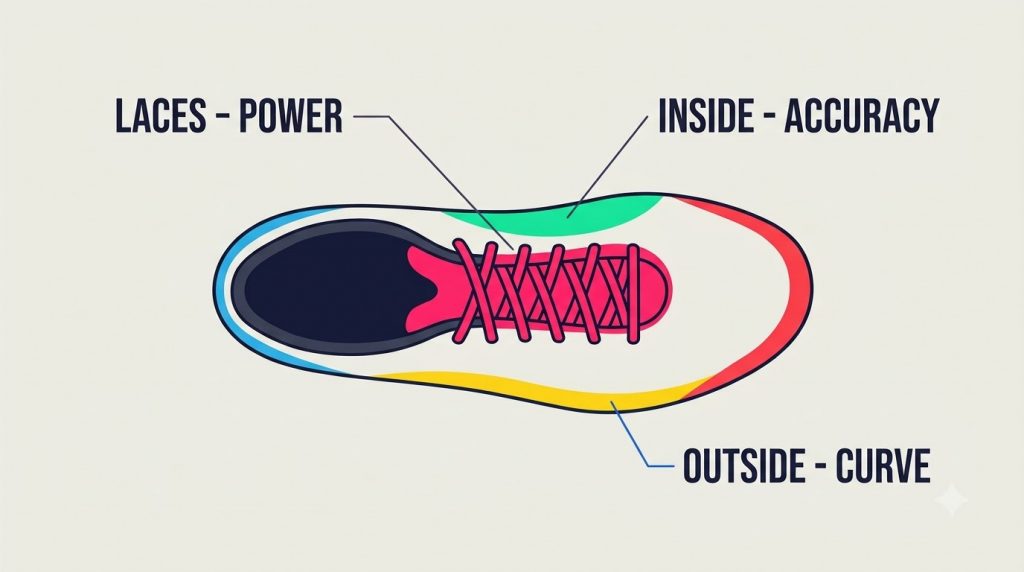
Different surfaces of the foot do different jobs. This is worth internalising, because “shoot harder” and “shoot better” often mean picking a different contact point rather than swinging faster.
| Contact surface | What it’s for | Trade-off |
|---|---|---|
| Laces / instep (top of the foot) | Maximum power — driven shots, long-range efforts, volleys | Hardest to place precisely |
| Inside of the foot | Accuracy and placement — side-footed finishes inside the box | Much less pace |
| Outside of the foot | Curve away from the goalkeeper, disguised shots | Difficult to control, needs practice |
| Toes | Almost nothing — occasionally a desperate poke in a crowded box | Wildly inaccurate |
Most goals at amateur level are scored with the inside of the foot from close range, not with thunderous laces strikes from distance. Power is a tool, not a personality. If you’re eight yards out and unmarked, place it.
The same surfaces do the work when you pass, which is why the thirteen types of passes in soccer overlaps so heavily with shooting technique — a driven pass and a driven shot are the same motion aimed at different targets.
Power Versus Accuracy: The Trade-off Nobody Explains
Here’s the thing that took me embarrassingly long to work out: you cannot maximise both at once, and trying to is why so many shots end up neither hard nor accurate.
Every shot sits somewhere on a slider. Turn it all the way to power and you’ll strike through the ball with your laces, accept a wider margin of error, and hope. Turn it all the way to placement and you’ll side-foot it into a corner with pace the keeper can actually reach.
The skill isn’t picking one forever. It’s reading the situation:
- Keeper off his line, you’re outside the box → power. Give him no time.
- One-on-one, keeper advancing → placement. Pick a side, side-foot it past him.
- Tight angle → power across the keeper, aiming for the far post.
- Crowded six-yard box → whatever makes contact first. Genuinely.
Deciding before you strike is what matters. The worst shots come from players who change their mind halfway through the swing.
Where to Aim Inside the Goal
Deciding where in the goal to shoot matters as much as how hard you strike the soccer ball, and it’s the part of shooting that gets the least practice time.
Low and to the corners beats high and central almost every time. Goalkeepers get down to low shots slower than they get their hands up — human beings simply move downwards less efficiently than they reach upwards. A shot rolled hard into the bottom corner troubles a keeper far more than a rising effort straight at his chest.
The far post is the percentage play from an angle. If the keeper has shaded towards his near post to cut down your angle, the far side of the goal is where the space is. It’s a longer shot, so it needs pace — this is a laces situation.
The near post works when you spot the keeper cheating off it, but the margin for error is thin, and a missed near-post shot goes harmlessly wide rather than testing anyone.
Never straight at the keeper. Obvious advice, and yet a huge share of amateur shooting ends up within a step of where the goalkeeper is standing, because the player looked at the goalkeeper rather than at the space beside him. Look at where you want the ball to go, not at the person trying to stop it.
One habit worth building: glance up as you take your final touch, note where the keeper is standing, then commit. That single glance — taken before the strike rather than during it — is what separates players who score from players who shoot.
Five Mistakes I See Most Often
Leaning back. Your body should be over the ball, chest slightly forward. Lean back and the ball goes up. If your shots clear the crossbar consistently, this and the plant foot are the first things to check.
Swinging with the knee only. The power chain starts at the hips. Players who kick from the knee down are using a fraction of the available force.
Looking up too early. You need to know where the goal is before you shoot, not during. Take the picture early, then watch the ball.
Trying to kill it every time. Swinging at maximum effort wrecks your mechanics. Strike at something like eighty percent of your maximum and you’ll get a harder, straighter ball than at a hundred — because the technique holds together.
Practising only from the penalty spot with a stationary ball. Real shots arrive moving, at awkward angles, with someone breathing on you. Which brings us to drills.
Drills That Build Shooting Power
None of these need a coach or a full pitch.
Technique reps without a goal. Strike a stationary ball against a wall from ten to fifteen yards. Ignore where it goes. Watch only your plant foot and your follow-through. Fifty repetitions, thinking about one element at a time. This is dull and it works.
One-touch finishing. Roll the ball out in front of yourself and strike it while it’s still moving. Moving balls are what you’ll actually face, and they punish sloppy plant-foot placement immediately.
Angle work. Set up eight to twelve yards out, wide of the posts on both sides. Shooting from an angle forces you to think about contact point and body shape rather than raw force.
Weak-foot volume. Devote a fixed share of every session — a quarter is a reasonable target — to your other foot. It will feel humiliating for several weeks and then it won’t. A player who can strike with both feet is dramatically harder to defend.
A rebound trainer makes solo sessions far less tedious, since you’re not walking after every ball — I’ve covered the rebounders worth owning separately. For a broader session structure, the essential soccer ball drills guide covers touch and control work that feeds directly into striking.
How Long Until This Feels Natural?
Honestly: the mechanics you can understand today. The plant foot and the ankle lock you can consciously fix within a session or two, and you’ll feel the difference immediately.
Making it automatic under pressure takes months of repetition, because in a game you don’t get time to run a mental checklist. That’s the whole point of drilling technique in isolation — so that the correct movement is what your body does by default when you have no time to think.
If you’re new to the game and this is your first technical guide, working through the basic soccer skills first will make everything here land better.
Common Questions
Do I need strong legs to shoot with power? Less than you’d think. Technique beats strength at every amateur level — that’s why lightweight professionals strike the ball harder than much bigger recreational players. Strength training helps once your technique is sound; before that, it mostly makes bad shots faster.
Why do my shots always go over the bar? Two usual suspects: you’re leaning back at contact, or your plant foot is landing behind the ball rather than beside it. Both tilt your body backwards and lift the strike. Film yourself from the side once and it’ll be obvious.
Should I shoot with my toes for extra power? No. Toe-pokes are unpredictable and they hurt. The instep gives you a larger, harder, flatter surface and far more control.
What’s the ideal distance to shoot from? There isn’t one — it depends on the angle, the keeper’s position, and whether anyone’s closing you down. As a rough guide, inside the box favours placement, outside favours power. The rules around penalties cover the one situation where the distance is fixed for you.
How do I add curve to the ball? Strike across the ball with the inside of your foot, contacting off-centre rather than through the middle. It’s a different technique from a power shot and worth learning separately once your driven strike is reliable.
Can I practise shooting without a goal? Yes, and most of your improvement will come from exactly that. Wall work with no target teaches the movement. Add targets later, once the shape is right.
How do I teach a young player to kick a soccer ball harder? Don’t start with power at all. Start with the plant foot and the ankle lock, using a stationary ball and no goal, and let them strike it gently until the shape is right. Children who are told to “kick it hard” learn to swing wildly, and that habit takes years to unpick. Power arrives on its own as the technique settles and they grow.
Does the ball itself make a difference? Some. An under-inflated ball absorbs energy and feels dead off the foot, and a ball that’s the wrong size for the player’s age makes clean contact harder. It’s worth knowing what a soccer ball should actually weigh by size before blaming your technique. That said, the ball is rarely the real problem — the plant foot usually is.
Anthony Molina writes about soccer technique, gear and coaching at FOOTBOLNO.