Last updated: August 2026
Key Takeaways
- Futsal has four outfield roles: fixo (defender), two alas (wingers) and the pivô (pivot), in front of the goleiro (goalkeeper).
- Positions are starting points, not zones. Outfield players cover the whole court, and a player who can do every job is called a universal.
- The three base shapes are 4-0, 3-1 e 2-2. The 3-1 is the most common at club level and the easiest to teach.
- A team playing the flying goalkeeper turns the shape into five against four — the highest-risk, highest-reward system in the game.
Futsal positions confuse people coming from eleven-a-side because the names describe jobs rather than places. A fixo is not a centre-back pinned to a defensive third; a pivô is not a striker waiting on the shoulder. On a court that is at most 42 m long, everybody defends and everybody attacks, and the position tells you what a player does when the ball arrives, not where they stand.
Here is what each role actually involves, the shapes they combine into, and how to work out which one suits you.
«Ask a fixo what their job is and a good one says ‘keep the ball moving and be behind everything’. Ask a bad one and they tell you they defend. That’s the whole difference between the two.» — Anthony Molina, FOOTBOLNO.COM
The Four Positions
| Posição | Portuguese term | What the job is |
|---|---|---|
| Guarda-redes | Goleiro | Handles in the area, but far more involved in outfield play than in football. Throws are a primary attacking weapon |
| Defender | Fixo | Usually the last outfield player, and the one who starts attacks as well as breaking them up |
| Winger | Ala | Left and right. Usually the most skilful and creative players, and central to both attack and defence |
| Pivot | Pivô | The furthest forward. Not just a finisher — holds the ball with their back to goal and releases team-mates |
| Universal | Universal | Not a position so much as a player who can fill any of the outfield roles |
Those are UEFA’s own definitions, and the two useful things in them are easy to miss.
First, the goalkeeper is an outfield player who happens to be allowed to use their hands. Many futsal keepers tape their fingers rather than wear gloves, because throwing accurately matters more than catching comfort. What they may and may not do is unusually restricted — see the futsal goalkeeper rules for the four-second clock and the back-pass restrictions.
Second, the pivô’s main job is holding the ball, not scoring. A pivô who cannot receive with their back to goal and keep possession under pressure from a defender is not doing the job, however many goals they get.
Fixo: the Job Nobody Wants and Every Team Needs
The fixo sits behind everything. They are the last outfield player, the one who covers when a winger commits, and — much more importantly — the one who starts almost every attack.
What a good fixo does:
- Keeps the ball moving side to side while the others create space in front
- Covers the space behind whichever winger has pushed on
- Reads when to step out and press and when to hold the line
- Shoots from distance often enough that opponents cannot ignore them
Why it is hard: the fixo makes more decisions per minute than anyone else on the court, and the consequences of a bad one are immediate. Lose the ball as a pivô and you concede a counter. Lose it as a fixo and you concede a goal.
Ala: the Two Who Do Everything
The alas are the left and right wingers, and in most teams they are the busiest players on the court. They receive in wide areas, drive at defenders, combine with the pivô, and then run back and defend the same channel.
The demands: repeated sprints, one-on-one ability, and the discipline to track back every single time. An ala who attacks well and defends badly turns a 3-1 into a 2-2 without anyone deciding to change shape.
The technical requirement is receiving on the half-turn while being pressed from behind, then either driving inside or laying the ball into the pivô. Do that reliably and you play; do not and you do not.
Pivô: Back to Goal, Everyone Else Facing Forward
The pivô plays furthest forward and almost always with their back to the goal they are attacking. They are the reference point: the pass that relieves pressure, the pivot the whole shape turns around.
What the job needs:
- Holding the ball with a defender behind, without fouling and without losing it
- Laying off first time into runners
- Spinning when the defender gets too tight
- Finishing from close range, usually with one touch and often with the sole or the toe
The best pivôs are not the tallest players. They are the strongest in a small space and the calmest under contact — which is a different quality entirely from being a good finisher.
The Three Base Formations
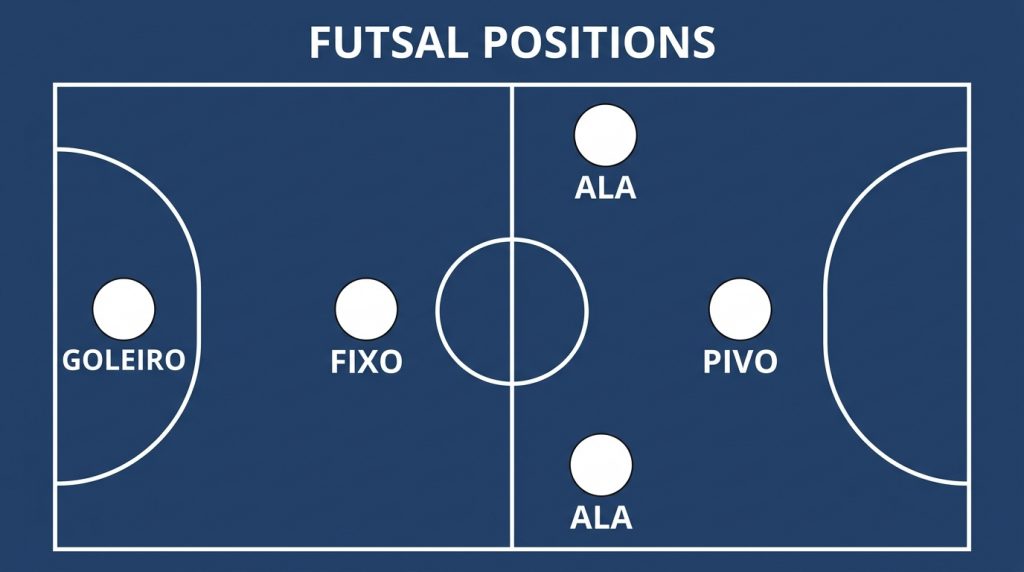
Positions arrange themselves into three basic shapes, described from the goalkeeper forward.
4-0 — four outfield players in a line across the court, no fixed pivô. Everything comes from rotation and movement, with players taking turns to break forward. It is the hardest system to defend against and the hardest to coach, because it requires all four to be comfortable in every role.
3-1 — a fixo, two alas and a pivô. The most common shape in club futsal and the natural starting point for a new team. The pivô gives an outlet, the alas provide width, the fixo balances.
2-2 — a square: two players deep, two forward. Simple to organise and defensively solid, but it produces fewer angles and can become static without disciplined movement.
There is also the 1-2-1 diamond, which is the 3-1 seen a different way: fixo at the back, alas either side, pivô in front. Coaches use both labels for the same arrangement.
Rotation Is the Whole Point
Static positions do not survive contact with a good defence. What makes futsal futsal is rotation — players constantly swapping roles so that defenders never settle onto a man.
The standard patterns are simple to name and difficult to execute:
- An ala drops, the fixo pushes into the space they left
- O pivô comes short, an ala runs beyond into the vacated space
- Two players cross behind the ball, dragging their markers into each other
The point of every one of them is the same: create a moment where the defender has to choose between following their player and holding their position. On a court this size, that moment is usually all the space you get.
This is why «what position do you play» is a slightly odd question in futsal. Most players have a primary role and can perform two others. Those who can do all of them are the universals, and they are the ones coaches build teams around.
The Flying Goalkeeper
The most distinctive shape in futsal is the one where the goalkeeper joins the attack, giving five outfield players against four defenders.
It is entirely legal: the Laws allow any player or substitute to change places with the goalkeeper, so teams either push their keeper forward or swap in an outfield player wearing the goalkeeper’s jersey. Some sides use it as a tactic from the first minute; most use it chasing a game.
The trade-off is absolute. Five against four in attack is a large advantage. An empty net behind you is a large risk, and futsal has no offside, so a single interception is a shot at an unguarded goal from anywhere on the court.
Substitutions Change How Positions Work
The rules make futsal positions more fluid than football’s, and this is written into the Laws rather than left to convention.
A match is five players a side including the goalkeeper, with a maximum of nine substitutes in official competitions and an unlimited number of substitutions. Players come on and off through their own substitution zone while the ball is in play, without stopping the game.
Practically, that means a futsal squad is a set of rotating units rather than a starting five plus bench. Teams change all four outfield players at once, in blocks, roughly every couple of minutes, and each block often has its own shape. A side can defend with a 2-2 block and attack with a 3-1 block in the same passage of play.
Which Position Suits You?
Play fixo if you read the game quickly, pass well under pressure and can shoot from range. Composure matters more than pace.
Play ala if you are quick, comfortable one-on-one and willing to run back as hard as you run forward. This is where most eleven-a-side wingers land.
Play pivô if you are strong in contact, good with your back to goal and clinical from close range. Height helps but strength and balance help more.
Play in goal if you can throw accurately, use your feet under a four-second clock and stay calm when the shot comes from four metres. Futsal keeping is not football keeping with a smaller goal — the goal is 3 m by 2 m, and blocking beats diving.
Aim to be universal. Every coach wants players who can cover two roles, and it is the fastest route into a team.
For the framework the positions operate in, our guide to futsal rules covers the format, and the fouls that shape defending are in the futsal penalty rules.
Common Questions
What are the positions in futsal? Goalkeeper (goleiro), defender (fixo), two wingers (alas) and a pivot (pivô). A player able to cover several outfield roles is called a universal.
What is a fixo in futsal? The defender — usually the last outfield player, responsible for covering behind the team and for starting attacks.
What is a pivô? The most advanced player, who receives with their back to goal, holds the ball under pressure and releases team-mates as well as finishing.
What is the best futsal formation? The 3-1 for most teams: it is the easiest to organise and gives natural width and an outlet. The 4-0 is more dangerous but needs four players comfortable in every role.
Do futsal players stay in position? No. Positions are starting points, and rotation — constantly swapping roles — is the core of futsal attacking play.
How many players are on a futsal team? Five on the court including the goalkeeper, with up to nine substitutes in official competitions and unlimited substitutions.
What is a flying goalkeeper? A goalkeeper, or an outfield player in the keeper’s jersey, who joins the attack to make it five against four. It leaves the goal empty behind them.
Is there offside in futsal? No, which is exactly why the flying goalkeeper is such a risk: a single interception can be shot at an empty net from anywhere.
Anthony Molina writes about soccer technique, gear and coaching at FOOTBOLNO.