Last updated: August 2026
Key Takeaways
- A skill move exists to make a defender move the wrong way. If it doesn’t do that, it’s decoration — and decoration loses the ball.
- Learn three or four moves properly rather than twenty badly. Every effective dribbler in the world has a small repertoire they can do at full speed under pressure.
- Start with the step over, the cut and the pull-back. They work at every level and they’re the foundation of the fancier ones.
- The move matters far less than the timing. A basic cut at the right moment beats an elastico at the wrong one.
Search for soccer skill moves and you’ll get a hundred tutorials, each promising twenty tricks. Learn all twenty and you’ll be able to do none of them in a match, because a skill move performed slowly with nobody near you is a completely different thing from one performed at speed with a defender closing.
So this guide is ordered by what’s actually usable, starting with moves you can take into a game this week.
«Watch any decent winger for a full match and count how many different skill moves they use. It’s usually two or three. The same two or three, over and over, because they work. The twenty-move highlight reel is content, not football.» — Anthony Molina, FOOTBOLNO.COM
What a Skill Move Is Actually For
A defender can only move in one direction at a time. Every soccer skill move exists to make them commit to the wrong one, so you can go the other way.
That’s the entire purpose. Which leads to three consequences most tutorials skip:
The defender has to believe it. A half-hearted step over convinces nobody. Sell the fake with your body, not just your foot.
Timing beats complexity. The move works when the defender’s weight is shifting. Do it too early and they reset; too late and they’ve already tackled you.
You need somewhere to go. Beating a defender into a crowd achieves nothing. Space first, move second.
If you’re still working on keeping the ball close at speed, that comes first — our guide to dribbling a soccer ball covers the control that every move below assumes you already have.
Moves for Beginners
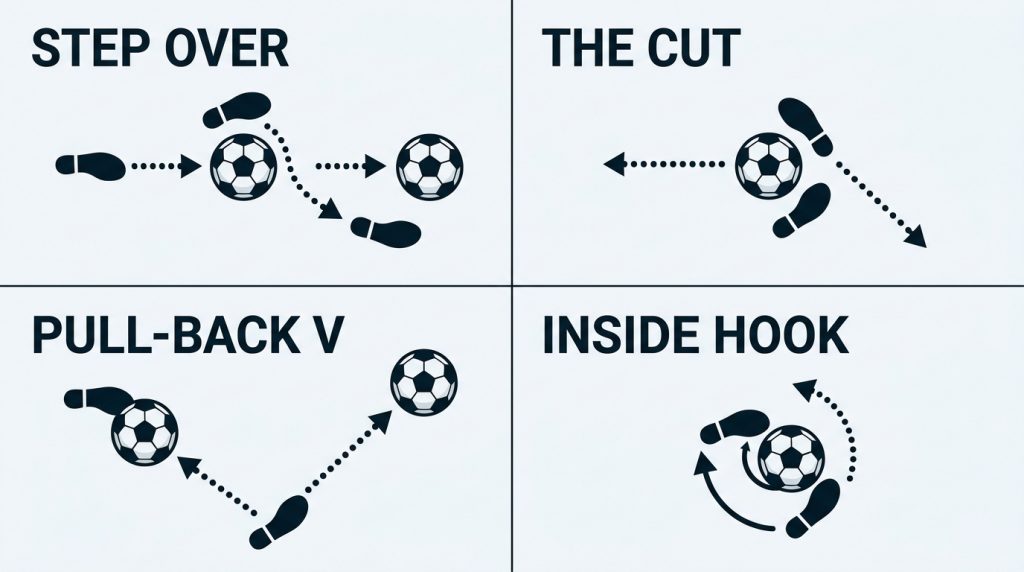
These four are usable within a week and they never stop being useful.
The Step Over
The most recognisable move in soccer, and the one every player tries first. You swing your foot over the top of the ball without touching it, as if you’re about to push it that way, then take it in the opposite direction with the outside of your other foot.
Beats: a defender who reacts to your feet. Common error: stepping over so slowly that nobody is fooled. It has to look like a real touch.
The Cut (Inside Chop)
Simple and brutally effective. You’re running one way, you plant your outside foot, chop the ball back across your body with the inside of the other foot, and go the other direction.
Beats: a defender running alongside you at speed. Their momentum carries them past. Common error: cutting too gently, so the ball stays in the defender’s reach.
The Pull-Back V
Drag the ball backwards with the sole of your foot, then push it away at an angle with the inside of the same foot. The path traces a V.
Beats: a defender diving in from the front. Common error: doing it with your back to goal and no plan for the next touch.
The Inside Hook
Wrap your foot around the outside of the ball and pull it back inside, turning your body with it. It’s the standard way to escape pressure from behind.
Beats: a defender tight to your back. Common error: turning into the defender rather than away from them.
Intermediate Moves
Worth adding once the basics are automatic.
The Cruyff Turn
You shape to pass or cross, then instead drag the ball behind your standing leg with the inside of your foot and spin away.
Beats: a defender who commits to blocking the cross. Why it works: the fake is a whole-body action, which makes it far more convincing than a foot movement.
La Croqueta
Named after Iniesta’s version. You push the ball from one foot to the other in a single quick movement, sliding it across your body and past the defender’s outstretched leg.
Beats: a defender lunging in from the front. Requires: close control and nerve, because the ball travels right past their boot.
The Ronaldo Chop
Swing your kicking leg as if to shoot or cross, then at the last moment chop the ball behind your standing leg with the inside of your foot.
Beats: a defender who buys the shot fake and turns to block. Requires: a convincing shooting motion, which means your actual shooting technique needs to be good enough to be believable.
The Nutmeg
Pushing the ball through a defender’s legs and collecting it behind them. Not so much a technique as an opportunity — you take it when the gap appears.
Beats: a defender standing with their feet apart, usually as they reach in. Note: it’s humiliating when it works and embarrassing when it doesn’t, which is a fair description of the risk.
Advanced Moves
These take months and most players never need them. Included because they’re worth understanding, not because you should start here.
The Elastico
The ball goes out with the outside of the foot and comes back with the inside in one flowing motion. Ronaldinho’s signature.
Beats: a defender who reacts to the first movement. Reality check: genuinely hard. Expect weeks before it looks like anything.
The Roulette (Maradona Spin)
You step on the ball with one foot, spin 360 degrees, and drag it away with the other.
Beats: two defenders converging — it’s one of the few moves that works against pressure from multiple sides. Reality check: needs balance and a very reliable first touch on the drag.
The Rabona
Kicking the ball with your kicking leg wrapped behind your standing leg. Used to cross with your strong foot from the wrong side.
Reality check: almost never necessary. Learning to use your weak foot solves the same problem more reliably.
The Rainbow
Flicking the ball up over your own head with your heels. Spectacular and almost never useful in a match.
Reality check: pure entertainment. Fine to learn, but not before anything above.
Which Move for Which Situation
| Move | Difficulty | Best against |
|---|---|---|
| Step over | Easy | A defender watching your feet |
| Cut | Easy | A defender running alongside you |
| Pull-back V | Easy | A defender diving in from the front |
| Inside hook | Easy | Pressure from behind |
| Cruyff turn | Medium | A defender committing to block a cross |
| La croqueta | Medium | A lunging defender, tight space |
| Ronaldo chop | Medium | A defender buying a shot fake |
| Nutmeg | Opportunistic | A defender with legs apart |
| Elastico | Hard | A defender reacting early |
| Roulette | Hard | Two defenders converging |
| Rabona | Hard | Almost nothing — use your weak foot |
| Rainbow | Hard | Nothing. It’s for fun |
How to Actually Learn One
The method matters more than the move.
Stage 1: Static, no ball. Walk through the footwork without a ball until the pattern is automatic. Feels ridiculous, saves weeks.
Stage 2: Static, with a ball. Same movement, ball at your feet, no pressure, no defender. Fifty repetitions each side.
Stage 3: Walking pace, moving. Perform it while moving forward slowly. This is where most people discover their version doesn’t work in motion.
Stage 4: Match pace, cone as defender. Full speed past a static marker. Ugly at first.
Stage 5: Against a passive defender. A friend who doesn’t tackle, just stands and reacts.
Stage 6: Against a real defender. Small-sided games. Expect to lose the ball often for a few weeks.
Skipping to stage 6 is why so many players “know” moves they can’t use. Each stage takes days, not months, and the whole progression for one move is realistically two to three weeks.
One more thing worth saying: none of this works without a soft first touch. If the ball bounces away from you before the move even starts, the move was never the problem — juggling is the fastest fix for that.
Fifteen focused minutes per session beats an hour of random attempts. For structuring a full session around this, our essential soccer ball drills guide covers the wider routine.
When Not to Try a Skill Move
This is the part coaches care about and tutorials ignore.
In your own defensive third. Losing the soccer ball twenty metres from your own goal creates a chance for the opposition. Pass it — and if you’re unsure which pass, the thirteen types of passes covers the options.
When a teammate is in a better position. The pass is faster than any move you can perform.
Against two or more defenders. Beat one and the second takes the ball. The exception is the roulette, and even then it’s a gamble.
When you’re not facing forward. Turning into pressure with a fancy move usually ends in a turnover. Lay it off and reposition.
As the first thing you try. A simple pass and a run to receive it back beats most one-on-one attempts.
Repeatedly against the same defender. Defenders learn. If your step over worked twice, the third time they’ll wait for it.
The honest ratio: in a full match, a good winger might attempt five or six take-ons and succeed at two or three. That’s considered a strong return. Skill moves are a low-percentage tool used in the right place, not a way to play.
Where you play changes how much this matters — wingers use these constantly, defenders almost never. Our position self-assessment covers what each role actually demands.
For Parents and Youth Coaches
Children love skill moves, which makes them a brilliant teaching tool and a slight trap.
Let them learn tricks. The motivation is real and the ball control transfers to everything else. A kid who spends an hour practising step overs is getting an hour of touches on a soccer ball, which is exactly what they need.
Don’t correct their use of them in games too hard. Trying a move and failing is how the judgement develops. Shouting “just pass it” produces players who never take anyone on.
Do introduce the idea of space. “Was there someone free?” is a better question after a failed dribble than “why did you do that?”
Expect the rainbow phase. Every young player goes through wanting to learn the flashiest thing they’ve seen. It passes, and the touch it builds stays.
Common Questions
What is the easiest soccer skill move to learn? The step over or the cut. Both take a few sessions to get right and both work against real defenders at every level of soccer.
How many skill moves should I know? Three or four that you can do at full speed under pressure. Knowing twenty at walking pace is worth less than knowing two properly.
What’s the most effective skill move in a real match? The simple cut, by a distance. It changes direction, protects the ball with your body, and requires no special technique — just timing.
How long does it take to learn a skill move? Two to three weeks per move to reach match usability, if you work through the stages above. Getting it to work reliably in games takes longer.
Do skill moves work against good defenders? Less often, and that’s expected. Better defenders don’t dive in, so they don’t commit their weight, which is what most moves rely on. Against them, the answer is usually a pass and movement rather than a trick.
Should I learn moves with both feet? Eventually, yes. A player who can only cut one way is easy to show onto their weak side. Start with your strong foot, then add the other once the pattern is solid.
Are soccer skill moves useful for defenders? Some. The inside hook and pull-back are escape moves that any player benefits from — defenders need to get out of pressure too. The elastico, not so much.
Anthony Molina writes about soccer technique, gear and coaching at FOOTBOLNO.