Last updated: August 2026
Key Takeaways
- The greatest comebacks share one thing: the losing team stopped playing the way that had built their lead. Almost none of them were undone by tactics alone.
- Liverpool’s 2005 final against Milan remains the benchmark — three goals down at half-time in a European Cup final, level within six minutes of the restart.
- Two-legged ties produce the most extreme swings, because a team can be four goals behind and still have ninety minutes to fix it.
- Every comeback on this list happened in front of a crowd that had decided it wasn’t over. That’s not romance — it measurably changes how a match is played.
Soccer produces comebacks that no other sport quite matches, because goals are rare enough that a two-goal lead feels safe and infrequent enough that losing one feels impossible. In a sport where a typical match produces two or three goals, a three-goal swing is a statistical event.
What follows are five that genuinely shouldn’t have happened, with the scores and dates checked rather than remembered. Then the more interesting question: what actually makes them possible.
«I’ve been in dressing rooms at half-time two goals down. The thing nobody tells you is that the panic isn’t in the team that’s behind — it’s in the team that’s ahead, the moment the first one goes in.» — Anthony Molina, FOOTBOLNO.COM
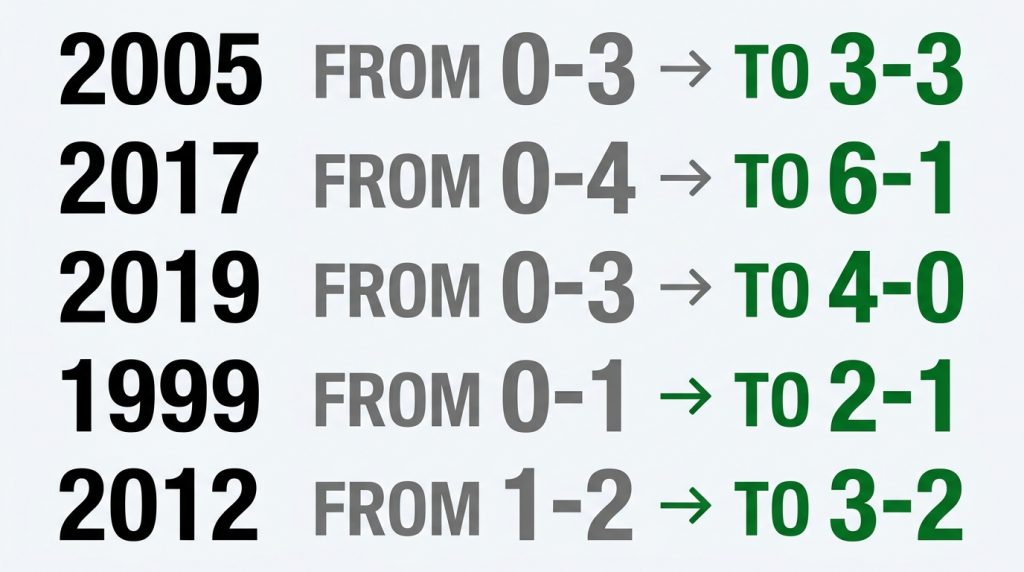
Istanbul, 2005: Liverpool 3–3 Milan
25 May 2005, Champions League final, Atatürk Olympic Stadium.
Milan scored inside a minute through Maldini, then Crespo added two more before the interval. Liverpool went in at half-time three goals down in a European Cup final — a position from which no team had ever recovered at that stage of the competition.
In the second half Liverpool scored three times in a six-minute spell. The match finished 3–3 and went to penalties, which Liverpool won 3–2.
Nothing on this list is more improbable. The comeback took six minutes of a final that had been over for forty-five.
The Remontada, 2017: Barcelona 6–1 PSG
8 March 2017, Champions League round of 16, Camp Nou.
Barcelona lost the first leg in Paris 4–0. No team had ever overturned a four-goal deficit in the Champions League knockout stage.
They won the second leg 6–1, taking the tie 6–5 on aggregate, with the decisive goals arriving in the closing minutes of stoppage time.
What makes it stranger than Istanbul in one respect: Barcelona knew for three weeks exactly how many goals they needed, and still needed almost all of them in the last six minutes.
Anfield, 2019: Liverpool 4–0 Barcelona
7 May 2019, Champions League semi-final second leg.
Barcelona won the first leg 3–0 at Camp Nou. Liverpool won the return 4–0, going through 4–3 on aggregate — without two of their leading forwards.
The fourth goal came from a corner taken quickly while the Barcelona defence was still organising itself. It’s the most-replayed moment of the tie, and it’s a reminder that comebacks are often decided by attention rather than brilliance.
Camp Nou, 1999: Manchester United 2–1 Bayern Munich
26 May 1999, Champions League final, Camp Nou.
Bayern led from the sixth minute and were still ahead as the match entered stoppage time. United scored twice in those final minutes to win 2–1.
The tape of Bayern’s players on the pitch at full time is the definitive image of what a late comeback does to the team that was winning.
Manchester, 2012: The Last Day
13 May 2012, final day of the Premier League season.
Manchester City needed to beat Queens Park Rangers to win the title on goal difference. They were losing 2–1 deep into stoppage time, with QPR down to ten men after Joey Barton’s dismissal.
City scored twice in the closing moments to win 3–2 and take their first Premier League title. It remains the only time the English championship has changed hands in stoppage time on the final day.
Why Comebacks Happen
Highlights show the goals. They don’t show the mechanism, which is fairly consistent across all five of these.
The leading team changes what it was doing. A side that scored three goals by attacking suddenly drops deep to protect the lead. That invites pressure, and pressure produces chances. This is the single most common factor.
Momentum is real, even if it’s uncomfortable to admit. The first goal back changes the behaviour of twenty-two players and a crowd simultaneously. Defenders clear rather than pass; attackers press higher; the referee’s decisions get louder.
Substitutions and shape. Nearly every comeback involves the trailing manager taking a genuine risk — an extra forward, a change of system, accepting that losing 4–0 and losing 2–0 are the same result.
Set pieces. A team chasing a game puts more bodies in the box more often. Corners and free kicks become the most likely source of goals, which is why so many comeback goals arrive from them.
Time pressure cuts both ways. The trailing team plays with nothing to lose. The leading team plays with everything to lose, and that shows in decision-making.
What a Comeback Looks Like From the Pitch
Watching one on television and being in one are different experiences, and the difference explains a lot about why they happen.
The scoreline stops being information. For the team that’s behind, three goals down and two goals down feel identical — both mean “keep going”. For the team ahead, every goal conceded changes the calculation. That asymmetry is the engine of every comeback in soccer.
Positions stop being fixed. Centre-backs end up in the opposition box. Wingers track back forty metres. The tidy structure of player positions dissolves, which creates space nobody planned for — usually for the team that’s chasing.
Fatigue lands unevenly. Defending a lead is physically harder than it looks, because you’re reacting rather than dictating. Teams protecting a scoreline in the last twenty minutes are often more tired than the team attacking them.
The ball spends more time in the air. A chasing team crosses more, so more of the game becomes aerial duels and second balls — which is precisely why so many comeback goals come from corners and long throws rather than from open play.
Someone always makes a decision they wouldn’t normally make. A goalkeeper comes up for a corner. A defender tries a pass they’d never attempt at 0–0. Sometimes it works, and that’s the goal everyone remembers.
The Amateur Version
None of this is confined to elite soccer. If you play in any league, you’ll be involved in a comeback at some point — from one side or the other.
If you’re behind: score first, then reassess. Chasing three goals at once produces chaos; chasing one produces a plan. Keep the ball on the ground and use the width of the field rather than launching it forward — the passing options matter more here than at any other point in a match.
If you’re ahead: keep playing the way that got you the lead. Dropping deep to defend a two-goal advantage is how two-goal advantages disappear. Retaining possession is more defensive than defending.
Either way, watch the substitutions. The moment the opposition brings on an extra forward, someone in your team needs to say it out loud. Set pieces become the main threat, and a defence that has stopped organising for corners is a defence about to concede one — the sort of thing defensive positioning is drilled to prevent.
For younger players, this is one of the most useful things a coach can teach, and it has nothing to do with technique — it’s about noticing what has changed. Our beginner’s guide to playing soccer covers the basics that make it possible to act on that noticing.
What the Losing Teams Had in Common
Worth stating plainly, because it’s the practical lesson.
In four of the five matches above, the leading team had been comfortably better for a sustained period. None of them lost because they were outclassed. They lost because the game changed state and they didn’t change with it.
Milan didn’t collapse over ninety minutes — they collapsed over six. PSG had three weeks to prepare and still conceded three in the final minutes. Bayern led for eighty-four minutes.
That’s the uncomfortable part: being better for most of a match protects you less than it should.
Common Questions
What is the greatest comeback in soccer history? Liverpool against Milan in the 2005 Champions League final is the usual answer, and the reason is the stage — three goals down at half-time in a European final, level within six minutes of the restart, won on penalties.
What is the biggest comeback in Champions League knockout history? Barcelona overturning a 4–0 first-leg defeat to PSG in March 2017, winning 6–1 to go through 6–5 on aggregate.
Has anyone come back from four goals down in a final? Not in a Champions League final. Four-goal recoveries have happened in two-legged ties, where a team has a second match to work with, which is a fundamentally different situation from a single ninety minutes.
Why do comebacks happen more in two-legged ties? Because the trailing team gets a full ninety minutes and knows exactly what it needs from the first whistle. In a single match, the deficit usually becomes clear too late to restructure around it.
Do comebacks happen more often at home? The matches on this list all turned at home for the recovering side, and crowd effect is the usual explanation. It’s worth noting that home advantage in general is real but modest — a packed stadium doesn’t score goals by itself.
What’s the biggest comeback in a Premier League match? Several teams have recovered from three goals down. The most-cited is Newcastle against Arsenal in 2011, where Newcastle came back from 4–0 to draw 4–4 — a result frequently listed among the league’s greatest recoveries.
Can you learn anything from these as an amateur player? Yes, and it’s mostly about state changes rather than skill. Teams that concede a comeback almost always stopped doing what was working. Teams that complete one almost always simplified rather than panicked.
Anthony Molina writes about soccer technique, gear and coaching at FOOTBOLNO.