Last updated: August 2026
Key Takeaways
- The whole game in one sentence: two teams of eleven try to put a ball in the other team’s goal without using their hands, and whoever does it more times wins.
- You need about eight rules to play your first game. The rest you’ll pick up by playing, and nobody will mind.
- Learn four skills in this order: controlling a ball, passing, dribbling, shooting. Skipping to shooting is the most common beginner mistake.
- You do not need to be fit, fast or young to start. Every amateur team has players who are none of those things.
Soccer looks simple from outside and then you turn up to your first session and realise you don’t know where to stand, what the lines mean, or why everyone stopped when the whistle went.
This guide is what I’d tell someone who’s never played. Not a rulebook — the actual minimum you need to get through a first game without feeling lost, and what to work on afterwards.
«The thing nobody tells beginners is that everyone else on the pitch is also making mistakes constantly. Watch a professional match closely and count the misplaced passes. Soccer is a game of errors — you’re just joining in.» — Anthony Molina, FOOTBOLNO.COM
The Game in Ninety Seconds
Two teams. Eleven players each in the full version, fewer in casual and youth games. Two halves of forty-five minutes at adult level, shorter for kids.
Each team defends one goal and attacks the other. You move the ball with your feet, or any part of your body except your hands and arms. Put it fully over the goal line between the posts and that’s a goal. Most goals wins. A draw is a normal result and not a failure of the format.
One player per team — the goalkeeper — may use their hands, but only inside their own penalty area.
That’s genuinely the whole thing. Everything else is detail.
The Field and What the Lines Mean
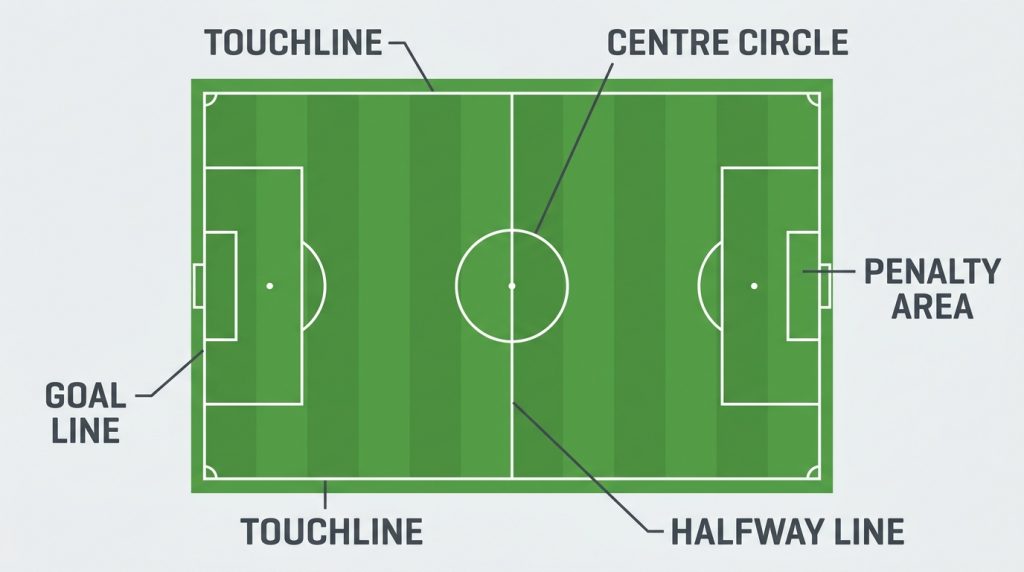
You don’t need to memorise dimensions, but knowing what each line does saves confusion.
Touchlines — the long sides of the field. Ball fully over them, it’s a throw-in for the team that didn’t touch it last.
Goal lines — the short ends. Over them without going into the goal, it’s either a goal kick (if the attacking team touched it last) or a corner kick (if the defending team did).
The penalty area — the big box. The keeper can handle the ball here, and a foul by the defending team inside it means a penalty kick.
The centre circle — where kick-off happens. Opponents stay outside it until the ball moves.
The halfway line — splits the field in two and matters mainly for offside, which we’ll get to.
Pitch sizes vary a lot. A full adult pitch is roughly 100–110 metres long, but youth and small-sided games use much smaller ones, and nobody will ask you to measure anything.
What You Actually Need to Buy
Less than you’d think for a first session:
- Boots appropriate to the surface — moulded studs for grass, flat soles for indoor or artificial turf
- 护胫板 — required in organised soccer, and a genuinely good idea. Our guide to the best shin guards covers the options
- Socks long enough to cover the guards
- A ball, if you want to practise alone — size 5 for adults, smaller for children, as covered in what a soccer ball should weigh
That’s it. No gloves unless you’re going in goal. Turn up in any shorts and shirt.
The Rules You Actually Need on Day One
There are seventeen Laws of the Game. You need these eight.
1. No hands. Outfield players cannot deliberately touch the ball with hand or arm. Accidental contact usually isn’t punished — the referee judges intent and whether your arm made your body unnaturally bigger.
2. Throw-ins. Ball out over a touchline. Both feet on the ground, both hands on the ball, throw from behind and over your head. Getting this wrong is the single most common beginner error and it’s a free throw to the other team.
3. Goal kicks and corners. Ball out over a goal line. Attacker touched it last, defending team restarts with a goal kick. Defender touched it last, attacking team gets a corner.
4. Fouls. Tripping, pushing, holding, or a tackle that gets the player instead of the ball. Results in a free kick to the other team.
5. Free kicks. Awarded after a foul. Opponents must retreat about ten yards. Direct free kicks can be scored straight from the kick; indirect ones must touch another player first.
6. Penalty kicks. A foul by the defending team inside their own penalty area. One player against the keeper from twelve yards. The full rules around penalties are worth reading before your first game.
7. Offside. The rule that confuses everyone. Simplified: when a teammate plays the ball forward to you, you must not be nearer to the opponents’ goal than both the ball and the second-last defender. You can’t be offside in your own half, from a throw-in, or if you’re behind the ball. In casual games it’s often ignored entirely.
8. Cards. Yellow is a warning for a serious foul or persistent fouling. Red means you leave the field and your team plays a player short. Beginners almost never see either.
Everything else — advantage, substitutions, drop balls — you’ll absorb by playing.
The Four Skills, in the Right Order
New players almost always want to practise shooting. It’s the least useful thing to start with, because in a game you’ll shoot maybe twice and touch the ball fifty times.
First: controlling the ball. When a pass arrives, can you stop it dead? This is the foundation and it’s the difference between playing and chasing. Juggling is the fastest way to build it — our guide to juggling a soccer ball starts from zero.
Second: passing. The most-used skill in the game by a wide margin. Inside of the foot, ball along the ground, aimed at a teammate’s feet. The thirteen types of passes covers the range once the basic one is reliable.
Third: dribbling. Moving with the ball under control. Useful, but less often than beginners assume — see how to dribble a soccer ball for technique and, more importantly, when not to.
Fourth: shooting. Now you can learn to strike the ball properly. It’s satisfying and it matters — just not first.
A useful ratio for solo practice: half control and passing, a quarter dribbling, a quarter shooting. Most beginners do the reverse and wonder why games feel chaotic.
Where Do I Stand? Positions for a Beginner
Broadly there are four groups: goalkeeper, defenders, midfielders, forwards. As a beginner you’ll usually be put in defence or midfield, where teammates can cover for you.
Don’t worry about picking one yet. Play wherever you’re put for the first few months — you’ll learn more, and your instinct about where you belong will develop on its own. When you’re ready to think about it properly, our position self-assessment walks through six questions and points you at a shortlist. For a full breakdown of every role, see player positions in soccer.
One practical tip for your first game: stay in your area. Beginners chase the ball all over the field, which leaves huge gaps and exhausts them by half time. Hold a rough position and let the ball come to your zone.
Formats: Not Every Game Has Eleven Players
Beginners assume soccer means eleven a side on a full field. Most soccer actually played in the world doesn’t look like that, and the smaller formats are far better places to start.
| Format | Players | Field | Why it suits beginners |
|---|---|---|---|
| 11-a-side | 11 per team | Full field | The standard game. Lots of running, fewer touches for each player |
| 7-a-side | 7 per team | Around half a field | Popular in adult leagues. Much more involvement |
| 5-a-side | 5 per team | Small field, often boarded | Constant touches, short games, very forgiving |
| Futsal | 5 per team | Indoor hard court, heavier ball | Brilliant for technique — the ball barely bounces |
| Youth small-sided | 3–7 per team | Scaled-down field | Designed so children touch the ball constantly |
If you’re an adult starting out, a 5- or 7-a-side league is almost always the better entry point than a full-field team. You’ll touch the ball five times more often per game, and every one of those touches is practice. The smaller field also means less running, which matters more than beginners expect in the first month.
Futsal deserves a special mention: it’s played with a low-bounce ball on a hard court, and the tight space forces quick decisions and clean control. Many professionals credit it for their technique. Our comparison of a soccer ball versus a futsal ball explains why the equipment differs, and the full futsal rules cover how the game changes.
Your First Training Session
Knowing the shape of a session removes most of the nerves.
Warm-up, ten to fifteen minutes. Jogging, stretching, light ball work. Nobody is judging you here.
Technical drills, twenty minutes. Passing in pairs, control, maybe dribbling through cones. You’ll be worse than everyone else and it will matter less than you think.
Small-sided games, twenty minutes. Four against four or similar. This is where you learn fastest, because everything happens more often than in a full game.
Full-sided game or fitness, the rest. Depends on the coach.
What to bring: boots, shin guards, water, and a willingness to be bad at something in front of strangers for a few weeks. That last one is the actual barrier for most adults.
Finding a Team as an Adult Beginner
This is the part people get stuck on, and it’s easier than it looks.
Casual leagues and pick-up games. Most towns have a weekly game where anyone can turn up. Search for “casual soccer” or “pick-up soccer” plus your area. Standards vary wildly and nobody expects much.
Beginner-specific sessions. Some clubs run “back to soccer” or adult beginner programmes explicitly for people who’ve never played.
Indoor and small-sided leagues. Five- or seven-a-side is less physically punishing than eleven-a-side, the games are shorter, and you touch the ball far more — which means you improve faster.
Ask about the level before you go. A quick message saying you’re a complete beginner filters out the wrong groups and, in my experience, usually gets a friendly answer.
Go alone if you have to. Waiting for a friend to join is how most people never start.
For Parents Signing a Child Up
Different problem entirely, and mostly about not putting them off.
Youth soccer usually starts around age four or five with small-sided games — often three or four a side, tiny goals, no goalkeepers. That’s deliberate: more touches per child.
What matters at the start is whether they enjoy it, not whether they’re good. Skills come later and unevenly. Kids who are the worst in the group at seven are frequently fine by ten.
Don’t coach from the sideline during matches. It’s the single most common complaint from youth coaches, and children who are being shouted instructions can’t develop their own decision-making.
If you’re considering coaching yourself, our guide to becoming a soccer coach covers licences and where to start.
Beginner Mistakes Worth Skipping
Chasing the ball all over the field. Covered above. Hold your position and let play come to you.
Only using your strong foot. Start weak-foot work now, while you have no habits to unlearn. It’s dramatically easier at this stage than later.
Always looking down at the ball. Get your head up as early as possible, even though it costs you control at first.
Booting it clear in panic. Understandable, but a controlled pass to a teammate is almost always better. Take the extra half-second.
Thinking fitness comes first. You get soccer-fit by playing soccer. Waiting until you’re in shape to join a team is a way of never joining a team.
Being embarrassed. Genuinely the biggest one. Everyone at your first session was a beginner once, and adult teams are usually welcoming because they need players.
How Long Until I’m Not Terrible?
A rough and honest timeline for an adult starting from nothing:
- First few sessions — everything feels fast and confusing. Normal.
- A month — basic control improves, you stop chasing the ball, positioning starts to make sense.
- Three months — you can pass reliably and contribute to a game rather than just being present.
- A year — you’re a functional amateur player who knows where to be.
Children move faster in technique and slower in tactical understanding. Adults are the reverse — you’ll understand the game before your feet catch up, which is frustrating and completely normal.
Common Questions
How old is too old to start playing soccer? There isn’t an upper limit for recreational play. Plenty of people start in their thirties, forties and later. If you’re worried about impact, small-sided or walking soccer is easier on the body.
Do I need to be fit to start? No. You’ll be tired for the first few weeks and then you won’t be. Fitness is a result of playing, not a prerequisite.
How many players are on a soccer team? Eleven per side in the full game, including the goalkeeper, plus substitutes. Youth and casual formats use fewer — the details are in our guide to how many people play on a soccer team.
What’s the difference between soccer and football? The same sport under different names. “Soccer” is standard in the US, “football” in most of the world. Both terms originated in England.
Can I learn to play soccer on my own? You can learn the technical basics alone — control, juggling, dribbling, shooting against a wall. You cannot learn positioning, timing or decision-making without playing with others. Do both.
How long is a soccer game? Ninety minutes at adult level, split into two halves of forty-five with a fifteen-minute break, plus a few minutes of stoppage time. Youth games are shorter and scale with age.
What should I do if I get the ball and panic? Pass it to the nearest teammate. It’s never the wrong answer for a beginner, and it buys you time to think about the next one.
Anthony Molina writes about soccer technique, gear and coaching at FOOTBOLNO.