Last updated: August 2026
Key Takeaways
- Curve comes from spin, and spin comes from striking across the ball off-centre. Kicking harder does nothing except send a straight ball faster.
- Inside of the foot bends the ball away from your standing leg. Outside of the foot bends it the other way. Those are the two curves, and the inside one is far easier to learn.
- Your plant foot points where you want the ball to start, not where you want it to finish.
- The follow-through decides the shape. Wrapping your leg across your body produces curve; stopping at the ball produces a scuffed straight shot.
Everyone wants to bend a free kick around a soccer wall. Most people try by kicking harder, which is exactly backwards — power and curve come from different things, and chasing one usually costs you the other.
The bend itself is simple physics that you can feel within about twenty attempts once you know where to hit the soccer ball. Getting it accurate takes a lot longer, but the basic curve is genuinely learnable in an afternoon.
«Every player I’ve coached who couldn’t bend the ball was making the same mistake: striking through the middle and hoping. You cannot curve a ball you hit in the centre. It’s not a strength thing, it’s a geometry thing.» — Anthony Molina, FOOTBOLNO.COM
Why a Ball Bends at All
A spinning ball curves because it drags air around itself as it turns. On one side that spin pushes against the oncoming air, on the other it moves with it — the pressure difference is unequal, and the ball drifts toward the low-pressure side.
That’s the Magnus effect, and it’s the same reason a topspin tennis shot dips and a cricket ball swings.
Two practical consequences follow from it:
No spin, no curve. A soccer ball struck cleanly through its centre travels straight, however hard you kick it.
More spin means more bend, but less speed. Energy that goes into rotating the ball doesn’t go into moving it forward. That’s the trade-off, and it’s why a heavily curled shot travels slower than a driven one — a point that also applies when you shoot for power.
The Two Curves
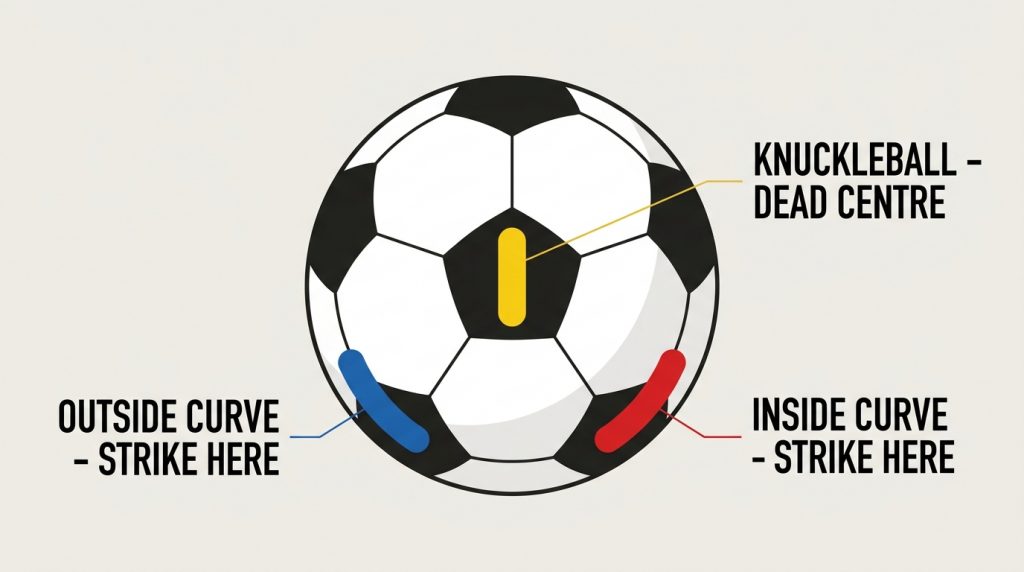
There are only two, and they bend in opposite directions.
| Curve | Foot surface | Bends | Difficulty |
|---|---|---|---|
| Inside curve | Inside of the foot | Away from your standing leg — right-footers bend it right to left | Much easier, the default |
| Outside curve | Outside of the foot | Toward your standing leg — right-footers bend it left to right | Harder, less power, more disguise |
A right-footed player taking a free kick from the left of goal will usually use the inside of the foot to bend it toward the far post. From the right, the outside of the foot does the same job — which is why left-footed players are valuable on the right side of a free kick.
Learn the inside curve first. The outside one is a refinement, not a starting point.
The Technique, Step by Step
Step 1: Approach at an Angle
A wider angle than a normal shot — somewhere near forty-five degrees. You need room for your leg to swing across the ball rather than through it, and a straight run-up doesn’t give you that.
Three or four steps is plenty.
Step 2: Plant Foot Beside the Ball, Pointing at the Start Line
This is the part people get wrong.
Your plant foot points where you want the ball to begin its flight, not where you want it to end up. The curve does the rest of the work. If you aim your body at the target, the ball will bend away from it and miss.
Place it roughly a foot’s width to the side of the ball, as with any strike — the same principle covered in the shooting technique guide.
Step 3: Strike Across the Ball, Off-Centre
Here’s the actual secret, and it’s one sentence: hit the lower outside quadrant of the ball with the inside of your foot, and swing across the ball rather than through it.
For a right-footed inside curve, that means contacting the ball to the right of its centre line, with your foot travelling from right to left across it.
Contact point matters more than force:
- Off-centre and low — curve with some lift
- Off-centre and level — flatter curve, more speed
- Dead centre — no curve at all, whatever your follow-through does
The bigger the offset from the centre, the more spin and the less pace.
Step 4: Lock the Ankle
Same as any strike. A loose ankle absorbs energy and makes contact inconsistent, and with curve you need repeatable contact more than you need power.
Step 5: Follow Through Across Your Body
Your kicking leg should finish across your body, not pointing at the target. That wrapping motion is what imparts the spin.
If your leg finishes straight ahead, you didn’t cut across the ball, and you’ll get a straight shot with a slightly odd contact.
Where to Aim
Once the ball curves, aiming changes completely — you’re no longer aiming at the goal, you’re aiming at a point in space that the curve will pull the ball away from.
Over the wall, aim at the outside shoulder of the wall. The curve brings it back toward the goal. Aim at the goal directly and you’ll bend it wide.
From open play, aim at the goalkeeper’s near side and let it move to the far post. Keepers set their feet based on where the ball starts, and a late-curving ball moves after they’ve committed.
Height comes from contact position, not from leaning back. Under the centre lifts it; leaning back lifts it and kills the accuracy.
The one universal rule: the ball ends up somewhere different from where you aimed. Practising is largely about learning by how much.
Drills to Build a Reliable Curve
Wall target, no goal. Mark a spot on a wall and try to hit it from an angle where a straight ball can’t reach it. Forces genuine curve rather than a straight shot that happens to go in.
Cone gate. Put two cones five metres in front of you as a gate, and a target ten metres beyond them and off to one side. The ball must pass through the gate and finish at the target — impossible without bend.
Mannequin or bag wall. Anything upright works. Bags, cones stacked, a friend standing well to the side. Bend it around the obstacle.
Ten in a row, same spot. Consistency matters more than the spectacular one. If you can bend nine out of ten to the same place, you have the technique; if it’s two out of ten, you’re guessing.
Both feet, eventually. Curling with the weak foot is genuinely hard, but even a modest outside-of-the-boot curve with the other foot makes you unpredictable.
Fifty repetitions a session, focusing on contact point rather than result, will get you further than three hundred full-power attempts at the top corner. For a broader routine, our essential soccer ball drills guide covers session structure.
Free Kick Situations in a Real Soccer Match
Bending a soccer ball in an empty park is one problem. Doing it in a match with a wall, a goalkeeper and eight seconds of pressure is another.
Direct free kick, central, twenty metres. The classic. A wall of three or four, the keeper covering the open side. Curve over the wall’s outside shoulder. This is the shot everyone practises and the one that comes up least often.
Direct free kick from a wide angle. Far more common, and easier. From the left as a right-footer, you can bend a soccer ball across the face of goal — either it goes in at the far post or someone touches it in. Both outcomes are good.
Corner kicks. An in-swinging corner is a curved soccer ball, nothing more. A right-footer taking a corner from the left bends it toward goal; from the right, the same foot bends it away. Which corner you take from should be decided by which foot you have.
Crosses from open play. Every good cross has curve on it. Bending the ball away from the goalkeeper and into the space between them and the defenders is the whole skill — a straight cross is easy to claim.
Curving a pass. The least glamorous and most useful. A soccer ball bent around a defender’s outstretched leg into a teammate’s run is the same technique at a quarter of the power, and it comes up several times per match.
Note how few of these are the free kick everyone imagines. If you only practise the twenty-metre wall situation, you’re drilling the rarest of them.
The Knuckleball Is the Opposite
Worth knowing because people confuse the two.
A knuckleball is a shot with almost no spin at all. Struck dead centre with a firm, short follow-through, it moves unpredictably in the air because the airflow over the seams keeps switching sides.
It isn’t a better curve — it’s a different shot with a different purpose. Curve is predictable and repeatable; knuckleball is chaotic, which is what makes it hard for keepers and equally hard for the person taking it.
Learn to curve first. Knuckleballs are unreliable even for professionals.
Mistakes That Kill the Curve
Striking through the middle. The single most common one. No off-centre contact, no spin, no bend.
Kicking harder to get more curve. Backwards. More force through the centre gives you a faster straight ball.
Aiming at the target. Your plant foot and body should aim at where the ball starts. Aiming at the goal sends a curling ball wide of it.
Stopping the follow-through. The wrap across the body is what generates spin. Cutting it short produces a scuffed shot.
Leaning back. Sends it over the bar, same as with any strike.
Trying it before your basic strike is reliable. Curving is a variation on a clean contact. If your normal shot is inconsistent, add this later — start with basic soccer skills and clean striking.
Practising only from free-kick distance. Start at ten metres where you can see what the contact did. Distance hides feedback.
How Long Does It Take?
You’ll feel the ball bend for the first time within one session — usually by accident, which is itself informative.
Getting a reliable curve on demand takes a few weeks of regular practice. Placing that curve where you want it, over a wall and under the bar, takes months. Professionals who take free kicks spend years on it and still miss most of them.
Set the bar accordingly: consistent bend at a target is a realistic goal, and it’s genuinely useful in matches. Bending one into the top corner from twenty-five metres is not something to measure yourself against.
Common Questions
How do you curve a soccer ball with the inside of your foot? Approach at an angle, plant your foot beside the ball pointing where you want the flight to start, strike the lower outside quadrant with the inside of your foot, swinging across the ball, and follow through across your body.
Why won’t my ball curve? Almost certainly because you’re hitting it in the centre. Move your contact point off-centre and make sure your leg swings across the ball rather than straight through it.
Do you need special boots to curve the ball? No. Boot texture makes a marginal difference to grip on the ball, far less than technique. Any boots will curve a ball if you strike it correctly.
Does ball pressure affect curve? Somewhat. A slightly softer ball grips the foot a little longer and can spin more readily, but an under-inflated ball loses too much pace. Standard pressure for the size is right — our guide to soccer ball weight and size covers the specifications.
Is it easier to curve with the inside or outside of the foot? Inside, by a wide margin. The contact area is bigger and the motion is more natural. Outside-of-the-boot curve is a later addition.
Can you curve a ball on the ground? Yes — a curved pass along the grass is a real and useful skill, bending around a defender’s leg into a teammate’s path. Same contact principle, less lift.
Why do free kicks curve more in some stadiums? Altitude and air density affect how much the Magnus effect bites. Balls curve less in thin air, which is one reason high-altitude venues have a reputation for strange flight.
Anthony Molina writes about soccer technique, gear and coaching at FOOTBOLNO.