Last updated: June 2026
«I’ve watched people with zero playing background become genuinely excellent youth coaches within two seasons — because they showed up every week, listened to feedback, and actually studied the game. A license gets you in the door, but consistency keeps you there.» — Anthony Molina, FOOTBOLNO.COM
So you want to coach soccer. Maybe you grew up playing rec leagues, maybe you’re a parent watching your kid’s U8 team get completely outclassed, or maybe you just love the game and want to give something back. Whatever the reason, the question is the same: where do you actually start?
Here’s the short answer: you don’t need a professional playing career, you don’t need a pile of money, and you don’t need years of experience before you touch a whiteboard. What you need is a clear path — and that’s exactly what this guide is.
In 2026, the US Soccer coaching education system is more accessible than it’s ever been. There are online entry-level modules, affordable grassroots licenses, and a structured ladder that takes you from sideline volunteer to professional head coach if that’s where you want to go. This guide walks you through every step of that path — from your very first session helping out at a local club to the prerequisites for a Pro License.
Let’s get into it.
📋 Key Takeaways
Key Takeaways
- You can start coaching youth soccer this week with zero experience — volunteer at a local club and complete the free US Soccer Introduction to Grassroots Coaching module simultaneously.
- The full USSF pathway runs from a free 20-minute online module through Grassroots, D, C, B, A (Youth or Senior), and Pro License — each with defined prerequisites, durations, and costs.
- Compliance requirements (SafeSport, background check) are non-negotiable before working with minors; get them done before you apply anywhere.
- Non-technical skills — communication, empathy, session design — matter as much as tactical knowledge, especially in youth coaching.
- Most first coaching jobs come through networking and direct club outreach, not job boards.
- Total cost from Grassroots through Pro spans roughly $15,100–$19,100 over a career of ten or more years; through the C License is under $3,000.
How Can You Start Coaching Soccer With No Experience?
The fastest way to start coaching soccer without experience is to volunteer with a local youth program and complete the free US Soccer Introduction to Grassroots Coaching online module — you can do both in the same week. That combination gives you immediate sideline access and your first official credential.
Most people assume they need to “qualify” before they’re allowed near a team. That’s not how youth soccer actually works in the United States. Organizations like AYSO (American Youth Soccer Organization) and US Youth Soccer run thousands of teams across the country and constantly need adults willing to show up and help. The barrier to entry is lower than you think — what clubs are really screening for is reliability and attitude, not tactical knowledge.
The coaches who grow fastest aren’t the ones who know the most on day one — they’re the ones who show up, ask questions, and actually apply what they learn on the field.
Here’s a practical starting sequence if you’re coming in with zero background.
Step 1 — Complete the free online intro module. US Soccer’s Introduction to Grassroots Coaching is a free, 20-minute module available through the US Soccer Learning Center. It costs nothing, takes less than half an hour, and is the official prerequisite for the entire Grassroots License pathway. Do this first. It signals to any club you approach that you’re serious.
Step 2 — Volunteer with a local youth organization. Contact AYSO or US Youth Soccer clubs in your area and offer to help as an assistant or sideline volunteer. You don’t need a license to assist a licensed head coach. This is where you learn what a session actually looks like: how warm-ups are structured, how you transition between drills, how you manage 12 eight-year-olds who’d rather chase a butterfly than run a possession exercise.
Step 3 — Shadow a licensed coach intentionally. There’s a difference between “helping out” and learning. Ask the head coach why they ran a particular drill. Ask what they’d change if they ran the session again. Keep a simple notebook with observations after each practice. This habit — watching and reflecting — builds coaching intelligence faster than any textbook.
Step 4 — Take your first in-person Grassroots course. Once you’ve got a few weeks of volunteer experience, register for one of the four Grassroots in-person modules (4v4, 7v7, 9v9, or 11v11) through the US Soccer Learning Center. These are four-hour sessions offered through local state associations and cost $25 each. Pick the format that matches the age group you’re already working with.
Step 5 — Build local relationships. Licensing courses, club volunteer days, and association meetings are where first jobs come from. Most entry-level coaching positions in the US are filled by word of mouth. Tell people you’re looking. Offer to help. Be the person who’s always around.
The timeline here is realistic: within 60–90 days of starting, you can have completed your intro module, two grassroots courses, and a genuine volunteer reference from a local club. That’s a typical example of how coaches at the entry level build their first credential set — the US Soccer coaching education system is structured specifically to make this progression achievable in a short window.
No prior playing experience required. No special connections. Just consistency.
What's the *single biggest* obstacle preventing you from starting your coaching journey right now?
Select your answer
Compliance and Safety Requirements Before You Coach Youth
Before you set foot on a sideline in any official capacity with a US Soccer-affiliated organization, there are non-negotiable compliance requirements. This isn’t bureaucracy for its own sake — it’s the baseline that protects the players in your care. Get these done before you apply for any coaching role, paid or volunteer.
SafeSport Training. Na stránkách US Center for SafeSport provides mandatory training covering abuse prevention, reporting obligations, and safe environments for youth athletes. The core course is free and takes approximately 90 minutes to complete. Renewal is required annually. US Soccer’s Learning Center links directly to the SafeSport certification process. No legitimate club will let you work with minors without this on file.
Background Check. A criminal background screening is required by virtually all US Soccer-affiliated clubs and leagues before you coach youth players. Processing typically takes 3–10 business days. Some organizations cover the cost; others pass it to the coach (usually $10–$30). Don’t wait until you have a job offer — initiate this as soon as you begin pursuing coaching roles so you can present a completed check immediately.
Concussion Training. Na stránkách CDC’s Heads Up concussion training for coaches is free, takes about 30 minutes, and is required or strongly recommended by most youth soccer organizations. You’ll learn to recognize symptoms, understand return-to-play protocols, and communicate with parents and medical professionals. Many state associations require it separately from SafeSport.
CPR and First Aid Certification. While requirements vary by organization, having a current CPR/First Aid certification (available through the American Red Cross or American Heart Association, typically $50–$80) makes you a stronger candidate and a safer coach. Some clubs require it; others strongly prefer it.
State-Specific Requirements. Certain states require fingerprinting or additional background checks for anyone working with minors in youth sports. Check your state association’s website or ask the club director what’s required in your jurisdiction.
Renewal Cycles. SafeSport training requires annual renewal. Background checks typically need to be refreshed every one to two years depending on the organization. Build reminders into your calendar so compliance gaps don’t interrupt your ability to coach.
«Complete your SafeSport training and background check before your first club contact — clubs that can’t hire you on the spot because you’re waiting on paperwork will move to the next candidate.»
What Coaching Licenses Do You Need? The Official Pathway
The official US Soccer coaching pathway runs from a free 20-minute online module all the way up to the Pro License — the credential required for MLS head coaches. Every step is defined, every prerequisite is documented, and the whole system was restructured in 2018 to be more accessible at the entry level.
Disclaimer: License requirements, costs, and course structures are subject to change. The information below reflects published USSF guidelines as of June 2026. Always confirm current requirements and pricing directly through US Soccer’s Learning Center before registering for any course.
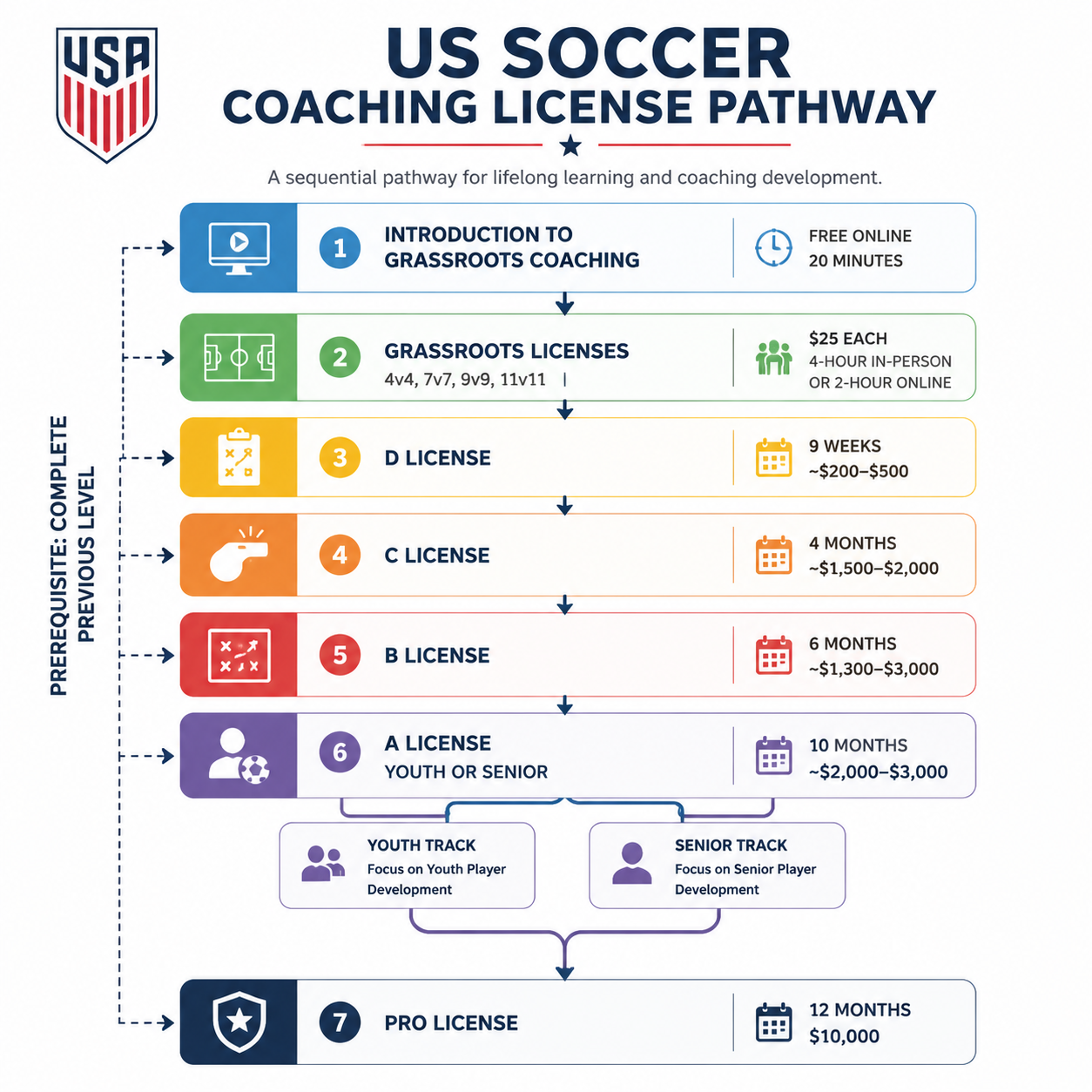
Here’s the full pathway in one table, so you can see the big picture before we go level by level:
| License | Prerequisites | Duration | Approximate Cost | Target Level |
|---|---|---|---|---|
| Intro to Grassroots | None | 20 min (online, free) | $0 | Entry — all youth coaches |
| Grassroots (4v4–11v11) | Intro module | 2 hrs online / 4 hrs in-person | $25/module | Recreational youth (ages 4–12) |
| D License | 2 in-person Grassroots + 1 online | 9 weeks / ~32 hrs | $200–$500* | Youth beginners to U-12 |
| C License | D held for 6+ months | 4 months | $1,500–$2,000 | Competitive youth U-13 to U-17/19 |
| B License | C held for 12+ months, 3+ yrs experience | ~6 months / 96 hrs | $1,300–$3,000 | U-13+ performance environment |
| A License (Youth) | B held for 12+ months, 4+ yrs experience | 10 months | $2,000–$3,500 | U-13 to U-19 academies |
| A License (Senior) | B held for 12+ months, 4+ yrs experience | 10 months | $3,500 | College / high-performance senior |
| Pro License | A held for 12+ months, active pro/national level coaching | 12 months | $10,000 | MLS, NWSL, national team staff |
*D License cost range is based on state association pricing and is not published as a single national figure by USSF. Confirm with your state association. C License cost ($1,500–$2,000) and B License cost ($1,300–$3,000) are per ussoccerplayers.com and US Soccer Learning Center published guidance. Costs are subject to change — always verify through US Soccer’s Learning Center.
One thing worth flagging upfront: advancing through this system isn’t just about passing courses. Each step above the Grassroots level requires that you actually be coaching at the time of application. US Soccer’s model is built around applied learning — you’re expected to test what you learn on a real team, not just study theory in a classroom.
For beginning coaches working with different age groups, understanding equipment appropriate to each level is also part of the job — for example, knowing how much a soccer ball weighs and which ball size is appropriate at each age matters for session design and player safety.
For Youth & Beginners: The Grassroots Pathway
The Grassroots Pathway is designed for anyone who coaches children — from a parent helping out at a U6 rec team to a school PE teacher running after-school training. It covers four game formats that correspond directly to US Soccer’s Player Development Initiatives for ages 4 through 12.
Each module focuses on the game model appropriate for that age group:
- 4v4 — smallest format, youngest players; emphasis on fun, basic touches, and movement
- 7v7 — introduces positional concepts and simple teamwork
- 9v9 — bridges small-sided play to the full game; begins introducing roles and shape
- 11v11 — the full game format; session design for older youth in competitive rec or entry-level competitive programs
The courses run either as two-hour online sessions or four-hour in-person field and classroom days through state associations. To progress toward the D License, you’ll need at least two in-person Grassroots courses — online-only modules don’t qualify for D eligibility on their own, according to US Soccer’s published pathway requirements.
Legacy Licenses and Waivers. If you completed older USSF credentials before the 2018 pathway restructuring, here’s how that maps to the current system:
- Former F License holders: You are required to complete the online Introduction to Grassroots Coaching plus two in-person small-sided Grassroots courses to advance to the D License.
- Former E License holders: Only the online Introduction to Grassroots Coaching is required — the E is considered sufficient for the small-sided requirements.
- Foreign license holders (C License entry): US Soccer has a waiver process for qualified coaches holding recognized foreign licenses. This is handled through the organization hosting the C License course you’re interested in. Contact the course host directly to determine if you qualify before registering.
- B License waiver: The waiver for the B License requires holding the equivalent of a UEFA B License plus five or more years of playing experience with a senior US National Team or at the professional level.
Always confirm current waiver eligibility with the specific course host or through the US Soccer Learning Center, as these policies can be updated.
One compliance note worth repeating: SafeSport training and a background check are requirements before you can work with youth players under most US Soccer-affiliated organizations. US Soccer’s Learning Center includes information on both the free SafeSport certification and the background screening process. This isn’t optional — it protects the kids, and no legitimate club will skip it.
If you’re coaching a youth soccer team for the first time and need help thinking about how you talk to your players and build a positive team identity, a good starting resource is our list of youth soccer team mottos and slogans — it sounds small, but team culture starts with language.
Test Your Knowledge: US Soccer Grassroots Modules
Which US Soccer Grassroots module is recommended for coaches working with players aged 6-8 (U7/U8)?
If you are coaching a U10 team, which Grassroots module would be the most appropriate for your age group's game format?
A coach working with players aged 11-12 (U11/U12) should complete which Grassroots module to best prepare for their team's game format?
For coaches whose teams play the full-sided 11v11 game, which age group does the 11v11 Grassroots module primarily target?
Select an option — the correct answer will highlight
For Competitive Careers: D, C, B, A & Pro Licenses
Once you’re past the Grassroots level, the pathway shifts from recreational coaching into what US Soccer calls the “performance environment.” These licenses aren’t just about what you know — they’re about what you’re doing right now as a coach.
D License is the first formal license. It’s a nine-week blended course — in-person sessions plus virtual meetings, individual work with a coach educator, and independent research. The focus is on the U-6 to U-12 age groups and covers what US Soccer calls the Six Tasks of a Coach. Expect to pay somewhere in the $200–$500 range, depending on your state association.
What to prepare for the D: Course cohorts open periodically — check US Soccer’s Learning Center for available dates in your state. You’ll need to show proof of your two completed in-person Grassroots modules and your online Grassroots credential before enrollment is confirmed. Courses may require travel depending on your location.
C License requires that you’ve held your D for at least six months and are currently coaching. It’s a four-month course with weekly learning — a mix of online modules, live virtual meetings, and four in-person days. The C License teaches core coaching concepts with a focus on U-13 to U-17 players. Cost: roughly $1,500–$2,000 (Source: US Soccer Learning Center). This is where coaching starts to feel like a real discipline, not just a hobby.
What to prepare for the C: Contact the host organization running the C License in your region — they manage applications and can advise on waiver eligibility for foreign license holders. If you don’t hold a D but meet other criteria, ask the host about waiver options before assuming you need to start from scratch.
B License is where the application process becomes more rigorous. You need your C for 12 months, three or more years of coaching experience, current coaching status with access to 11v11 training, and a signed letter from your club confirming your role. The six-month course commits you to two to three hours of virtual learning weekly, two in-person meetings, and one-on-one sessions with instructors. Cost: $1,300–$3,000 (Source: US Soccer Learning Center).
What to prepare for the B: Applications require a signed letter from club leadership confirming your position, roles, and responsibilities. You must demonstrate active coaching in a performance environment with access to 11v11. Current or retired players who participate in youth training camps may be able to earn credit toward required coaching hours — check with the course host.
A License splits into two tracks. The Mládež track focuses on developing the future professional player — it requires four years of experience and access to a U-13 to U-19 environment. The Senior track focuses on high-performance senior or college soccer. Both are ten-month commitments with three in-person multi-day meetings, weekly virtual sessions, independent research, and a final assessment. Costs run $2,000–$3,500 for Youth, $3,500 for Senior (Source: US Soccer Learning Center).
What to prepare for A: Applications are submitted through US Soccer’s coaching portal. The Senior track specifically requires access to a college soccer program or minor league club — confirm you have that access before applying.
Pro License is the top of the ladder. It’s a 12-month course, costs $10,000, and requires that you’ve held an A License for at least a year and are actively coaching in MLS, NWSL, USL, MLS Next Pro, NISA, or on a US National Team staff. Three in-person weeks, two monthly virtual meetings, two six-day onsite visits from a USSF instructor, and an international visit where possible. This is the credential for the highest level of professional coaching in the US.
One important detail: US Soccer requires holders of a UEFA Pro License to also obtain the USSF Pro License to coach in MLS. There’s no automatic equivalency transfer, per US Soccer’s published Pro License admissions requirements available through the US Soccer Learning Center.
The B License is where coaching becomes a real discipline — you’re expected to show up with experience, a current team, and proof that someone trusts you enough to sign off on your role.
Alternative and Parallel Credentials: United Soccer Coaches Diplomas
The USSF pathway is not the only credential system relevant to US coaches. United Soccer Coaches (formerly the National Soccer Coaches Association of America) offers its own diploma and certificate programs — the National Diploma, Premier Diploma, and accompanying grassroots certificates — that are widely recognized in the high school and college coaching community.
Key distinctions:
- Where USC diplomas carry weight: High school programs, college coaching searches (particularly at the NAIA and D3 level), and clubs focused on US methodology. Many school district HR portals list the United Soccer Coaches National Diploma alongside USSF credentials as acceptable qualifications.
- Where USSF licenses are required: Club soccer at the competitive level, MLS/NWSL/USL organizations, and any role requiring a specific USSF license level by league policy. USC diplomas do not substitute for USSF licenses in these contexts.
- Networking value: United Soccer Coaches runs one of the largest annual coaching conventions in the world. Membership and diploma programs come with access to that network, which is genuinely valuable for coaches pursuing college and high school pathways.
- UEFA equivalency: For coaches with European backgrounds, UEFA B/A/Pro licenses are partially recognized by USSF through the waiver process described above. The USC diplomas are a US-specific credential system and do not map directly to UEFA or USSF equivalencies.
The practical recommendation: pursue the USSF pathway as your primary credential system if you’re targeting club or professional coaching. Add USC diplomas if you’re also pursuing high school or college roles, or if you want the convention network access. Visit United Soccer Coaches for current program details.
Time and Budget Planning for Your Coaching Journey
Understanding the total investment — time and money — at each stage lets you plan realistically rather than getting surprised by costs or scheduling conflicts.
Cost Scenarios by Stage
Stage 1 — Entry (Grassroots + Compliance):
- Introduction to Grassroots module: free
- Four Grassroots modules (2 online, 2 in-person minimum): ~$50–$100
- SafeSport certification: free
- Background check: ~$10–$30
- CPR/First Aid certification: ~$50–$80
- Stage 1 total: approximately $110–$210
Stage 2 — D License:
- D License course: $200–$500 (varies by state association)
- Potential travel/lodging for in-person sessions: $0–$300+ depending on location
- Stage 2 total: approximately $200–$800
Stage 3 — C License:
- C License course: $1,500–$2,000
- Potential travel for in-person days (4 days): $0–$500+
- Stage 3 total: approximately $1,500–$2,500
Stage 4 — B License:
- B License course: $1,300–$3,000
- Travel/lodging for two in-person meetings: $0–$800+
- Stage 4 total: approximately $1,300–$3,800
Stage 5 — A License (Youth or Senior):
- A License course: $2,000–$3,500
- Travel/lodging for three multi-day in-person meetings: $0–$1,500+
- Stage 5 total: approximately $2,000–$5,000
Stage 6 — Pro License:
- Pro License: $10,000
- Travel for three in-person weeks + international visit: significant; budget $2,000–$5,000+
- Stage 6 total: approximately $12,000–$15,000+
Cumulative Grassroots through Pro: roughly $17,000–$27,000+, factoring in travel and compliance costs — compared to the course-fee-only estimate of $15,100–$19,100.
Scholarships, Reimbursement, and Financial Support
- State association scholarships: Many USSF state associations offer partial scholarships or subsidized course rates for D and C License candidates. Contact your state association’s coaching education director directly and ask.
- Club reimbursement: Competitive clubs at the regional and national level sometimes reimburse coaching license costs — particularly for coaches who commit to multi-year contracts. Ask before you accept a role; it’s a normal negotiation point.
- USSF financial assistance: US Soccer has offered financial assistance programs for underrepresented groups in coaching. Check the US Soccer Learning Center for current availability.
- Employer-sponsored training: High school coaching positions tied to school employment sometimes qualify for professional development funding. Check with your district’s HR or professional development office.
Realistic Time Commitments by License Level
| Level | Weekly Time Commitment | Total Duration | In-Person Requirements |
|---|---|---|---|
| Grassroots | 2–4 hrs per module | Days to weeks | 2+ in-person sessions required |
| D License | ~4–6 hrs/week | 9 weeks | Multiple in-person days; may require travel |
| C License | ~4–6 hrs/week | 4 months | 4 in-person days |
| B License | 2–3 hrs/week virtual + coaching hours | 6 months | 2 in-person meetings |
| A License | ~4–6 hrs/week | 10 months | 3 multi-day in-person meetings |
| Pro License | Full professional commitment | 12 months | 3 in-person weeks + visits |
What Key Skills Make a Great Soccer Coach (Beyond a License)?
A license tells a club you understand the game’s framework. It doesn’t tell them you can communicate clearly under pressure, motivate a teenager who’s stopped caring, or design a session that actually sticks. Those things come from a different kind of work.
«Technical knowledge opens doors, but it’s empathy and communication that keep players engaged and growing.» — Anthony Molina, FOOTBOLNO.COM
Here are the five non-technical skills that consistently separate good coaches from forgettable ones — especially in youth soccer.
1. Effective Communication
This means more than talking clearly. It means reading the room. After a tough loss, the most technically accurate tactical debrief in the world might be the wrong call — sometimes your players need acknowledgment first and analysis later. In practice, strong communication looks like a two-minute huddle after a drill that focuses on one correction, stated in plain language, followed by an immediate chance to apply it. One thing at a time.
With parents, communication matters just as much. Parents of youth players have strong opinions and real anxieties. Being direct, consistent, and calm with them — especially on playing time and player roles — prevents 80% of the sideline drama that derails youth programs.
2. Leadership and Decision-Making
Coaches make decisions constantly, and some of them are uncomfortable. Who starts. Who comes off. How you handle a player who breaks team rules. How you respond when you get a bad referee call. Your players watch how you handle pressure far more closely than they watch your tactical diagrams.
Practically: set clear standards early in the season, apply them consistently, and model the behavior you want from your team. If you want your players to work hard and stay positive, they need to see you do exactly that on the sideline.
3. Planning and Session Design
A well-designed session has a logic to it. It doesn’t just string together drills — it builds from individual skill to small-group to game-speed application. For example: start with ball control work, progress to 3v1 possession under light pressure, then run a larger possession game that rewards the skill you were working on. Players internalize concepts faster when the session has a visible thread.
Poor session planning is one of the most common problems in youth coaching — coaches show up with a vague idea and fill time. Structure your session in advance, write it down, and you’ll immediately deliver a better experience.
For coaches building their tactical knowledge from scratch, understanding the basics of soccer positions and roles gives you the vocabulary you need to design purposeful sessions.
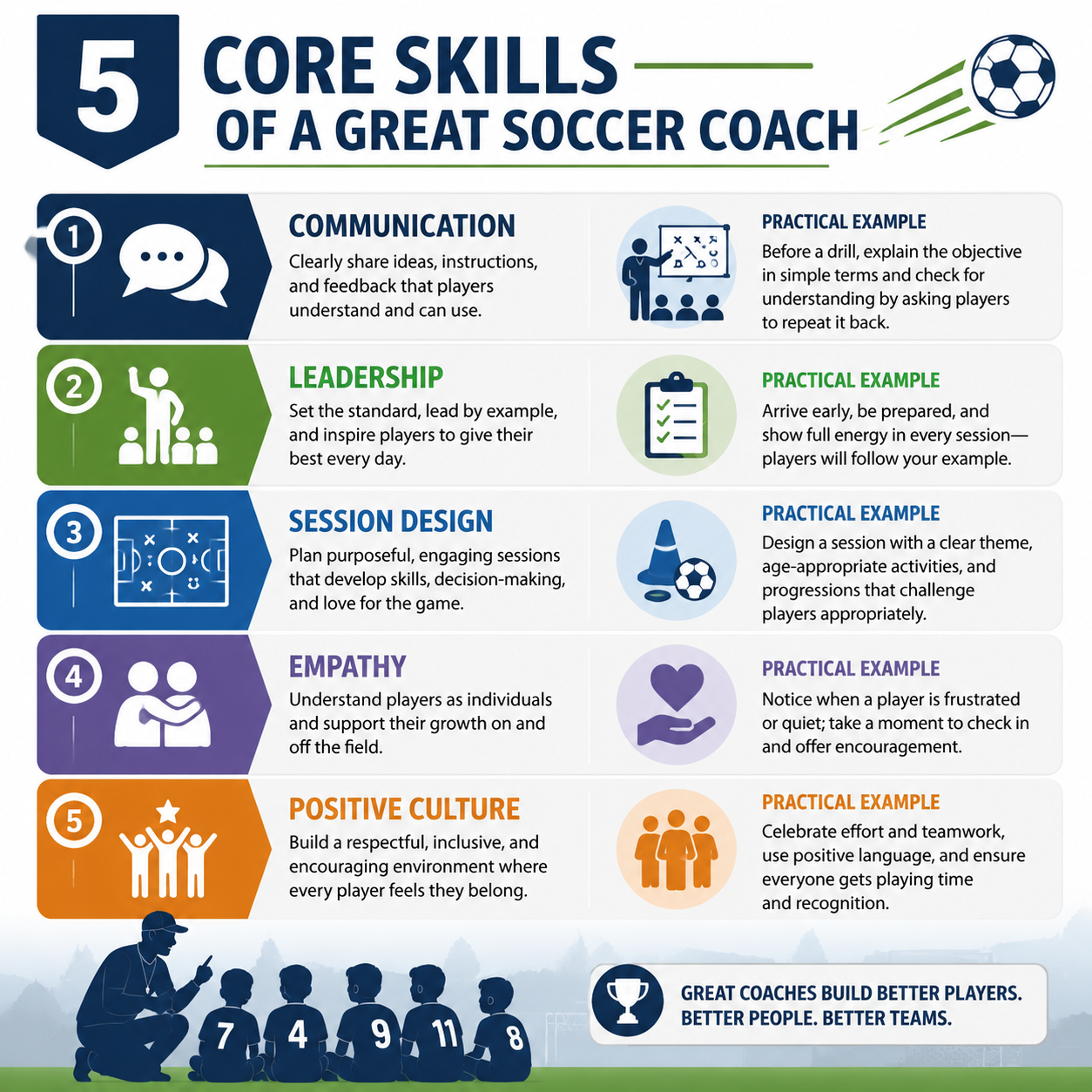
4. Empathy and Individual Approach
Not every player responds the same way to the same feedback. A confident 14-year-old can handle direct correction in front of the group. A nervous new player hearing the same correction in the same tone might shut down for the rest of the session. The skill is reading the individual and adjusting.
Practically: with players you don’t know yet, start with simpler tasks where they can succeed, give public praise for effort (not outcome), and save technical corrections for 1-on-1 moments or small groups. Trust builds before coaching lands.
5. Building a Positive Team Culture
Culture isn’t a speech. It’s the sum of small decisions made consistently over time. Praising effort publicly. Correcting errors privately. Not tolerating disrespect between teammates. Celebrating improvement, not just results.
In youth soccer specifically, the evidence on long-term player development is consistent: kids who enjoy training, feel safe making mistakes, and feel valued by their coach are far more likely to stay in the sport. A player-centered environment — where development comes before winning — produces better players and better people.
Note: Coaching practices in youth development involve pedagogical and child welfare considerations. The approaches described here reflect broadly accepted principles in youth sports coaching. For age-specific developmental guidance, consult qualified sports education professionals or your state association’s coaching education resources.
Where Can You Find Your First Coaching Position?
Your first coaching job almost certainly won’t come from a job board. It’ll come from showing up, getting known, and being in the right place when someone needs help. That said, there are specific channels worth working through systematically.
Local youth soccer club websites. City and county club sites often post assistant coach, age-group coach, and volunteer coach openings on their own “Jobs” or “Get Involved” pages. State youth soccer association websites (run through US Youth Soccer’s regional structure) also list openings. Start here. Search your state’s association site and the five largest clubs in your area.
School district HR portals. Middle school and high school head coach and assistant coach positions are posted on district HR/careers pages — not usually on national job boards. Set up a search alert for “soccer coach” on your district’s portal. High school assistant roles in particular are realistic first paid positions for coaches who’ve completed their Grassroots credentials.
Parks and recreation departments. Many city and county rec departments run youth soccer programs and hire seasonal coaches. These positions are typically part-time, often paid per session, and require minimal formal credentials beyond a background check and SafeSport certification.
Networking during licensing courses. This is underrated. Everyone in your D License cohort is active in the same local coaching market. Your course instructor knows every club director in the region. Introduce yourself, ask questions, exchange contact information. A casual conversation during an in-person course day has produced more first coaching jobs than any LinkedIn post.
LinkedIn and Indeed with targeted filters. Search “youth soccer coach,” “assistant soccer coach,” and “soccer trainer” with your metro area as a filter. Set up alerts. Most entry-level and volunteer roles aren’t heavily advertised, but some do appear on these platforms.
The most effective approach is parallel outreach: contact local clubs directly (email the director or technical director, not a generic info@ address), search school district boards weekly, and attend every licensing event in your area. Build the relationships before the opening exists, and you’ll hear about it first. Networking and relationship-building in local sports coaching markets consistently outperforms passive job searching at the entry level — a pattern well-documented in sports employment research and consistent with how most coaches describe finding their first role.
Realistic Pay and Weekly Time Commitments for Entry Roles
Understanding what entry-level coaching actually pays — and demands — helps you plan accordingly and set honest expectations.
Recreational youth club coach (volunteer or paid per session):
- Pay: $0 (volunteer) to $15–$40/session for rec programs
- Weekly hours in-season: 3–6 (1–2 practices + game)
- Weekly hours off-season: minimal
Club soccer assistant coach (competitive rec / developmental):
- Pay: $0–$25/hour depending on club and region
- Weekly hours in-season: 6–10 (2–3 sessions + games + communication)
- Weekly hours off-season: 2–5 (recruiting, planning, optional training)
High school assistant coach:
- Pay: Seasonal stipends typically range from $1,500–$4,000 depending on district, state, and sport budget
- Weekly hours in-season: 10–15 (daily practice + games + travel)
- Weekly hours off-season: minimal unless involved in offseason conditioning
High school head coach:
- Pay: Stipends typically $3,000–$8,000+ depending on district; sometimes combined with a teaching salary
- Weekly hours: 15–20+ in-season
Club DOC trajectory: A Director of Coaching role at a mid-size competitive club typically pays $40,000–$70,000+ annually in full-time capacity, but realistically requires several years of competitive coaching experience and a B or A License.
Note: Pay ranges vary significantly by region, club budget, and organization type. These figures are indicative. Negotiate based on local market conditions and always clarify hourly vs. salaried vs. stipend structures before accepting.
One practical note before you apply anywhere that works with minors: have your background check and SafeSport training completed. Clubs that can’t hire you on the spot because you’re waiting on a background check will move to the next candidate. Get it done early.
Checklist: First Coaching Job Readiness
Check off items as you complete them
Common Mistakes First-Year Coaches Make
Even coaches who prepare well tend to repeat a handful of predictable errors in their first season. Being aware of them in advance is half the fix.
- Overloading players with information. First-year coaches often correct everything they see, all at once. The result is players who are confused and hesitant. Choose one thing to work on per session and reinforce it throughout.
- Showing up without a written plan. Improvising on the fly almost always produces lower-quality sessions. Write your session plan before you arrive — objective, warm-up, main activity, small-sided game, cool-down. It takes 15 minutes and transforms the experience for your players.
- Letting parents run the sideline. Not setting clear expectations with parents early in the season leads to escalating sideline interference. Send a brief parent communication at the start of the season outlining your approach to playing time, game behavior, and how to raise concerns. Most parents respond positively to structure.
- Skipping reflection after sessions. The coaches who improve fastest spend 5–10 minutes after every session writing down what worked and what didn’t. Without that habit, you’re likely to repeat the same mistakes.
- Waiting until you feel “ready” to apply for roles. No first-year coach feels ready. The experience is what makes you ready. Complete the required credentials, get your compliance paperwork done, and start reaching out. Action produces confidence — not the other way around.
Frequently Asked Questions
Do you need to have played soccer professionally to be a good coach?
No — and the evidence from professional coaching careers makes this case better than any theoretical argument could.
José Mourinho never played at a notable professional level. He worked as a translator and assistant before building one of the most decorated head coaching careers in the history of the sport — multiple Champions League titles, Premier League, La Liga, Serie A, and Primeira Liga championships. He’s the most cited example in coaching education discussions of a coach who succeeded entirely on intellect, preparation, and man-management.
Arrigo Sacchi played regional amateur football in Italy and never reached the professional level. He went on to coach AC Milan to back-to-back European Cups (1989, 1990) and led Italy to the World Cup final in 1994. When critics questioned his authority given his playing background, his response became one of the most repeated lines in coaching: «I never realized that in order to become a jockey, you first had to have been a horse.»
André Villas-Boas had no professional playing career whatsoever. He studied coaching formally and began his career as a scout, eventually becoming one of the youngest head coaches in top European football and winning the UEFA Europa League with Porto in 2011.
The pattern is consistent. Playing experience gives you pattern recognition, physical intuition, and locker-room credibility — and those things are genuinely useful. But they’re not the only source of coaching knowledge, and they’re certainly not a prerequisite for success. The coaches who excel without elite playing backgrounds tend to compensate by being exceptional students of the game, meticulous session designers, and highly skilled communicators.
At the entry and intermediate levels — youth coaching, high school, college — playing background matters even less. What club directors at those levels actually evaluate is whether you can connect with players, organize a coherent session, and create an environment where kids want to come back next week.
Coaches who were average players and know it often become better teachers than elite players turned coaches. They’ve had to understand the game analytically rather than just feel it instinctively — and that analytical habit is exactly what you need when a 10-year-old asks you why they should position their body a certain way.
How long does it take to get a D License?
The D License course itself runs approximately nine weeks. But the total timeline from zero to D-licensed coach is longer than that, because you need to complete the prerequisites first.
Realistically: complete the free intro module (20 minutes), take two in-person Grassroots courses (these are offered periodically by state associations, so availability varies), then register for the D course when it opens in your area. Total time from start to finish — assuming you can find course dates that fit your schedule — is typically three to six months.
Can you coach your own child's team without a license?
In most recreational programs affiliated with AYSO or US Youth Soccer, parent volunteers can help as assistant coaches with minimal formal credentials — usually just a background check and SafeSport certification. However, serving as a head coach in an official capacity with a US Soccer-affiliated organization increasingly requires at least a Grassroots License.
Requirements vary by state association and organization. Check with your specific club or league. As a practical matter, completing the free intro module and at least one Grassroots course before stepping into any head coaching role is the right move — it protects you, protects the kids, and gives you actual tools to use.
What's the difference between a soccer coach and a club manager?
In the US context, these terms are often used differently than in European football. A coach — at any level from youth to professional — is primarily responsible for training sessions, match tactics, and player development. A club manager (or club director/technical director) typically handles broader organizational responsibilities: player recruitment, staff management, budget oversight, and program structure.
In European football (and particularly in England), “manager” historically meant the person who handled both team selection and club administration — the Fergie model. In the US, those functions are increasingly separated, especially at the professional level. An MLS head coach coaches; a sporting director or general manager handles the front office.
At the youth and amateur level in the US, these roles often overlap — many volunteer head coaches end up doing both jobs because the club doesn’t have dedicated administrative staff. As you move up, understanding both the coaching and organizational sides of how a club runs is genuinely valuable.
How much does it cost to get fully licensed, from Grassroots to Pro?
Adding up the published cost ranges across all levels:
- Grassroots modules: ~$100 total (four at $25 each)
- D License: $200–$500
- C License: $1,500–$2,000
- B License: $1,300–$3,000
- A License: $2,000–$3,500 (Youth) or $3,500 (Senior)
- Pro License: $10,000
Total from Grassroots to Pro: roughly $15,100–$19,100 at published course rates, spread across a career that would realistically take ten or more years to complete. Adding travel, lodging, compliance costs, and equipment over the full journey, the true investment is higher — see the Time and Budget Planning section above for scenario-based breakdowns.
The early licenses — everything through C — are accessible at a combined course cost of under $3,000, which puts a genuinely competitive youth coaching credential within reach for most people. Scholarships and club reimbursement can reduce that further.
Do I need a license to coach at all?
For volunteer or informal assistant roles at the recreational level, many organizations require only SafeSport training and a background check — not a formal USSF license. However, most clubs operating within the US Soccer affiliate structure will expect at minimum a Grassroots License for any head coaching role, even at the recreational level. At the competitive club level, a D License or higher is typically required.
The short answer: start the free online intro module now regardless, because it costs nothing and immediately strengthens any application you make.
What happens to my license if I stop coaching for a few years?
USSF licenses themselves don’t expire, but your SafeSport training and background check do require renewal — SafeSport annually, background checks every one to two years depending on organization. If you’ve been out of coaching for a period and want to return to competitive levels, you may need to demonstrate current coaching activity to meet application prerequisites for advanced courses. Contact the US Soccer Learning Center to confirm your status and any reinstatement requirements.
Can I coach in the US with a UEFA license?
Partially. Holders of UEFA B or A licenses may qualify for waivers for the USSF C or B License respectively, depending on their experience. The waiver process is handled through the host organization for the specific course — contact them directly with your credentials. Holders of the UEFA Pro License are not automatically eligible to coach in MLS; US Soccer requires them to also obtain the USSF Pro License. There is no automatic equivalency transfer at any level — each waiver is evaluated individually.
Are there scholarships for coaching licenses?
Yes, though availability varies. State associations frequently offer partial scholarships or reduced rates for D and C License candidates. US Soccer has run financial assistance initiatives for underrepresented groups in coaching. Some competitive clubs reimburse license costs as part of coaching agreements. The best approach: contact your state association’s coaching education director directly and ask what’s available before paying full price.
What does the D License specifically prepare you to do?
The D License focuses on coaching the U-6 to U-12 age groups in both small-sided and full-game formats. The course content is organized around what US Soccer calls the Six Tasks of a Coach — a framework covering session design, player communication, and game observation.
Practically, a D-licensed coach is equipped to run structured training sessions for youth recreational and entry-level competitive teams, use appropriate training methodologies for the developmental stage of the age group, and apply basic principles of player-centered coaching. It’s the credential that takes you from “helpful parent volunteer” to “qualified youth coach” — and it’s the foundation for everything that follows in the pathway.
→ Start your coaching journey at the US Soccer Learning Center — register for the free Introduction to Grassroots Coaching module, find in-person Grassroots courses in your state, and explore the full licensing pathway in one place.