Last updated: August 2026
Key Takeaways
- Don’t start by juggling. Start by catching — one touch up, catch it in your hands. Everyone who skips this stage spends weeks chasing a bouncing ball around a garden.
- Contact is on the laces, foot roughly flat, ankle locked. Toes send the ball spinning off sideways, which is why most beginners can’t get a second touch.
- Aim for waist height. Higher gives you time to panic; lower gives you no time at all.
- Juggling is not a match skill — nobody juggles in a game. What it builds is the soft first touch that decides everything else you do with the ball.
Almost everyone learns to juggle a soccer ball the same wrong way: they drop the ball, swing at it, watch it fly sideways into a fence, and repeat that for an hour. Progress is close to zero and it’s genuinely demoralising.
The fix is to stop trying to juggle at all for the first session. What follows is a progression that treats juggling as a series of small, achievable steps rather than one skill you either have or don’t.
«I’ve never once juggled the ball in a match, and I tell every player that honestly. But the kids who can do fifty are always the ones with the softest first touch — the two things are connected, even though one never shows up on a pitch.» — Anthony Molina, FOOTBOLNO.COM
Why Bother If It Never Happens in a Game?
Fair question, and the honest answer is that juggling is training, not a match skill.
What it actually develops:
A soft first touch. Juggling is a hundred repetitions of cushioning a falling ball. That’s exactly what you do when a pass arrives in the air.
Both feet. You can’t juggle for long one-footed, so it forces weak-foot use without you having to think about it.
Ankle control. The locked, flat ankle you need to juggle is the same one you need to strike a ball cleanly.
Concentration under repetition. Boring, but real.
What it doesn’t develop: anything tactical, and any ability to beat a defender. A player who can do two hundred juggles and can’t pass under pressure is not a good player. Keep it in proportion — juggling is a warm-up habit, not a training programme.
What You Need
A soccer ball and about two metres of space. That’s genuinely it.
One thing worth getting right: ball pressure and size. An over-inflated ball bounces off your foot unpredictably; a slightly soft one is much easier to control while learning. If you’re teaching a child, a size 3 or 4 makes a real difference — it’s the correct equipment for small feet, not a compromise. Our guide to what a soccer ball should weigh covers sizes by age.
Shoes matter less than people think, but bare feet on grass work surprisingly well for learning the touch.
The Contact Point
This is where most beginners go wrong, and fixing it changes everything.
Use your laces — the flat, hard part on top of your foot where the shoelaces sit. Not the toes.
Keep the foot flat, parallel to the ground at the moment of contact, with the ankle locked and rigid. A relaxed ankle sends the ball off at an angle.
Contact the underside of the soccer ball, in the middle. Off-centre contact adds spin, and a spinning ball is much harder to control on the next touch.
Keep the knee bent and lift from the knee, not from the hip. It’s a small controlled lift, not a kick.
If your ball keeps flying sideways, it’s almost always the toes or an unlocked ankle. Nothing else produces that particular failure.
The Progression That Actually Works
Each stage has a target. Don’t move on until you hit it comfortably — the whole point is that you’re never attempting something you can’t nearly do.
Stage 1: Drop and catch. Hold the soccer ball, drop it, let it bounce once, touch it up with your laces, catch it in your hands. Twenty times each foot. You’re learning contact, not juggling.
Stage 2: Drop and touch, no bounce. Same, but touch it before it hits the ground. Catch it after one touch. Twenty each foot.
Stage 3: Two touches. Touch, touch, catch. Same foot both times. Then alternating feet.
Stage 4: Five in a row. This is the first stage that feels like juggling. Expect it to take several sessions.
Stage 5: Ten in a row. Around here it stops being conscious and starts being rhythm.
Stage 6: Twenty-five, alternating feet. Alternating is harder than it sounds and it’s the stage most people skip. Don’t.
Stage 7: Fifty, then a hundred. At this point it’s stamina and concentration rather than technique.
Most people can reach stage 4 within a week of short daily practice. Stage 7 takes months. Both are normal.
Adding Thigh, Chest and Head
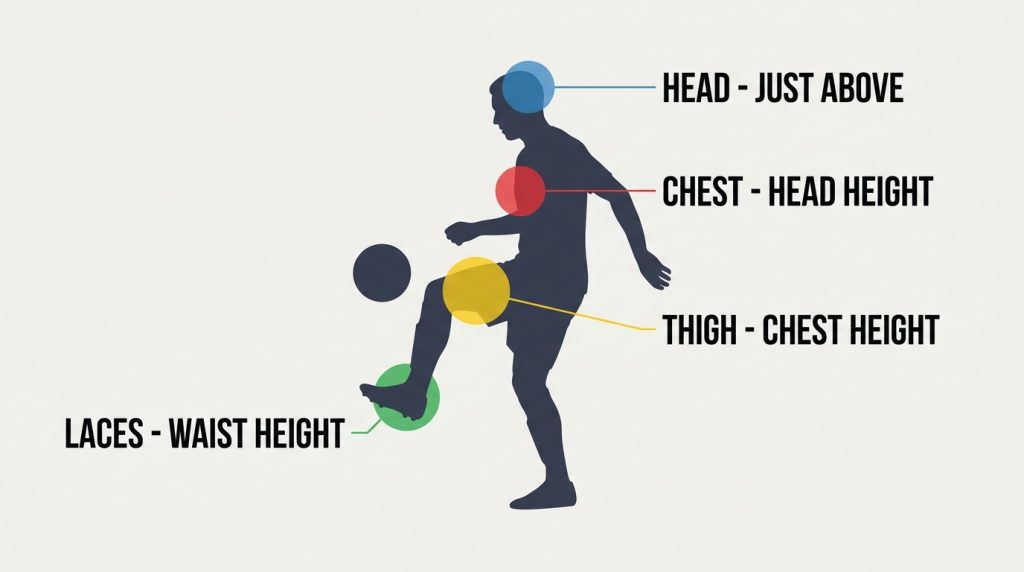
Once you’re comfortable with feet, the other surfaces open up — and they’re genuinely easier, which is why they’re worth adding early for motivation.
| Surface | Height to aim for | Notes |
|---|---|---|
| Laces | Waist | The default. Hardest and most useful |
| Thigh | Chest | Flat thigh, parallel to the ground. Much easier than the foot |
| Chest | Head | Lean back slightly, cushion rather than bounce |
| Head | Just above the head | Use the forehead, not the top of the skull. Eyes open |
A good intermediate target is foot–foot–thigh–foot–thigh in sequence. It sounds fancy and it’s easier than twenty-five straight foot juggles.
Mistakes That Keep People Stuck
Using the toes. Covered above and responsible for most of the frustration. The ball needs a flat surface.
Kicking instead of lifting. Juggling touches are small. If the ball goes above your head, you’ve kicked it and you now have a second problem — a falling ball with momentum.
Juggling too high. Waist height gives you a rhythm. Chest height gives you time to overthink and lets small errors compound.
Standing rigid. You should be moving constantly, adjusting a step at a time under the ball. Beginners plant their feet and wait for the ball to come back to exactly where it left.
Only using the strong foot. You’ll hit a ceiling around fifteen touches and stay there.
Practising in long sessions. Ten focused minutes daily beats an hour on Sunday. This is a coordination skill, and coordination consolidates between sessions rather than during them.
Comparing yourself to clips online. Freestylers train juggling as its own discipline for years. It has almost nothing to do with playing well.
Juggling Challenges Worth Trying
Once you can keep a soccer ball up for twenty touches, straight repetition gets dull fast. These variations keep it interesting and each one trains something specific.
Alternating feet only. No two touches with the same foot. Builds the weak foot faster than anything else here.
Around the world. Circle your leg around the soccer ball between touches. Pure showmanship, excellent for balance.
Sit-down juggle. Sit on the ground, keep the ball up with your feet. Removes your ability to move and forces precise contact.
Wall juggle. Juggle against a wall at chest height. Teaches you to control a ball arriving with pace rather than one you lifted yourself.
Sequence juggling. Foot, thigh, chest, head, back down. Harder than a hundred straight foot touches and far more useful.
Two-ball juggling. One soccer ball per foot. Genuinely difficult, and a good long-term target.
Timed juggling. Sixty seconds without dropping, counting nothing. Removes the number anxiety that makes people tense up.
Getting From Ten to a Hundred
The technique doesn’t change past ten touches. What changes is everything around it.
Breathe. People hold their breath while juggling and tire out at around twenty.
Look at the soccer ball, not your feet. Your feet know where they are. Watching the ball from the top of its arc gives you time to position.
Count out loud. It sounds silly and it keeps rhythm honest.
Accept the plateau. Nearly everyone sticks somewhere between fifteen and thirty for a while. It breaks on its own with continued practice.
Do it before every session. Two minutes of juggling as a warm-up is worth more than a monthly hour, and it doubles as a touch warm-up before dribbling work or shooting.
For a wider routine that mixes juggling with control and passing, the essential soccer ball drills guide puts it in context, and if you’re brand new, basic soccer skills is the place to start.
Teaching a Child to Juggle
Children learn this faster than adults, but they quit faster too if the first attempt is a failure.
Start at stage 1 and stay there longer than feels necessary. Catching is a win they can repeat. Chasing a loose ball is not.
Use a smaller, softer ball. A size 3 for under-8s, or even a lightweight training ball indoors.
Set targets they’ll actually hit. “Three in a row” beats “keep it up”. A target that’s reached produces another attempt; a vague one produces boredom.
Let them use the thigh early. It’s much easier than the foot and it keeps the ball alive, which keeps them interested.
Don’t correct more than one thing at a time. “Flat foot” this week. “Waist height” next week.
Common Questions
How long does it take to juggle a soccer ball ten times? With ten focused minutes a day, most beginners get there in one to three weeks. Reaching a hundred usually takes a few months. Both figures vary a lot with age and coordination.
Why does my ball spin off to the side? You’re contacting it with the toes or with an angled foot. Flatten the foot, lock the ankle, and hit the underside of the ball in the middle.
Should the ball bounce between touches when learning? Yes, at the very start. Letting it bounce once gives you time and makes the early stages achievable. Drop the bounce at stage 2.
Can I learn to juggle on concrete? You can, but the bounce is harder and less forgiving. Grass is better for learning. Concrete also wears the ball quickly.
Does juggling actually make you better at soccer? Indirectly. It builds a soft first touch, weak-foot comfort and ankle control, all of which matter in a match. It doesn’t build decision-making, and it isn’t a substitute for playing.
What’s a good number of juggles for my age? There’s no official standard, and chasing a number misses the point. As a rough guide, twenty-five alternating feet means your touch is solid enough that juggling has done its job.
Is it better to juggle with shoes or barefoot? Both work. Barefoot on grass gives you more feel and speeds up learning the contact point; shoes are what you’ll actually play in. Alternate.
Anthony Molina writes about soccer technique, gear and coaching at FOOTBOLNO.