Last updated: June 2026
«I’ve spent years watching footage of the best passers in the game — De Bruyne, Kroos, Xavi — and the one thing they all share isn’t technique. It’s the decision made before the ball even arrives. The pass type they choose tells you everything about how they read the game.» — Anthony Molina, FOOTBOLNO.COM
Passing is the language of soccer. Every goal, every dangerous chance, every spell of pressure starts with a pass. But when most people talk about “passing,” they’re thinking of one thing: kicking the ball to a teammate. The reality is far more layered than that.
There are short passes and long ones, ground passes and aerial deliveries, safe choices and high-risk creative flicks that can unlock a defense in a single movement. Each type does a specific job. Each one fits a specific moment. Knowing the difference — really knowing it — changes how you watch the game and how you play it.
So: how many types of passes are in soccer? Coaches and analysts categorize them differently, honestly. But in this guide, I’m breaking down 13 distinct pass types that cover everything from basic possession play to the most advanced techniques you’ll see at the highest level. I’ll explain what each one does, when to use it, and why it matters — with a full comparison table to start.
Note: The taxonomy of pass types varies across coaching traditions. The 13 types presented here represent a practical framework for players and analysts at all levels. Distance bands and technique cues are general guidelines, not universal standards.
| Pass Name | Category | Objetivo | Best Used When | Typical Distance | Difficulty |
|---|---|---|---|---|---|
| Short Pass | Ground | Maintain possession, build play | Tight spaces, under pressure | Up to 10 m | Beginner |
| Side-Foot Pass | Ground | Maximum accuracy on ground | Close range, controlled build-up | Up to 20 m | Beginner |
| Through Pass | Ground | Break defensive line | Runner moving into space | 10–30 m | Advanced |
| Back Pass | Ground | Reset, relieve pressure | No safe forward option | Variable | Beginner |
| Long Pass | Aerial | Switch play, launch attacks | Wide-open field, counterattack | 20–40+ m | Intermediate |
| Cross | Aerial | Deliver into penalty area | Wide position, teammates in box | 10–30 m | Intermediate |
| Lofted Pass | Aerial | Clear lines, switch flanks | Defender blocking direct path | 20–40 m | Intermediate |
| Chip Pass | Aerial | Lift ball over opponent | Goalkeeper off line, defender diving | 5–20 m | Advanced |
| Back-Heel Pass | Creative | Surprise, change direction | Tight space, marker on your back | Short | Advanced |
| Outside-Foot Pass | Creative | Disguise, unexpected angle | Defender anticipating inside ball | Variable | Advanced |
| No-Look Pass | Creative | Deceive defender, open passing lane | Defender watching your eyes | Variable | Advanced |
| One-Touch Pass | Creative | Speed up play, break press | Quick combinations, high press | Variable | Advanced |
| Flick Pass | Creative | Redirect ball in tight space | First-touch redirect under pressure | Short | Advanced |
| Cross-Field Pass | Aerial | Switch point of attack | Ball on one side, space on the other | 30–50 m | Intermediate |
📋 Key Takeaways
- Understanding the three pass categories — ground, aerial, creative — helps you read team tactics and pick the right delivery in any situation.
- Ground passes (short, side-foot, through, back) are the backbone of ball control and build-up, especially effective in tight spaces.
- Aerial passes (long, cross, chip, lofted) let you shift the point of attack and bypass defensive lines — they demand clean technique from both passer and receiver.
- Creative passes (back-heel, no-look, outside-foot) are for unexpected solutions and disorienting the opponent, but they require a high level of skill to execute reliably.
- The through pass is the primary tool for splitting a compact defense — it demands precise timing and a clear read of the runner’s trajectory to create genuine scoring chances.
The 3 Core Categories of Soccer Passes: Ground, Aerial, and Creative
There are 13 pass types worth knowing. Trying to memorize all 13 at once, though, is the wrong approach. A better starting point is understanding that every pass in soccer belongs to one of three core categories — and each category serves a completely different purpose.
«A pass can be classified by distance: short (up to 10 m), medium (10–20 m), and long (over 20 m).» — РФЛ Арена
Ground passes keep the ball rolling along the surface. They’re the backbone of possession soccer, build-up play, and any style that prioritizes control over chaos. When you watch a team comfortably moving the ball around the back under pressure, those are all ground passes. Reliable, easier to execute accurately, and the foundation of combination play.
Aerial and lofted passes travel through the air — bypassing defenders by going over them. Long switches of play, driven crosses into the box, delicate chip passes over a rushing goalkeeper. They cover more distance, carry more risk, and demand better technique from both the passer and the receiver. But when they work, they can change the entire structure of a game in a single moment.
Creative and skill passes sit in their own category because what defines them isn’t trajectory or distance — it’s disguise and unpredictability. A back-heel, a no-look pass, a trivela with the outside of the boot. These aren’t used to simply move the ball; they’re used to make defenders look completely wrong-footed. The risk is high. The reward can be decisive.
Here’s the useful thing about this framework: the three categories roughly map to the different phases of soccer. Ground passes dominate the build-up. Aerial passes feature in transitions and final-third delivery. Creative passes appear in the moments when standard options are blocked and a team needs something the opponent hasn’t prepared for.
Knowing which category a pass belongs to tells you more about a team’s tactics than any formation ever could.
The sections below break down each category in detail — starting with the passes every player learns first and finishing with the ones that take years to master.
Ground Passes: The Foundation of Possession and Build-Up Play
Ground passes are exactly what they sound like: passes that stay on the turf from the moment of contact. They’re the most common passes in soccer at every level, from youth academies to the Champions League final. And they’re the most common for a reason — when executed well, they’re the safest and most controllable way to move the ball. Understanding player positioning helps clarify which roles rely on ground passes most heavily across different phases of play.
The technique guidance in this section is intended for general educational purposes and does not replace instruction from a qualified soccer coach.
«Short passes (up to 10 meters) are used for ball control, maintaining possession, and creating combinations.» — ФК «МИТОС»
Four types of ground passes are essential to understand.
Short Pass
The short pass covers roughly up to 10 meters. It’s the core unit of possession soccer — the building block of every tiki-taka combination and the most-used tool in any team’s arsenal. Short passes are specifically designed for controlling the ball in tight spaces, escaping pressure, and maintaining possession during the build-up phase, a principle consistently applied across modern coaching frameworks at every level of the game.
When you watch Barcelona moving the ball through their own half with ease, or the USMNT building from the back in a World Cup qualifier, those quick, compact exchanges are short passes doing exactly what they’re supposed to do. The goal isn’t to go forward — it’s to maintain control until the right moment to progress appears.
Technique matters here. Short passes are most effective when played firmly enough to reach the teammate cleanly, but not so hard that they require complicated control. Weight of pass is everything at close range.
- Use when: You’re under pressure in your own half, space ahead is blocked, or you need to recycle possession safely.
- Avoid when: The receiver is tightly marked with no turn available and a longer option is free.
Side-Foot Pass
The side-foot pass is widely regarded as the most precise pass in soccer. You execute it with the inside of the foot — the flat, broad surface between the heel and the toes — which gives you maximum contact area with the ball and, therefore, maximum control over direction. It’s the technique coaches teach first, and it’s the technique elite players still use most often.
What makes the side-foot pass different from a generic “short pass” is the deliberate emphasis on accuracy over power. You’re trading pace for control. The result is a pass that arrives exactly where you intended, at the right height, at a manageable pace for your teammate. This is the most common technique for precise short and medium ground passes — and it forms the technical foundation of combination play from the back across all modern playing styles.
From experience watching youth players develop, those who commit to the side-foot pass early — even when they feel like lashing the ball — develop cleaner combination habits faster than those who default to striking with their laces.
- Use when: Accuracy is paramount, the receiver is in a clean position, and power is secondary.
- Common mistake: Planting the supporting foot too far from the ball, causing the pass to lack direction.
Through Pass
The through pass is where ground passing stops being about maintenance and starts being about penetration. This is the pass that cuts through a defensive line — played into the space behind defenders for a teammate running onto it. The tactical purpose is specific: to break the defensive shape and create a one-on-one situation or a direct shot on goal.
«A penetrating pass (through ball) is a pass through the defensive line — the primary way to create a one-on-one opportunity.» — Tiu.ru
It’s the pass that requires the most vision to execute, because you’re not passing to where your teammate is — you’re passing to where they’re going to be. Timing, weight, and reading of the defender’s position all have to align. One fraction too slow and the defender intercepts. One fraction too hard and the ball runs through to the goalkeeper. But when it works — when De Bruyne threads one between two central defenders at full speed — there’s nothing more effective in the game.
- Use when: A teammate is making a run in behind and the defensive line is high or stepping up.
- Avoid when: The runner hasn’t yet committed to the run — a through pass to a static player is just a gift to the goalkeeper.
Back Pass
The back pass gets underestimated by players who think soccer only flows forward. It doesn’t. A well-timed back pass is one of the most tactically intelligent plays available to any outfield player.
The purpose is to keep possession, relieve pressure, and reset the attack. When there’s no safe forward option, when the press is closing, when the team needs a moment to reorganize — the back pass is the solution. It functions as a control-and-rest tool: it lets the team breathe, repositions players into better positions, and maintains the ball without taking unnecessary risks. Teams that use the back pass well — and Spain’s national team is the classic reference point — can dictate tempo almost entirely through this single decision. Slow it down when ahead, play backward to invite the press, then switch quickly.
- Use when: The press is closing rapidly, no forward or wide option is safe, and the goalkeeper or a recovering teammate is available.
- Rule note: Under FIFA Laws of the Game, a goalkeeper cannot handle a back pass deliberately played to them with the foot — doing so results in an indirect free kick. This rule applies at all levels.
Checklist: Ground passing fundamentals — key checks before each type of pass (Short, Side-foot, Through, Back)
Check off items as you complete them
Aerial & Lofted Passes: How to Bypass Defenders and Switch Play
Ground passes give you control. Aerial passes give you range. The moment a team lifts the ball off the ground intentionally — with purpose, not desperation — they’re using a different tool entirely, one designed to skip over defensive lines and cover distances that no ground pass can efficiently manage.
Five aerial pass types define this category.
Long Pass
A long pass typically covers 20 meters or more, often 30–40 meters in match situations.
«Long passes (over 20 meters) are used to move the ball to the other half, start an attack, or create danger near the goal.» — ФК «МИТОС»
Its primary tactical purposes are to switch the point of attack, launch a counterattack, or deliver the ball to a forward in a single movement that bypasses the midfield entirely. The ball progresses quickly and creates sharp moments in front of the opponent’s goal — the core objective of the long pass in any direct-play system.
The technique requires a different foot contact point than the side-foot pass. For most long passes, players strike through the lower half of the ball with the instep, generating both distance and loft. Understanding soccer ball weight is relevant here — the ball’s mass directly affects the force and follow-through required to achieve distance and arc accurately. The accuracy demands are higher because the target is further away, and the consequences of a misplaced long ball are worse: you hand possession to the opponent with no pressure nearby.
Long passing is directly associated with direct-play styles, where the objective is to bypass the press quickly and put the ball in front of the striker. But even possession-based teams use long passes selectively, particularly for diagonal switches to isolate a winger.
- Use when: The opponent’s midfield is compact and bypassing it with a single ball is more efficient than working through it.
- Common mistake: Striking the middle of the ball rather than underneath it, producing a flat drive instead of a useful aerial delivery.
Cross
A cross is a specific type of aerial pass delivered from a wide position into the penalty area for a teammate to attack. The emphasis is on timing and delivery accuracy rather than pure distance — a cross from the byline into the six-yard box is shorter than many long passes, but its purpose is completely different: to create a finishing opportunity from a direct delivery.
Crosses vary by height (low driven crosses vs. high lofted deliveries), by curve (inswinging vs. outswinging), and by target zone (near post, far post, cutback). Each variation creates a different type of chance. A goalkeeper can command a high, floating cross. A driven low ball through the six-yard box is much harder to defend — which is why you see elite fullbacks like Trent Alexander-Arnold consistently targeting that delivery zone.
- Use when: Teammates are making runs into the box and defenders are ball-watching or flat-footed.
- Avoid when: The box is overloaded with defenders and no runner has separation.
Lofted Pass
The lofted pass is a high-arc aerial delivery, typically used over a medium-to-long distance to change the angle of attack or deliver the ball over the top of a defensive line.
«A lofted (high) pass travels in a high arc — ideal for switching the ball to the other flank or lobbing it behind defenders.» — Tiu.ru
Unlike a cross, a lofted pass isn’t necessarily directed into the penalty area — it can be used to switch flanks, drop the ball into a wide channel, or find a target man making a run in behind. The key technical element is the follow-through. A proper lofted pass requires the player to strike underneath the ball cleanly and follow through upward, generating the arc that gives the ball its trajectory. Drop the follow-through and the ball stays flat; you wanted a lofted delivery but you’ve played a low liner into the defender’s legs.
- Use when: A direct ground route is blocked but space exists behind or wide of the defensive line.
- Common mistake: Leaning back too far, causing the ball to balloon too high and lose accuracy.
Chip Pass
The chip is a specific aerial pass where the ball is gently lifted over an opponent — a defender, a goalkeeper, or a pressing player — at close range. It’s different from a lofted pass in that the motion is shorter and sharper: the player jabs under the ball with a stabbing motion, creating immediate lift with minimal follow-through.
The chip is most famous as a finishing technique (think lobbing a stranded goalkeeper), but it functions as a genuine pass in situations where a defender is diving in or blocking the direct path. A chip over an outstretched leg into the path of a striker’s run is a legitimate option in the right situation.
«When you get the ball with a defender behind you and a teammate ahead of their line, sometimes the right pass isn’t along the ground. It’s the one that goes over them.» — Anthony Molina, FOOTBOLNO.COM
- Use when: A defender or goalkeeper has committed to a block and space exists behind them at close range.
- Avoid when: Distance is too great — a chip loses pace quickly and becomes easy to track.
Cross-Field Pass
The cross-field pass is a long, switching delivery — typically 30–50 meters — played from one side of the field to the opposite flank. Its sole tactical purpose is to shift the point of attack entirely, exploiting the space that opens up on the weak side when the defense has condensed around the ball.
Where the long pass is often vertical (up the channel or over the top), the cross-field pass is diagonal — it changes the angle of play rather than simply advancing the ball. You’ll see it frequently from central midfielders and center-backs who spot an isolated winger on the far side while the ball is under pressure near the opposite touchline. Technically, it demands the same instep contact and clean follow-through as the long pass, but the angle of the body and the direction of the follow-through shift to generate the diagonal trajectory. An inaccurate cross-field pass doesn’t just miss its target — it travels straight to an opponent on the other side of the field with no defensive cover behind it.
- Use when: The ball is pinned on one side, the defense has shifted to cover, and a winger is free on the opposite flank.
- Common mistake: Underhitting the pass — a cross-field ball that dies in the center of the pitch is easy to intercept.

Creative & Skill Passes: When to Use Flair to Unlock a Defense
Reliability is valuable. Creativity is devastating. The creative pass category exists for the situations where standard options are covered, the defense has adapted, and you need something they haven’t prepared for. These are the passes that make highlight reels — but that description undersells them. They’re tactical tools, not showboating.
When every conventional passing lane is closed, a creative pass isn’t a gamble — it’s the logical solution. The demand is both technical and psychological: the player must have the confidence to attempt an unconventional delivery under pressure and the spatial awareness to execute it accurately without conventional visual confirmation.
«Creative passes are not just for show — they are tactical solutions when conventional options are blocked, demanding both vision and confidence.» — Anthony Molina, FOOTBOLNO.COM
Five pass types define this category.
Back-Heel Pass
The back-heel is executed by striking the ball with the heel of the boot. The player plants the supporting foot alongside the ball, then drives the heel through contact — often in a direction completely opposite to where they appeared to be moving. The core tactical advantage is complete unpredictability for the opponent: the direction of delivery is entirely concealed until the moment of contact, making it nearly impossible to intercept by reading body shape alone.
When is it justified? When you have a marker tight on your back, the defender is committing to one side, and a teammate is already positioned to receive in the opposite direction. The back-heel skips the turn entirely and delivers the ball to where you needed it without telegraphing the move. The risk is real — if the receiving teammate isn’t ready, the ball goes to no one. So this only makes sense when the combination is pre-read and the teammate is already open and expecting contact.
Roberto Carlos used it to devastating effect in combination play. Zlatan Ibrahimović built entire move sequences around it. In MLS, you’ll see it occasionally from technically gifted attacking midfielders in tight spaces around the penalty area.
- Use when: A teammate is already positioned behind you and turning to play forward would be too slow.
- Avoid when: The receiving teammate hasn’t signaled awareness — a back-heel to a distracted player is simply a turnover.
Outside-Foot Pass (Trivela)
The outside-foot pass — often called the trivela in the Portuguese tradition — uses the outside of the boot to strike the ball. This generates natural curve in the opposite direction from an inside-foot pass, which is exactly what makes it so difficult to defend against.
If a right-footed player hits a trivela, the ball naturally curves from left to right as it travels. A defender expecting the ball to go one way gets beaten by the ball going the other. This disguise is the core tactical advantage — the pass arrives from an angle the defender wasn’t protecting. In terms of execution, it requires confident technique: striking with the outside of the boot limits your contact surface, so accuracy demands practice. Elite playmakers use it regularly when they’ve identified that an inside delivery is covered and the outside angle is open.
- Use when: The inside delivery is clearly covered and a curved outside ball reaches the same target from a less-defended angle.
- Common mistake: Making contact too close to the toes rather than across the outer laces, causing the ball to skew wide.
No-Look Pass
The no-look pass is exactly what it sounds like: the player’s eyes face one direction while the ball goes another. The tactical logic is simple and effective — defenders read the passer’s eyes. If you eliminate that information by looking away from your intended target, you force the defender to process multiple possibilities simultaneously, creating the fraction of a second that opens the passing lane.
De Bruyne executes no-look passes to an elite standard. He’ll fix his eyes on one side of the penalty area while playing a first-time ball to the other, leaving the covering midfielder completely wrong-sided. It’s not done for aesthetics — it’s done because the situation demands it. If the defender is reacting to his eyes, the no-look pass is the tactically correct choice.
The risk is higher than any other pass type because you’re operating without your own visual confirmation of the target. It only makes sense when you’ve already mapped the position of the receiver before looking away — and you have the spatial awareness to hold that information accurately while executing under pressure.
- Use when: The defender is clearly tracking your eyes and one look away from the target is enough to open the lane.
- Avoid when: The receiver’s position is uncertain — spatial confidence is the prerequisite, not the bonus.
One-Touch Pass
The one-touch pass — playing the ball immediately on receipt, without a controlling touch — is the ultimate tempo weapon. Its purpose is to eliminate the time between receiving and releasing the ball, making the team’s circulation so fast that the opposition press can’t close down before the ball moves on.
Tiki-taka soccer is built on one-touch combinations. The individual technique is actually simpler than a through pass or trivela — you’re directing a ball that’s already moving. But the cognitive demand is enormous: you have to decide where the ball is going before it arrives. The best one-touch passers are already processing their next action while the ball is still in flight toward them.
Working with youth players who can execute technically clean one-touch passes in training but freeze in game situations reveals the core challenge clearly: the physical execution is straightforward. The anticipation and decision-making is where one-touch passing separates elite players from average ones.
- Use when: The press is closing and a second touch would cost possession; the receiving teammate is already in a clean position.
- Common mistake: Committing to the one-touch before scanning — executing without a plan produces random redirection, not combination play.
Flick Pass
The flick pass is a short, redirecting touch — typically a first-touch flick that changes the direction of the ball without a full controlling motion. Where a standard pass begins with the player in possession, the flick pass uses the momentum of a ball arriving at the player to redirect it to a teammate in a new direction, often before the defender can react to the change of angle.
The most common execution uses the outside of the foot or the heel to deflect a moving ball into a new lane. The motion is minimal — a slight angling of the foot or body at the moment of contact. The effect is to serve as a one-touch relay that reshapes the angle of attack instantly. You’ll see it most often in tight midfield areas, in combination play around the edge of the penalty area, and in situations where two attackers are combining against a single recovering defender. Technically gifted players in the mold of Iniesta or David Silva used the flick pass as a regular tool for third-man combination play — the ball arrives, the flick redirects it, and a third player is already running onto the redirected ball before the defense can reorganize.
- Use when: A ball is arriving at a useful pace and a small angle change is enough to reach a free teammate.
- Avoid when: The ball is arriving slowly or awkwardly — a flick pass requires pace in the incoming ball to work as a deflection tool.
Glossary: Key Terms and Common Confusions
Different coaching traditions and broadcast cultures use different names for the same passes. Here are the most common overlaps and distinctions worth knowing.
Chip vs. Lofted Pass vs. Lob
All three travel through the air, but the mechanics differ. A chip uses a short jabbing motion to lift the ball immediately over a close obstacle — the contact is sharp and the follow-through is minimal. A lofted pass uses a full follow-through to generate a higher, longer arc over a greater distance. A lob is typically used as a synonym for the chip in a finishing context (lobbing the goalkeeper), but in passing contexts it can mean any high, arcing delivery. When in doubt: chip = short, immediate lift; lofted = longer, higher arc.
Long Pass vs. Cross-Field Pass
A long pass primarily advances the ball vertically — up the pitch toward goal or into the channel. A cross-field pass is a diagonal or lateral switch — it changes the side of the field rather than advancing play up the pitch. Both cover similar distances, but their purpose and direction differ fundamentally.
Through Pass vs. Slide-Rule Pass
These terms are used interchangeably in most contexts. A through pass is the standard coaching term for any ball played into space behind the defensive line. A slide-rule pass is a descriptive broadcasting term for a particularly well-weighted through ball — one so precisely measured it appears to have been placed with a precision instrument. All slide-rule passes are through passes; not all through passes earn the “slide-rule” description.
Switch vs. Cross-Field Pass
A switch is a tactical concept — changing the side of attack. A cross-field pass is the delivery mechanism most commonly used to execute a switch. You switch the play using a cross-field pass.
How Passing Defines a Team’s Identity: Tiki-Taka vs. Direct Play
A team doesn’t just pick passes at random during a match. Over time, patterns emerge — patterns that reflect a coherent philosophy about how the game should be played. The passes a team relies on most heavily become their identity. Two styles illustrate this contrast most clearly.
Tiki-Taka: Possession as a Weapon
Tiki-taka is the most influential passing philosophy in modern soccer. Developed systematically by Johan Cruyff at Barcelona and brought to its peak by Pep Guardiola’s Barcelona squads of 2008–2012 — and the Spanish national team that won the 2010 World Cup — it’s built on a specific philosophy: retain the ball so completely that the opponent never gets a chance to build their own attacks.
The dominant pass types in tiki-taka are the short pass, the side-foot pass, the one-touch pass, and the through pass. Crosses and long balls are used sparingly. The geometry of the system is built on triangles and diamonds — player positioning that always gives the ball carrier at least two short-pass options, so the ball can circulate under pressure without stopping.
This isn’t just about aesthetics. The tactical logic is sound: a team with the ball can’t concede. By making every player a passing option and maintaining those triangles across the pitch, tiki-taka teams create a system where losing the ball is close to impossible under normal circumstances. The occasional vertical through pass serves as the transition from circulation to penetration — the moment the defense shifts out of position and a gap opens.
The player profile required is equally specific. Tiki-taka demands technical precision under pressure, the ability to play one-touch, and constant repositioning to maintain triangle geometry. Xavi Hernández, Andrés Iniesta, and David Silva were the archetypes — not physically dominant, but technically perfect and perpetually moving to create angles.
Direct Play: Efficiency Over Elegance
Direct play sits at the opposite end of the philosophy spectrum. Where tiki-taka measures success in pass sequences and possession percentages, direct play measures success in shots, transitions, and goals. The objective isn’t to control the ball — it’s to get the ball forward as quickly as possible.
The dominant pass types in direct play are the long pass, the lofted pass, the cross, and the cross-field pass. A team playing a direct style will accept lower possession numbers if it means their striker gets more touches in the penalty area. The iconic visual is a central defender playing a 35-meter ball over the defensive line to a striker making a run in behind — the midfield bypassed entirely. Direct play passes typically cover 30–40 meters and are specifically designed to advance quickly and create sharp moments in front of goal.
Teams using this approach typically have a physically imposing striker — a target man who can hold the ball, win aerial duels, and bring teammates into play — because the long ball requires a reliable endpoint. Classic examples include England’s traditional style, Stoke City under Tony Pulis, and certain Bundesliga sides that prioritize transition speed over sustained possession. In MLS, you’ll see elements of direct play from teams built around physically dominant forwards who can exploit space behind a high defensive line.
Which Style Is Actually Better?
Neither. That’s the honest answer. The effectiveness of any passing style depends on the players available, the opponent’s defensive setup, and the game situation.
Tiki-taka becomes vulnerable when pressed aggressively by a high-energy team — the 2012 Chelsea Champions League semi-final against Barcelona demonstrated that a well-organized low block can neutralize possession-based play. Direct play becomes predictable when defenders are positioned to deal with the aerial threat, leaving the striker isolated with no second-ball support.
The most successful modern teams are tactically hybrid — they can circulate through short passes in build-up, switch play with a long diagonal or cross-field ball, and then exploit the final third with creative and one-touch combinations. Guardiola’s Manchester City sides after 2018 moved well beyond pure tiki-taka; they combined short passing spells with diagonal switches and vertical through balls in a single possession sequence.
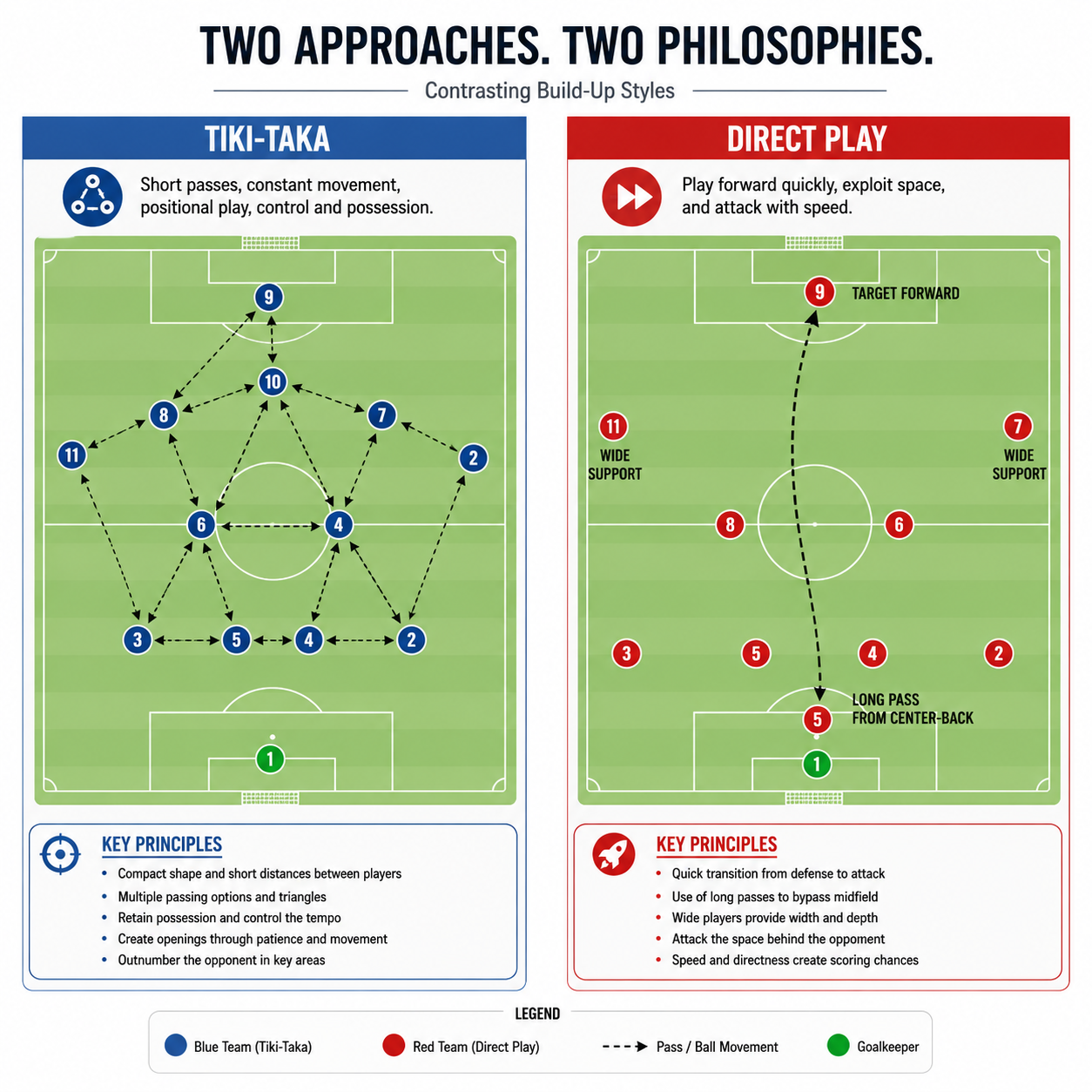
The key takeaway is this: passing style is a choice made by the coach and players about how they want to attack and how they want to press. Understanding the full range of pass types available — from the simple side-foot to the no-look — is what gives a team the range to execute whichever style suits the moment.
When watching a football match, which primary passing style do you find most captivating and enjoyable?
Select your answer
Frequently Asked Questions
What does passing mean in soccer?
Passing in soccer means deliberately moving the ball from one player to another using the foot, head, or any other legal body part. It’s the primary method of advancing play, maintaining possession, and creating scoring opportunities. A pass can be a simple two-meter side-foot exchange or a 40-meter aerial diagonal — what defines it is the intent to connect with a teammate rather than shoot or carry the ball.
How many types of passes are in soccer?
There’s no single official taxonomy, which is why you’ll find different numbers across coaching resources. At the broadest level, coaches classify passes by distance (short, medium, long), by trajectory (ground, aerial), by direction (vertical, diagonal, lateral), or by technique (inside-foot, outside-foot, lofted). This guide covers 13 distinct pass types that capture all the meaningful variations you’ll encounter at any level of the game, from youth soccer to the professional level.
What is a lofted pass in soccer?
A lofted pass is an aerial delivery where the ball travels in a high arc from passer to target. It’s used to bypass defenders who are blocking the direct ground path, to switch the ball from one flank to the other over distance, or to drop the ball behind the defensive line for a striker making a run. The technique involves striking underneath the ball with a clean follow-through upward. It’s distinct from a chip pass, which is a shorter, sharper jab motion used to lift the ball over an immediate obstacle at close range, and distinct from a lob, which is typically used as a synonym for the chip in finishing contexts.
What is the first pass in soccer — where does it all start?
The first pass in a move typically starts from the goalkeeper or the center-backs during build-up play from the back. Modern soccer increasingly begins with the goalkeeper distributing to a central defender, who then connects to the midfield through short ground passes. This is the foundation of build-up play, and it’s where teams signal their entire philosophy — a goalkeeper who plays to the center-backs is in a possession-based system; one who launches long balls directly forward is in a direct play system. Understanding soccer positions and their roles helps clarify why different positions use different pass types at each phase of play.
What is the difference between a through pass and a regular forward pass?
A regular forward pass moves the ball to a teammate in front of you, typically to their feet. A through pass moves the ball into the space behind the defensive line for a teammate to run onto — the target is a zone on the field, not a stationary player. The through pass requires the passer to predict the defender’s position, the runner’s trajectory, and the ideal weight of the pass simultaneously. It’s more difficult than any standard forward pass and carries higher risk, but it’s also the primary tool for splitting a compact defense and creating one-on-one situations with the goalkeeper.
What is the difference between a cross-field pass and a long pass?
A long pass primarily advances the ball up the pitch — toward the opponent’s goal or into a forward channel. A cross-field pass is a diagonal or lateral switch designed to move the ball from one flank to the other. Both cover similar distances (typically 30–50 meters), but their direction and purpose differ fundamentally. A cross-field pass exploits space on the weak side of the defense; a long pass exploits space in behind or above it.
What is the figure 8 soccer passing drill and why is it used?
The figure 8 passing drill is a structured training exercise where players move the ball in a figure-eight pattern between cones or teammates, practicing both the short pass and the movement off the ball that follows. It’s used because it simultaneously trains passing technique and the positioning habits that make combination play work in a match. The drill reinforces the principle that good passing isn’t just about the ball — it’s about where you move after you pass. Coaches working toward building a structured soccer program often use figure 8 drills as a warm-up progression for one-touch and combination passing sessions.
What is tiki-taka and which pass types define it?
Tiki-taka is a possession-based playing philosophy centered on maintaining the ball through rapid short passing and constant player movement. It was developed systematically at FC Barcelona under Johan Cruyff’s influence and brought to its peak by Pep Guardiola’s Barcelona sides between 2008 and 2012. The pass types that define tiki-taka are the short pass, the side-foot pass, the one-touch pass, and — at the key moment of penetration — the through pass. Long balls and aerial deliveries are used sparingly. The geometric structure of the system relies on players maintaining triangles and diamonds so the ball carrier always has at least two safe short options, making it structurally very difficult to press effectively against.
Key Takeaways
- 13 pass types, 3 categories: Ground passes (short, side-foot, through, back) dominate build-up and possession. Aerial passes (long, cross, lofted, chip, cross-field) cover range and bypass defensive lines. Creative passes (back-heel, trivela, no-look, one-touch, flick) exploit unpredictability when conventional options are closed.
- Distance bands matter: Short = up to 10 m; medium = 10–20 m; long = 20+ m. Cross-field passes typically cover 30–50 m diagonally across the pitch.
- The back-pass rule: A goalkeeper cannot legally handle a deliberate back pass played with the foot — an indirect free kick is awarded. Relevant at all levels.
- Style dictates frequency: Tiki-taka leans on short, side-foot, and one-touch passes. Direct play relies on long passes, crosses, and cross-field balls. Hybrid modern teams combine all three categories within a single possession sequence.
- Decision-making is the skill: Every pass type has a correct moment. Knowing the technique is necessary; knowing when to apply it under pressure is what separates functional passing from intelligent passing.
Passing is the one skill that every player on the pitch shares equally. The goalkeeper uses it. The center-back uses it. The striker uses it — even if just to lay the ball off and spin in behind. The 13 types covered in this guide represent the full range of what’s available in any given moment: from the simple, reliable side-foot pass to the high-risk, high-reward no-look that bypasses the press entirely.
The players who understand all 13 — who know which tool fits which situation — don’t just play soccer better. They read the game differently. They see the through pass before the ball arrives. They recognize the moment the outside-foot pass is the right call because every defender is positioned for the inside delivery. That decision-making, made in fractions of a second, is what separates functional passing from genuinely intelligent passing.
The types are the vocabulary. Decision-making is the language.