Last updated: August 2026
Key Takeaways
- A standard track is 400 m in lane 1, measured 30 cm out from the inside kerb. It is not 400 m in any other lane.
- The shape is fixed: two straights of 84.39 m and two bends built to a radius of 36.50 m.
- Lane 8 is 453 m — over 50 m further every lap than lane 1, and more than 200 m over four laps.
- Four laps is 1,600 m, not a mile. A mile is 1,609.34 m, so you finish about 9 m short.
Almost every athletics track in the world encloses a football pitch, and almost every runner using one has the same two questions: how far is one lap, and does it matter which lane I am in. The answers are 400 metres and yes, considerably.
All the figures below come from the IAAF/World Athletics facilities manual marking plan for a 400 m standard track.
«Everybody knows a lap is 400 metres. Almost nobody knows that only applies to the inside lane, which is why the guy doing his intervals in lane six is running further than he thinks and pacing off the wrong number.» — Anthony Molina, FOOTBOLNO.COM
The Official Geometry
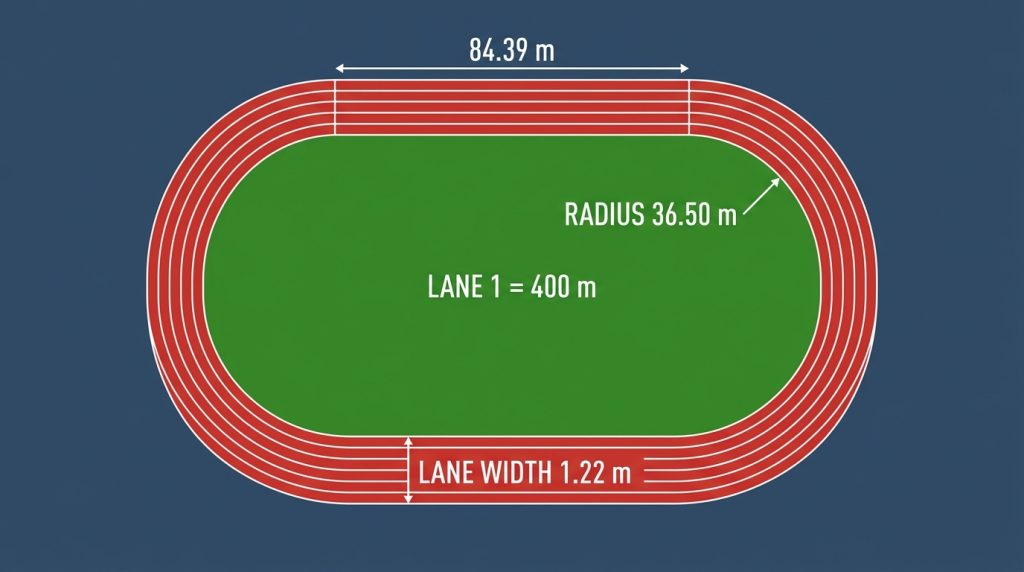
A standard 400 m track is not an approximation. Every dimension is specified.
| Element | Dimension |
|---|---|
| Length of each straight | 84.390 m |
| Construction radius of each bend (including the raised kerb) | 36.500 m |
| Radius of the measurement line in lane 1 (0.30 m outside the kerb) | 36.800 m |
| Lane width (including the 0.05 m line on the outside) | 1.220 m ± 0.01 m |
| Typical number of lanes | 8 |
Two lengths follow from those numbers, and the difference between them is the whole reason the measurement line exists:
- Inner edge of the track: 36.50 × 2 × π + 84.39 × 2 = 398.116 m
- Measurement line in lane 1: 36.80 × 2 × π + 84.39 × 2 = 400.001 m
You do not run on the kerb. You run about 30 cm outside it, and that 30 cm is worth nearly two metres a lap.
Distance by Lane
Only lane 1 is 400 m. Every lane outside it is longer, and the increments are not uniform.
| Lane | Distance per lap |
|---|---|
| 1 | 400.00 m |
| 2 | 407.04 m |
| 3 | 414.70 m |
| 4 | 422.37 m |
| 5 | 430.03 m |
| 6 | 437.70 m |
| 7 | 445.37 m |
| 8 | 453.03 m |
The reason lane 2 adds only 7.04 m while every lane after it adds 7.67 m is the measurement convention. Lane 1 is measured 30 cm outside the kerb, but lanes 2 to 8 are measured 20 cm from the inside line of the lane. That 10 cm difference makes the first step out cheaper than the rest.
You will find tables online that apply 7.67 m uniformly and give lane 2 as 407.67 m. They have applied the lane 3 to 8 rule to lane 2.
Laps, Miles and Kilometres
The arithmetic most runners actually want, all in lane 1:
| Distance | Laps in lane 1 |
|---|---|
| 400 m | 1 |
| 800 m | 2 |
| 1,000 m | 2.5 |
| 1 mile (1,609.34 m) | 4.02 |
| 1,600 m | 4 |
| 5 km | 12.5 |
| 10 km | 25 |
Four laps is not a mile. It is 1,600 m, which leaves you 9.34 m short — a little over the width of the straight. On a proper track there is a separate mile start line about nine metres behind the 1,600 m line for exactly this reason.
In lane 8, four laps is 1,812 m, more than 200 m further than four laps in lane 1. If you are running intervals off a stopwatch, that difference is the whole session.
Does a Full-Size Pitch Fit Inside?
Yes, but only just — and the maths is worth doing because it explains why so many track-and-field stadiums have slightly small pitches.
The infield is bounded by the inner edge of the track: a rectangle 84.39 m long flanked by two half-circles of radius 36.50 m. That gives a maximum width across the middle of 73 m and a maximum length of 157.39 m.
Take a full-size pitch of 105 × 68 m, the standard for international matches, and place it centrally. The corner of the pitch sits 52.5 m from the centre along the length and 34 m across. That corner falls inside the bend, and measuring from the centre of the bend’s circle it comes out at about 35.5 m — just inside the 36.50 m radius.
So a 105 × 68 m pitch geometrically fits, with roughly a metre of clearance at the corners and no run-off behind the goals worth mentioning. In practice stadiums with tracks usually run slightly narrower pitches, because the Laws allow the width to drop to 64 m for international matches and 45 m otherwise, and every metre saved becomes space for the athletics infield events. The full range of legal pitch sizes is in our penalty box and pitch dimensions guide.
How Many Laps of the Pitch Itself?
Different question, and one people ask when there is no track at all.
A pitch of 105 × 68 m has a perimeter of 346 m. So:
- One lap of the pitch: 346 m
- 1 km: about 2.9 laps
- 1 mile: about 4.65 laps
- 5 km: about 14.5 laps
Because pitch sizes vary — anywhere from 90 × 45 m to 120 × 90 m under the Laws — this is always an estimate unless you measure the one you are running on. Pace off one length and one width, add them, and double it.
Why 400 m, and Why That Shape
The dimensions are not arbitrary. The IAAF’s own facilities manual sets out why the 400 m standard track won: it is simple to build, its straight and curved sections are of almost equal length, and its uniform bends suit the running rhythm of athletes. Just as importantly, the area inside the track is large enough for the field events — and, as it happens, for a soccer field.
That last point is why the two sports ended up sharing venues in the first place. An oval sized for running produces an infield the size of a football pitch almost by accident, and municipal sports grounds all over the world were built on exactly that coincidence.
The equal-length principle is visible in the numbers. Each straight is 84.39 m and each bend, measured along the lane 1 line, is 115.61 m — so the two straights together make 168.78 m of the lap and the two bends make 231.22 m. Not equal, but close enough that a runner’s rhythm does not have to change every few seconds.
Running on a Track That Has a Soccer Field in It
The practical points, in the order they cause arguments:
Lane 1 is for the fastest runners and for timed efforts. If you are jogging, warming down or walking, use an outside lane. This is the near-universal etiquette at every track in the world and the one rule that matters.
Check whether the pitch is in use. A soccer field inside a track is usually booked separately, and a match or training session does not stop you running — but balls will arrive in lane 1 without warning, and it is your responsibility to look.
Run counter-clockwise unless told otherwise. Competitive athletics runs counter-clockwise, and mixing directions on a busy track is how collisions happen.
Do not do interval work in lane 8 and pace it off 400 m. Lane 8 is 453 m. Your splits will be 13 per cent slower than they look, and you will conclude you are unfit rather than that you are in the wrong lane.
Measuring an Oval Nobody Can Tell You About
Plenty of school and park tracks around a soccer field are not any standard length at all. Three ways to find out, in order of reliability:
Look for the markings. A properly built track has a start line and distance marks. If it says 100 m at the end of the straight and the straight looks about the length of a pitch, it is probably standard.
Use a GPS watch over several laps. One lap is within the error margin of most watches. Ten laps divided by ten is not.
Pace it out. A comfortable adult stride is roughly 0.75 m. Count paces for a full lap, multiply, and accept an error of a few per cent — enough to tell a 400 m track from a 300 m one.
Other Track Sizes You Will Meet
Not every oval is 400 m.
300 m tracks appear at high schools and smaller colleges. They need about 20 per cent less space than a 400 m track, and four laps is 1,200 m rather than 1,600 m.
200 m indoor tracks are the standard for indoor athletics, usually with six lanes, and lane widths from 0.90 m to 1.22 m. Eight laps to 1,600 m.
Unbanked park loops and school ovals are frequently not any standard distance at all. If nobody can tell you the length, measure it with a GPS watch over several laps rather than assuming.
Common Questions
How long is a running track around a soccer field? 400 metres in lane 1, the inside lane. The straights are 84.39 m each and the bends are built to a radius of 36.50 m.
Is every lane 400 m? No. Lane 1 is 400 m, lane 2 is 407.04 m and lane 8 is 453.03 m. Each lane from the third outwards adds 7.67 m.
How many laps is a mile? About 4.02 laps in lane 1. Four laps is 1,600 m, which is 9.34 m short of a mile.
How many laps is 5 km? 12.5 laps in lane 1.
Why is lane 1 measured 30 cm from the kerb? Because runners cannot run on the kerb itself. The measurement line represents the shortest realistic path, and at 30 cm out it comes to 400.001 m.
How wide is a running lane? 1.22 m, plus or minus a centimetre, including the 5 cm line on its outside.
Does a full-size football pitch fit inside a 400 m track? Just about. A 105 × 68 m pitch fits within the 73 m width and 157 m length of the infield, with around a metre of clearance at the corners and effectively no run-off.
How many laps of a soccer pitch make a mile? Roughly 4.65 laps of a 105 × 68 m pitch, whose perimeter is 346 m. Measure your own pitch if you want the real number.
Anthony Molina writes about soccer technique, gear and coaching at FOOTBOLNO.