Last updated: August 2026
Key Takeaways
- Everything below needs a ball and a flat surface. No cones, no rebounder, no partner, no goal.
- Space is not the limiting factor. Eleven of the fifteen drills fit in an area about the size of a car parking space.
- Do fifteen to twenty minutes, four or five times a week rather than an hour on Sunday. Touch is built by frequency.
- If you have a wall you can use, your options roughly double — a wall is the single most valuable thing in home training.
The reason most home training fails is not lack of equipment. It is that people do ten minutes of keepy-uppies, get bored, and stop. Everything here has a target you can measure, which is what turns practice into something you will actually repeat.
You need a ball. If you have a wall, a fence or a garage door you are allowed to kick, say so and skip to the wall section — those drills are worth more than the rest combined.
«Twenty minutes a day beats two hours on Saturday every single time. Ball skill is a habit, and habits are built by turning up, not by long sessions.» — Anthony Molina, FOOTBOLNO.COM
Close Control: Five Drills in a Space Two Metres Square
These need almost nothing. A patch of flat ground, a ball, and enough room to take two steps.
1. Toe taps. Tap the top of the ball alternately with the sole of each foot, staying on your toes. Thirty seconds, rest, repeat five times. Builds the light, quick feet everything else depends on.
2. Sole rolls. Roll the ball side to side with the sole of one foot, then switch. Fifty each foot. Trains the sole touch that futsal and tight-space play run on.
3. Foundations (inside-inside). Push the ball between the insides of your feet, keeping it in front of you. Aim for a hundred contacts without the ball escaping. This is the single best drill on the list for anyone under fourteen.
4. V-pulls. Pull the ball back with the sole, then push it diagonally forward with the inside of the same foot, making a V shape. Twenty each foot. It is the movement behind most turns.
5. Sole-to-sole taps. Tap the ball from one sole to the other, sideways, without letting it run away. Thirty seconds. Harder than it sounds and brilliant for balance.
How long: five to eight minutes total. These are a warm-up as much as a drill.
Wall Work: Four Drills Worth More Than Everything Else
If you have a wall you can kick against, this is where your time should go. A wall is a partner who never misses a pass and never gets tired.
6. Two-touch passing. Pass against the wall, control with one touch, pass back with the second. Fifty repetitions each foot. The whole value is in that first touch.
7. One-touch returns. Same drill, first time. Forces you to angle the receiving surface rather than stop the ball dead.
8. Alternate feet. Control with the right, pass with the left, then reverse. The fastest route to a usable weak foot that exists.
9. Directional first touch. Mark two spots roughly a metre either side of you — a shoe, a chalk line, anything. Control the rebound so the ball finishes on a spot, alternating left and right. This is the drill that separates a first touch that stops the ball from one that creates the next pass.
How long: ten minutes, and it is the most productive ten minutes in home training. The full technique behind it is in our guide to ball control drills.
Juggling: Three Progressions
Juggling gets mocked as a party trick and it is the highest-volume touch training available with no equipment. A hundred juggles is a hundred cushioned contacts.
10. Bounce juggling. Let the ball bounce between every touch. This is where beginners should start, and there is no shame in it.
11. Continuous juggling. No bounce. Count your record and try to beat it once a week rather than every session.
12. Pattern juggling. Right, left, right, left. Then thigh, foot, thigh, foot. Patterns are harder than free juggling and transfer better, because matches do not let you choose which surface receives the ball.
How long: five minutes, every session. If juggling is genuinely new to you, our guide to juggling a soccer ball breaks the first hundred down properly.
Movement and Fitness: Three With and Without the Ball
You cannot replicate match fitness in a garden, but you can build the two qualities that decay fastest: change of direction and repeated sprint ability.
13. Shuttle turns. Mark two points about eight to ten paces apart. Dribble to one, turn with the sole, dribble back. Six repetitions, thirty seconds rest, four sets. Add a different turn each set — inside hook, outside hook, drag back, Cruyff.
14. Ball-less shuttles. The same distance without the ball, sprinting. Ten repetitions with twenty seconds rest. Unglamorous and the closest thing to match conditioning you can do alone.
15. Wall-pass and sprint. Pass against the wall, sprint away five paces, sprint back, control the return. Combines the touch and the running. Twelve repetitions.
How long: eight to ten minutes. Do these last — they compromise touch quality if done first.
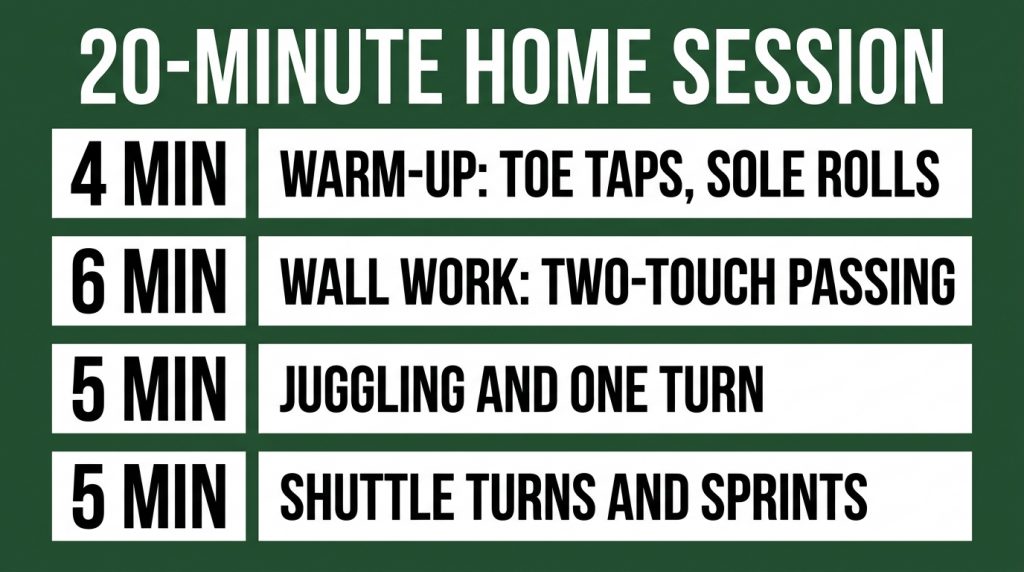
A 20-Minute Session You Can Repeat
| Block | Time | What |
|---|---|---|
| Warm-up | 4 min | Toe taps, sole rolls, foundations |
| Touch | 6 min | Wall work: two-touch, one-touch, alternate feet |
| Skill | 5 min | Juggling, plus one turn practised deliberately |
| Movimento | 5 min | Shuttle turns, then ball-less shuttles |
That is the whole programme. Four or five times a week beats any longer session done occasionally.
How to Make a Drill Get Harder
The reason home soccer training plateaus is that people repeat the same drill at the same difficulty for months. A drill you can already do is a warm-up, not training. There are four ways to make any of the fifteen above harder without buying anything.
Add speed. Do the same number of contacts in less time. Foundations at a hundred contacts is a starting point; a hundred contacts in sixty seconds is training.
Take the eyes off the ball. Look up at a fixed point on the wall or fence while doing toe taps, sole rolls or foundations. Every soccer skill is worth more when performed with the head up, and this is the only way to build it alone.
Force the weak foot. Do the whole session left-footed once a week. It will be bad, which is exactly the point.
Add a constraint. One touch instead of two. No sole. Ball must finish on a specific spot. Constraints do in five minutes what unstructured repetition does in thirty.
Track one number per session — juggles, consecutive wall passes, contacts in a minute — and write it somewhere. Not because the number matters, but because a number you can see is the difference between a habit that lasts three weeks and one that lasts a year.
Two Mistakes That Waste the Session
Practising what you are already good at. It feels productive and changes nothing. If your right foot is fine and your left is not, the session should be uncomfortable most of the time.
Going too fast too early. Speed built on a sloppy technique just makes the sloppiness permanent. Slow and clean, then quick and clean. Every soccer coach says it and almost nobody training alone listens.
Working in Very Small Spaces
A hallway or a room: stick to drills 1 to 5 and pattern juggling. Use a slightly deflated ball or a size 3 to keep it quiet and controllable, and accept that this is touch work only.
A driveway or car park space: everything except the shuttles. Hard surfaces are excellent for sole work and hard on the ball, so use an old one.
A garden with a wall: the full session. This is the best setup most people can get.
A garden without a wall: substitute the wall drills with throw-and-cushion — throw the ball up, control it with thigh or chest, settle it with the foot, repeat. Twenty each surface.
What Not to Bother With
Some popular home drills are close to worthless, and cutting them frees up time.
Shooting at a wall for power. You cannot judge accuracy without a target and you will annoy everyone within fifty metres. Practise striking technique where there is a goal.
Long passing in a garden. There is not enough distance for the ball flight to mean anything.
Endless freestyle tricks. Around-the-worlds and crossovers are fun and do very little for match play. Ten minutes of foundations beats an hour of tricks.
Heading against a wall. Repeated heading of a ball for practice is discouraged for young players, and there is no version of it in a garden that helps.
Making It Work for a Child
Ten minutes, not thirty. Concentration runs out long before enthusiasm does, and a session that ends while they still want more is a session they will ask to repeat.
Count something. Foundations, juggles, consecutive wall passes — a number to beat turns repetition into a game.
Use a smaller, lighter ball. A size 3 makes cushioning genuinely easier for small feet, and success keeps them going.
Let them show you. The demonstration at the end of the session is half the motivation.
Do not correct everything. One coaching point per session. The rest can wait.
How Long Before It Shows
Wall work produces a visible change in first touch after about two weeks of ten-minute sessions. Foundations and sole work take three to four weeks to feel natural. Juggling numbers climb fastest of all, which is exactly why it is a good motivator.
What home training cannot give you is decision-making under pressure. That only comes from playing, which is why this should sit alongside games rather than replace them — the full picture of what to work on is in essential soccer ball drills and, for the moves themselves, how to dribble a soccer ball.
Common Questions
Can you improve at soccer training alone at home? Yes, for technique. Touch, control, juggling and turns all improve alone. Decision-making and positioning do not — those need games.
What soccer drills can I do at home without equipment? Toe taps, sole rolls, foundations, V-pulls, juggling and, if you have a wall, two-touch and one-touch passing. All you need is a ball.
How long should a home session be? Fifteen to twenty minutes, four or five times a week. Frequency matters far more than session length for ball skill.
What is the single best drill with no equipment? Two-touch wall work if you have a wall. Foundations if you do not.
Do I need cones? No. Shoes, water bottles, chalk marks or nothing at all work fine. Cones make drills tidier, not better.
How much space do I really need? About the size of a parking space for most of it. Touch drills need two metres square.
Will this make me match fit? No. Shuttles help maintain change of direction and repeated sprint ability, but match fitness needs matches.
What about practising against a garage door? Fine if the door can take it and the noise is acceptable, but check both before you start. A solid wall is better for a consistent rebound.
Anthony Molina writes about soccer technique, gear and coaching at FOOTBOLNO.