Last updated: July 2026
«I’ve seen players freeze at the penalty spot in training — not because they don’t know how to shoot, but because nobody ever explained to them what the rule actually says. Once you understand the exact law behind it, everything from the distance to the goalkeeper’s position starts making sense.» — Anthony Molina, FOOTBOLNO.COM
Penalty kicks are one of the most dramatic moments in soccer. The stadium goes quiet, 22 players hold their breath, and one person stands 12 yards from goal with nothing between them and glory except a goalkeeper. But what exactly is a penalty kick, and why does it get awarded in the first place?
If you’ve ever watched a match and wondered why the referee pointed to that spot — or why the crowd erupted — this guide breaks it all down. We’re covering the official definition, the exact distance, how the procedure works, how it differs from a free kick, and when penalty shootouts come into play. All of it is based on the current IFAB Laws of the Game for 2025–2026.
Let’s get into it.
📋 Key Takeaways
- A penalty kick is awarded for a direct free kick offence committed by a defending player inside their own penalty area while the ball is in play.
- The penalty spot sits exactly 11 meters (12 yards) from the goal line — that distance hasn’t changed in over a century.
- The goalkeeper must keep at least part of one foot on or behind the goal line at the moment the ball is kicked.
- All other players must be outside the penalty area and at least 9.15 m from the penalty mark before the kick is taken.
- Procedure violations — wrong goalkeeper position, encroachment — can lead to a retake or a disallowed goal.
What is a Penalty Kick and When Is It Awarded?
A penalty kick (PK) is a direct shot on goal from the penalty mark, awarded when a player commits a foul inside their own penalty area while the ball is in play. That’s the short version. The fuller picture is a bit more specific, and knowing the details matters.
«A penalty kick is awarded if a player commits a direct free kick offence inside their penalty area or off the field as part of play as outlined in Laws 12 and 13.» — IFAB, Law 14: The Penalty Kick, Laws of the Game 2024–2025 cycle
The key phrase there is direct free kick offence. Not every foul inside the box earns a penalty. Only fouls that would normally result in a direct free kick — if committed outside the area — trigger a PK. Indirect offenses don’t count.
What fouls qualify?
According to IFAB Law 12 (Fouls and Misconduct), the following direct free kick offenses, when committed by a defending player inside their own penalty area, result in a penalty kick:
- Kicking or attempting to kick an opponent
- Tripping or attempting to trip an opponent
- Jumping at an opponent
- Charging an opponent
- Striking or attempting to strike an opponent
- Pushing an opponent
- Holding an opponent
- Impeding an opponent with contact
- Biting or spitting at someone
- Handling the ball deliberately (this one generates a lot of controversy)
That’s a broad list. Practically, most penalties come down to three situations: a defender trips an attacker running toward goal, a defender handles the ball inside the box, or a goalkeeper brings down a player clean through on goal.
One important distinction: the goalkeeper has a separate set of restrictions around handling. They can’t hold the ball for more than six seconds, or touch it after a deliberate back-pass from a teammate. But these violations result in an indirect free kick — not a penalty.
«Direct and indirect free kicks and penalty kicks can only be awarded for offences committed when the ball is in play.» — IFAB, Law 12: Fouls and Misconduct, Laws of the Game 2024–2025 cycle
This matters in practice. If the whistle has already blown and a defender shoves someone — no penalty. The ball has to be live.
Why does the referee point to the spot?
The referee’s job is to judge whether the foul meets three criteria: direct free kick offense, inside the penalty area, ball in play. When all three boxes are checked, they point to the penalty mark. Simple in theory. In practice, it’s one of the most scrutinized calls in the sport — and VAR has made these decisions even more contested.
From what I’ve seen at all levels of the game, the hardest calls aren’t the obvious ones. It’s the handball in the wall, or the attacker who goes down after minimal contact. Those are the moments where knowing the exact law text helps you understand why the referee did what they did. A particularly contentious area is handball: Law 12 distinguishes between a deliberate handling offence and accidental contact, taking into account factors like the position of the arm and whether it made the body unnaturally bigger. Not every ball-to-hand incident inside the box results in a penalty — context matters.
Note: The information in this section reflects the IFAB Laws of the Game as of the 2025–2026 cycle. Individual competitions and national associations may apply additional guidelines or interpretations. Rules are reviewed annually by IFAB.
How Is a Penalty Kick Taken? The Official Procedure
Here’s something that surprises people: there’s more to taking a penalty than just walking up and shooting. IFAB Law 14 lays out a precise procedure, and violations of that procedure can result in the kick being retaken or even overturned.
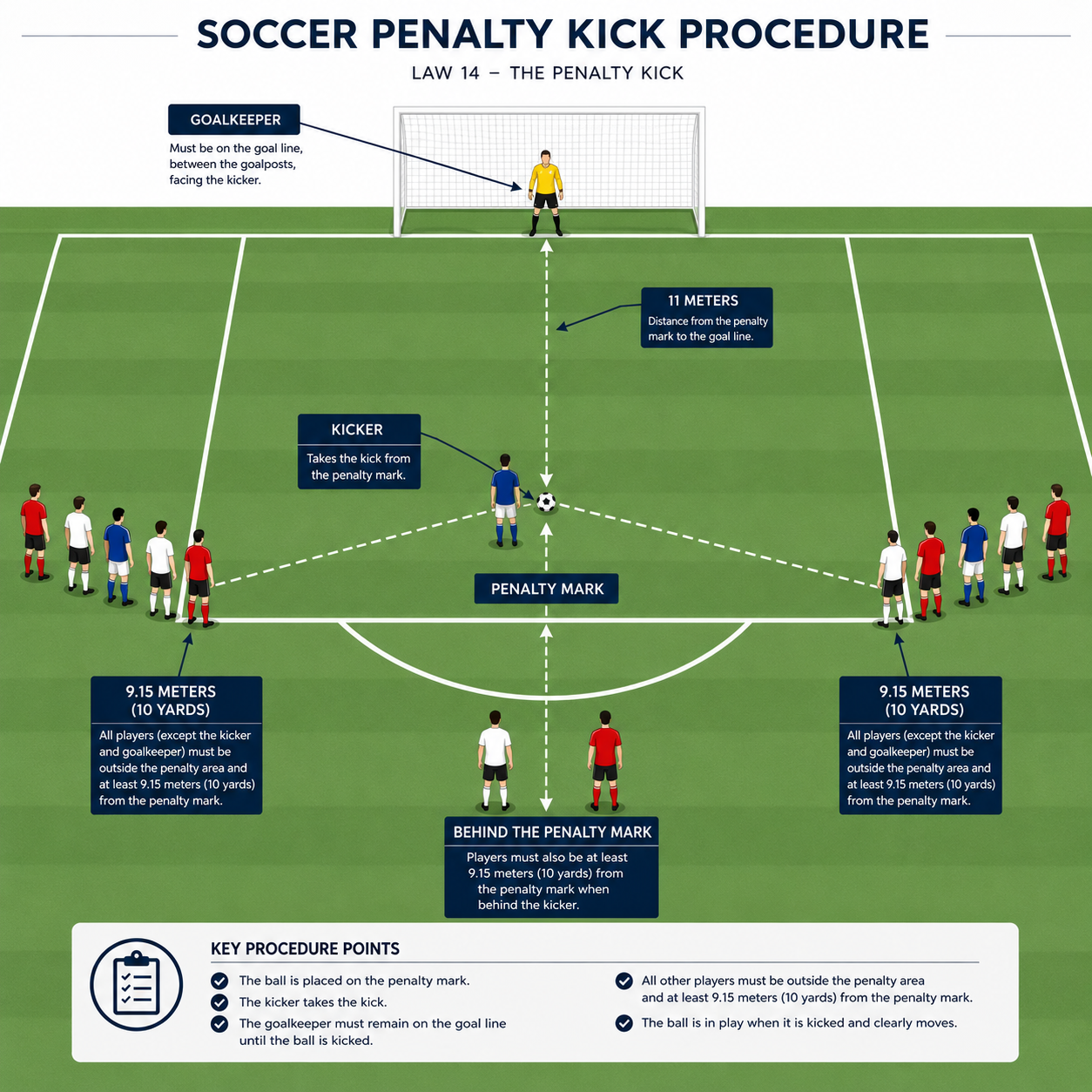
Let’s walk through what has to happen, in order.
Step 1: Ball placement. The ball must be stationary, with part of it touching or overhanging the center of the penalty mark. The goalposts, crossbar, and net must not be moving. A windy day doesn’t change this requirement — if the ball rolls off the spot before the kick is taken, it has to be reset.
Step 2: Identify the kicker. The player taking the kick must be clearly identified to the referee before the kick is taken. You can’t have ambiguity about who’s stepping up.
Step 3: Position the goalkeeper. The defending goalkeeper must stand on the goal line, facing the kicker, between the posts. They cannot touch the posts, crossbar, or net before the kick. And critically — they must have at least part of one foot touching, in line with, or behind the goal line at the moment the ball is kicked.
«The defending goalkeeper must have at least part of one foot touching, in line with, or behind the goal line at the moment the ball is kicked.» — IFAB, Law 14: The Penalty Kick, Laws of the Game 2024–2025 cycle
This rule was tightened in 2019 and remains in effect through the 2025–2026 laws.
Step 4: Everyone else gets out of the way. All other players — from both teams — must be inside the field of play, outside the penalty area, behind the penalty mark, and at least 9.15 m (10 yards) from the penalty mark.
«All players other than the kicker and goalkeeper must be at least 9.15 m (10 yds) from the penalty mark, behind the mark, inside the field, and outside the penalty area.» — IFAB, Law 14: The Penalty Kick, Laws of the Game 2024–2025 cycle
That last point is why you see that arc — «the D» — at the top of the penalty area. It isn’t part of the penalty box. It’s the visual boundary marking the 9.15-meter exclusion zone from the spot.
Step 5: The referee signals. Once everyone is in position, the referee gives the signal to kick. The kick must then be taken.
Step 6: The kick itself. The ball must be kicked forward. Back-heeling is technically allowed — as long as the ball moves forward on first contact. You can’t roll it backward from the spot.
Step 7: Ball in play. The ball is in play the moment it is kicked and clearly moves. From that point, the kicker cannot touch it again until another player touches it first. If they do, an indirect free kick is awarded to the defending team.
A note on feinting: a kicker is permitted to feint during their run-up as a legitimate way to deceive the goalkeeper. Once the run-up is completed, though, feinting at the point of the kick — «illegal feinting» in IFAB language — is a different matter. In a standard penalty kick, illegal feinting results in the kick being retaken and the kicker receiving a yellow card. In a penalty shootout, the kick is recorded as missed and the kicker is cautioned.
The 2025 update on double-touch
This is worth knowing. As of procedures effective from July 1, 2025, there is a specific rule for accidental double-touch during a penalty kick. If the kicker accidentally kicks the ball with both feet simultaneously, or the ball immediately touches their non-kicking leg after contact:
«If a kicker accidentally touches the ball twice and scores, the kick is retaken; if no goal is scored, an indirect free kick is awarded. In shootouts, the kick is recorded as missed.» — IFAB, Circular 31, 2025
That’s a nuance most casual fans don’t know — and it matters differently depending on whether it’s an in-game penalty or a shootout situation.
What if someone encroaches?
Encroachment — moving into a restricted zone before the kick — triggers specific, carefully defined outcomes depending on who encroaches and what happens with the kick. Here is the complete outcome matrix based on Law 14:
| Who Encroaches | Kick Scored | Kick Missed or Saved |
|---|---|---|
| Defending player (incl. goalkeeper) | Goal stands | Kick retaken |
| Attacking player (incl. kicker’s teammate) | Goal disallowed; indirect free kick to defending team | Kick stands (no advantage gained) |
| Both teams simultaneously | Kick retaken (unless a more serious offence, e.g. illegal feinting, occurred) | Kick retaken |
The goalkeeper receives a warning for the first encroachment offense in the match and a yellow card for any subsequent one.
The Penalty Spot: Exact Distance in Yards and Meters
The penalty spot is located exactly 11 meters (12 yards) from the midpoint between the goalposts, measured to the center of the penalty mark.
«Within each penalty area, a penalty mark is made 11 m (12 yds) from the midpoint between the goalposts and equidistant from them.» — IFAB, Laws of the Game (Law 1: The Field of Play), 2024–2025 cycle
That measurement hasn’t changed in decades, and the 2025–2026 revision didn’t touch it. If you ever hear «the 12-yard spot» or «the 11-meter mark,» they’re referring to the same thing.
To put it in perspective: the average adult can cover 12 yards in about 2–3 seconds at a full sprint — though this varies significantly by fitness level and conditions. The goalkeeper, starting from the goal line, has roughly 0.2–0.3 seconds to react to a well-struck penalty. Research published in the Journal of Sports Sciences (Lees & Owens, 2011) found that elite goalkeepers typically begin their lateral movement before the ball is struck, meaning positional reading is more decisive than pure reaction time. Those numbers help explain why the scoring rate on penalties is so high at elite levels — typically around 75–80%, according to data tracked by Opta Sports.
| Measurement | Metric | Imperial |
|---|---|---|
| Penalty spot to goal line | 11 m | 12 yd |
| Minimum distance for other players | 9.15 m | 10 yd |
| Goal width (for reference) | 7.32 m | 8 yd |
| Goal height (for reference) | 2.44 m | 8 ft |
Penalty Kick vs. Free Kick: What’s the Key Difference?
Both a penalty kick and a free kick follow a foul. Both give the attacking team a chance to play the ball uncontested. But they’re fundamentally different restarts — and knowing the distinction helps you read the game more clearly.
The simplest version: where the foul happens determines which restart you get. Foul inside the penalty area = penalty kick. Foul outside the penalty area = free kick.
The differences go deeper than location, though.
| Criteri | Penalty Kick | Free Kick |
|---|---|---|
| Location of Foul | Inside the defending team’s penalty area | Outside the penalty area |
| Spot of Restart | Fixed — the penalty mark (11 m / 12 yd from goal) | From the location of the foul |
| Defensive Wall | Not allowed — no players between spot and goal | Allowed — 3+ defenders can form a wall |
| Goalkeeper Position | Must stay on goal line until ball is kicked | Normal positioning — no restriction |
| Type of Foul | Direct free kick offense only | Direct or indirect, depending on the offense |
| Goal Possible Directly? | Sì | Yes for direct FK; No for indirect FK |
The wall rule is worth pausing on. For a free kick where the defending team sets up three or more players in a wall, attacking players must stay at least 1 meter away from that wall until the ball is in play. For a penalty kick, there is no wall — just a goalkeeper on the line and empty space.
That’s why penalty kicks feel so different from free kicks. A free kick from 25 yards out is contested. A penalty is you versus the goalkeeper, and the law deliberately sets it up that way.
«A penalty kick is a unique psychological challenge — it’s just you and the goalkeeper, with no wall or defenders to hide behind.» — Anthony Molina, FOOTBOLNO.COM
One more thing people mix up: not every free kick is a direct free kick. A direct free kick means you can score straight from the restart without the ball touching another player. An indirect free kick requires at least one other player to touch it first before a goal can stand. Penalty kicks function like direct free kicks — a goal counts immediately from the first touch.
If you want to understand all the ways players move the ball between these restarts, check out the breakdown of 13 types of passes in soccer — it connects nicely to understanding how set pieces and restarts flow.
When Are Penalty Shootouts Used in Soccer?
Penalty shootouts and in-game penalties share the same execution — same spot, same distance, same procedure — but they serve completely different purposes. Understanding that difference matters.
An in-game penalty is a punishment for a foul. A penalty shootout is a tiebreaker. Not the same thing.
When does a shootout happen?
Shootouts only occur in knockout-format competitions where a winner must be determined. If two teams are level after 90 minutes of regular time, they typically go to extra time (two 15-minute periods). If the score is still tied after extra time, they go to penalties.
You won’t see a shootout in a regular-season MLS match. Group stage games in the World Cup don’t have them either. They appear in:
- World Cup knockout rounds (Round of 16, quarterfinals, semis, final)
- Champions League knockouts (aggregate or single-leg)
- U.S. Open Cup knockout rounds
- FA Cup and EFL Cup knockouts
- Any competition format that requires a definitive winner
How does the shootout work?
Each team selects five players to take kicks. Teams alternate — one kick each, back and forth. If one team mathematically cannot win after fewer than five kicks each, it ends early. Otherwise, all five kicks are taken.
If it’s still tied after five kicks each, it moves to sudden death: one kick per team, alternating, until one team scores and the other doesn’t on the same round.
Players can only repeat their turn after every eligible player on the pitch has taken a kick. That includes the goalkeepers — in theory, your goalkeeper could be required to take a kick in a shootout.
What’s different about shootout procedure?
Most of the same Law 14 rules apply — goalkeeper on the line, other players in the center circle, kicker identified. But there are a few specific differences:
- All non-participating players must remain in the center circle during the shootout
- The goalkeeper being shot against stays in goal; the opposing goalkeeper is also in the center circle
- If a kick results in an accidental double-touch by the kicker, the kick is recorded as missed (not retaken)
- Any deliberate second touch is also recorded as a miss
- Illegal feinting is recorded as a missed kick, and the kicker is shown a yellow card
One that catches people off guard: VAR checks goalkeeper position extensively during shootouts. If the goalkeeper moves off the line early and saves the kick, the kick is retaken. The goalkeeper gets warned for the first offense and shown a yellow card for any repeat. If a goal is scored despite early movement, it stands — the defending team doesn’t benefit from their own goalkeeper’s violation.
«Penalty shootouts test not only skill but also mental resilience; every detail of the procedure is designed to ensure fairness under extreme pressure.» — Anthony Molina, FOOTBOLNO.COM
I’ve watched shootouts where the psychological pressure was so thick you could feel it through the screen. Players walking up to that spot in front of 80,000 people, knowing the whole tournament comes down to their right foot. That’s a different kind of pressure than a game penalty. Understanding the procedure — that it’s a controlled, structured process, not chaos — helps you appreciate what those players are managing mentally.
If you want to understand how goalkeepers position themselves across different restart scenarios, or where different player roles tend to factor into set pieces, the soccer positions guide has a solid breakdown of how each role functions in moments like these.
Checklist: Pre-Penalty Kick Verification
Check off items as you complete them
Frequently Asked Questions about Soccer Penalties
What is a PK in soccer?
PK stands for penalty kick — it’s the standard abbreviation used in American soccer coverage, youth leagues, MLS broadcasts, and coaching contexts. You’ll hear it interchangeably with «penalty» or «spot kick.» In official IFAB documentation, it’s always called a «penalty kick,» but in everyday usage, PK is the shorthand. If a commentator says «they’ve been awarded a PK,» they mean the referee has pointed to the 11-meter spot and a direct shot on goal is coming.
Are there penalty kicks in all forms of soccer?
Yes — every version of the game governed by IFAB rules includes some form of penalty kick, though the exact setup varies. In 11-a-side soccer, the penalty spot is 11 meters (12 yards) from the goal line, as covered throughout this article. In futsal — the indoor version of the game played on a smaller court with smaller goals — the penalty mark is just 6 meters from the goal line. That shorter distance reflects the smaller field dimensions and the faster pace of the game. The basic procedure is similar: ball on the spot, goalkeeper on the line, all other players outside the penalty area and at least 5 meters from the ball. If you’re interested in how futsal rules differ more broadly from the outdoor game, the futsal rules guide covers the full picture. Beach soccer also has penalties, though those rules fall under a separate FIFA framework.
Can a penalty kick be taken as a pass?
This question comes up a lot, especially after famous examples like the Messi–Suárez short penalty in 2015, where Messi tapped the ball to Suárez instead of shooting directly. The answer is yes, it’s legal — with one specific condition. The ball must move forward on first contact. If that condition is met, the kicker can play it short to a teammate who finishes from close range. It’s unusual and most defenses react quickly, but the law doesn’t prohibit it. What is prohibited: the kicker touching the ball a second time before another player makes contact. If Messi taps to Suárez and Suárez scores — that’s fine. If Messi taps it, then touches it again himself before Suárez arrives — that’s an indirect free kick against them.
What are the rules for the goalkeeper during a penalty kick?
The goalkeeper must remain on the goal line, facing the kicker, between the posts until the ball is kicked. They cannot touch the posts, crossbar, or net before the kick, and they cannot do anything to unfairly distract the kicker — waving arms excessively, making noise, or deliberately delaying the kick. The critical positional rule, clarified in 2019 and still active through the 2025–2026 laws: at least part of one foot must be touching, in line with, or behind the goal line at the moment of the kick. A goalkeeper can lean forward, shift weight, move laterally — as long as one foot maintains that contact with or behind the line. If they violate this and the ball is scored, the goal stands. If the ball is saved or missed and the violation had an impact on the outcome, the kick is retaken. The goalkeeper receives a warning for the first offense and a yellow card for any subsequent one in the same match.
How many yards is a penalty kick, and why that distance?
The penalty spot is 12 yards (11 meters) from the goal line — a number that has been standard in the Laws of the Game for well over a century. The distance wasn’t chosen based on any modern biomechanical study; it evolved from the game’s early history and has remained unchanged because it creates a genuine contest between kicker and goalkeeper without making the outcome feel predetermined. From 12 yards, a well-struck ball reaches the goal in roughly 0.2–0.3 seconds — fast enough that the goalkeeper must commit to a direction before the kick is taken, but not so fast that the outcome is a foregone conclusion. That balance is deliberate. The scoring rate on penalties at elite level is high — typically around 75–80%, according to data from Opta Sports — but not so high that teams feel penalties are automatic goals.
What happens if the ball hits the post and comes back during a penalty kick?
If a penalty kick rebounds off the post or crossbar back into the field of play, the kicker cannot touch the ball again until another player has touched it. If they do — even accidentally — an indirect free kick is awarded to the defending team. If a teammate gets to the rebound first and scores, the goal counts. This rule catches people off guard because the instinct is to follow up your own shot. In a regular penalty kick during open play, you have to hold back until the ball touches someone else. In a penalty shootout, the rules are slightly stricter: any deliberate second touch by the kicker is recorded as a missed kick, full stop. The key difference between in-game penalties and shootout kicks is that the game isn’t «live» during a shootout — each kick is a closed event with its own outcome.