Last updated: August 2026
Key Takeaways
- A futsal goalkeeper may control the ball with hands or feet in their own half for no more than four seconds. The clock covers both, which is what catches players coming from eleven-a-side.
- A goal clearance is thrown, not kicked, from anywhere inside the penalty area, and must leave the area directly. Four seconds applies here too.
- After playing a deliberate pass from a team-mate, the keeper cannot touch the ball again in their own half until an opponent has played it.
- Every one of these is punished with an indirect free kick, not a penalty — even inside the area.
The futsal goalkeeper plays a different game to the eleven-a-side one. They throw rather than kick to restart, they are on a four-second clock every time they touch the ball in their own half, and the rules that stop them recycling possession are stricter than anything in outdoor football.
Everything below comes from the FIFA Futsal Laws of the Game, and the rules are more specific than most summaries admit.
«Every outfield player who goes in goal at futsal gives away the same free kick in their first game: they collect a pass, look up, look up again, and the four seconds are gone. It is a shorter count than it sounds.» — Anthony Molina, FOOTBOLNO.COM
The Four Offences Only a Goalkeeper Can Commit
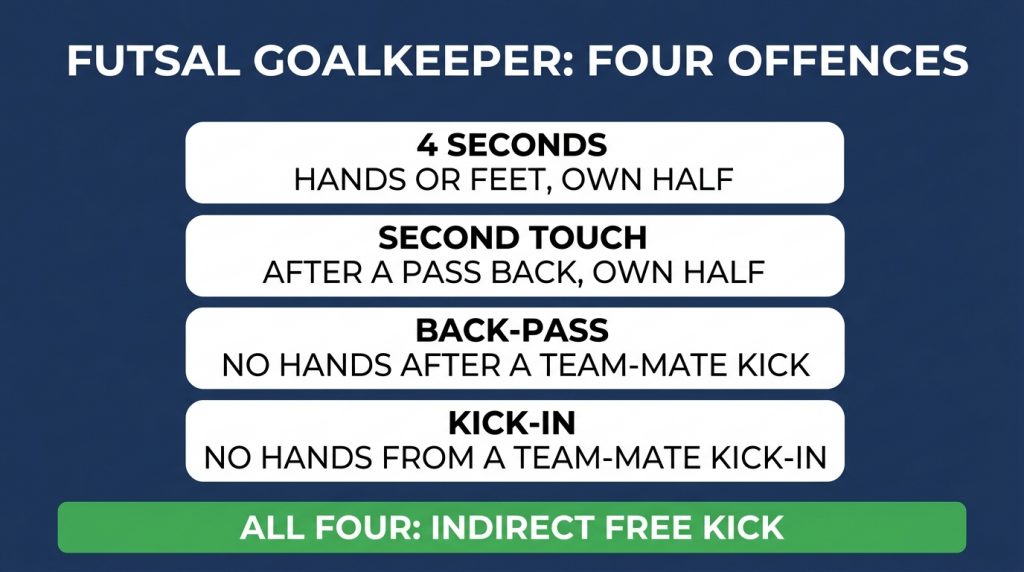
The Laws list exactly four offences specific to the goalkeeper. All four are punished with an indirect free kick to the opposing team.
| Offence | What it means in play |
|---|---|
| Controls the ball with hands or feet in their own half for more than four seconds | The count runs on foot control too, not just handling |
| After playing the ball, touches it again in their own half after a deliberate pass from a team-mate, with no opponent having played or touched it | The keeper cannot be used as a wall to reset possession |
| Touches the ball with the hands inside their own penalty area after a deliberate kick from a team-mate | The futsal back-pass rule |
| Touches the ball with the hands inside their own penalty area after receiving it directly from a team-mate’s kick-in | A kick-in cannot be played back into the keeper’s hands |
Two things stand out for anyone coming from the eleven-a-side game.
First, the four-second limit applies to feet as well as hands. Standing on the ball in your own half looking for a pass is a countable offence in futsal, and it is the single most common way an inexperienced keeper concedes a free kick.
Second, the second rule on that list has no equivalent outdoors. Once the keeper has played a deliberate pass from a team-mate, they are out of the move in their own half until an opponent touches the ball. A team cannot pass back, receive, pass back again and run down the clock.
Four Seconds: What Actually Starts the Count
The count begins when the keeper has control of the ball, and control includes the ball at their feet in their own half. It applies only in their own half — a keeper who dribbles over the halfway line is an outfield player for as long as they stay there, with no clock at all.
That is the tactical basis of the flying goalkeeper, the keeper who joins the attack to create a five-against-four overload. It is entirely legal, and the Laws make it easy: any player may change places with the goalkeeper, and any substitute may do so without informing the referees or waiting for a stoppage. A player swapping with the keeper must do it during a stoppage and tell the referees, and whoever takes the role must wear a goalkeeper’s jersey with their own number on the back.
The Goal Clearance Is a Throw
This is the rule that most surprises people watching futsal for the first time. When the ball goes out over the goal line off an attacker, play does not restart with a kick.
- The ball is thrown by the goalkeeper from any point inside the penalty area
- It must be taken within four seconds of the keeper being ready
- The ball is in play when it is thrown directly out of the penalty area
- Opponents must stay outside the penalty area until the ball is in play
- A goal cannot be scored directly from a goal clearance
If the throw does not leave the penalty area, the clearance is retaken — and critically, the four-second count is not reset. It continues from where it stopped once the keeper is ready again.
If the keeper takes longer than four seconds, the opposition gets an indirect free kick from the penalty area line at the nearest point to the offence.
There is one more trap. Once the ball is in play from the clearance, the keeper cannot touch it again — even with the feet — before an opponent has touched it. Doing so concedes an indirect free kick. Deliberately handling it outside the area is worse: that is a direct free kick and an accumulated foul against the team.
Four Seconds Is Everywhere, Not Just in Goal
The four-second count is not a goalkeeper rule that got attached to the position. It is the clock the whole restart system runs on, and knowing where it applies makes the keeper’s version make sense.
| Restart | Who takes it | Time limit | Penalty for running over |
|---|---|---|---|
| Goal clearance | Goalkeeper, thrown from inside the area | 4 seconds | Indirect free kick from the penalty area line |
| Kick-in | Any player, foot on or outside the touch line | 4 seconds | Kick-in to the opposing team |
| Corner kick | Any player of the attacking team | 4 seconds | Goal clearance to the opposing team |
| Ball controlled in own half | Goalkeeper only | 4 seconds | Indirect free kick |
Two details are worth memorising, because they turn a small mistake into a big one.
At a kick-in the ball must be stationary, placed either where it left the court or within 25 cm of that point on the ground outside, and the kicker must have one foot on the touch line or on the ground outside the court. Get any of that wrong and the kick-in simply goes to the other team.
At both the goal clearance and the corner kick, if the taking team causes a retake, the four-second count is not reset. It picks up where it stopped. A keeper whose throw fails to leave the penalty area does not get a fresh four seconds for the retake — they get whatever was left of the first count.
The Rule Nobody Reads Until It Costs Them
Of the four goalkeeper offences, the second one — touching the ball again in their own half after a deliberate pass from a team-mate — is the one that decides matches, because it is the rule that stops a leading team from parking possession.
It works like this. Your team is 3–2 up with two minutes left. A defender passes back, the keeper plays it wide, the winger is closed down and passes back to the keeper again. That second touch, in the keeper’s own half, with no opponent having played the ball in between, is an indirect free kick to the other team roughly where it happened.
The reset condition is an opponent playing or touching the ball. Not the ball crossing the halfway line, not a certain number of passes — an opponent has to be involved. That is why futsal teams under pressure play forward rather than backwards: going back to the keeper twice in the same phase is a foul waiting to happen.
Why Indirect, and Why That Matters
Every goalkeeper-specific offence gives away an indirect free kick, including offences committed inside the penalty area. A futsal keeper cannot concede a penalty by holding the ball too long.
When the offence happens inside their own penalty area, the kick is taken from the penalty area line at the point nearest to where it occurred, not from inside the area. Opponents must be at least 5 m from the ball.
That distinction matters more in futsal than outdoors, because 5 m on a court that is 16–25 m wide leaves very little room, and an indirect free kick from the edge of the area with a five-metre wall is a genuine chance.
The Keeper at a Penalty and a Second-Penalty-Mark Kick
Two restarts put the goalkeeper under specific restrictions.
At a penalty kick, taken from 6 m, the keeper must remain on the goal line, facing the kicker, between the goalposts, until the ball has been kicked.
At a direct free kick from the sixth accumulated foul, taken from the second penalty mark 10 m out, the rules are different again: the defending team may not form a wall, and the goalkeeper must stay in their own penalty area at least 5 m from the ball. It is a one-against-one from four metres further out than a penalty, and it is the moment where a futsal keeper earns their place.
What Does Not Apply
A few things futsal keepers are wrongly told:
There is no six-second rule. It is four, and it covers feet.
There is no protection inside the penalty area. The area defines where the keeper may handle the ball and nothing else.
The keeper is not restricted to their own half. They may go anywhere on the court; they simply cannot handle the ball outside their own penalty area.
Handling by the keeper inside their own area is not an offence at all — the deliberate handling law explicitly excludes them there. It only becomes an offence in the back-pass and kick-in situations listed above.
Coaching a Futsal Keeper
The technical demands are different enough that an outdoor goalkeeper needs retraining rather than adaptation.
Distribution first. The throw is a restart, an attack and a pass all at once, and it is used far more often than a kick. Accuracy over 15–20 m matters more than distance.
Feet as a first option. With a four-second clock, a keeper who can pass with either foot keeps the team playing. One who can only kick it long gives possession away.
Blocking, not diving. Shots come from close range on a hard surface, and the spreading, star-shaped block is the futsal keeper’s core save. Diving early is how goals get conceded through the body.
Reading the flying keeper. When the team plays with the keeper as an extra outfield player, the goal is empty behind them. Positioning and recovery become the whole job.
For the rest of the game around the position, our guide to futsal rules covers the format, and the differences in the ball itself are in soccer ball vs futsal ball.
Common Questions
How long can a futsal goalkeeper hold the ball? Four seconds, and the limit covers control with the feet as well as the hands, but only in their own half.
Can a futsal goalkeeper kick the ball? Yes, in open play. But a goal clearance — the restart after the ball goes out off an attacker — must be thrown, not kicked.
Can a futsal goalkeeper score? Yes in open play, but not directly from a goal clearance.
What happens if the goalkeeper takes too long? An indirect free kick to the opposing team, taken from the penalty area line at the point nearest to the offence if it happened inside the area.
Can the goalkeeper come out of the penalty area? Yes, anywhere on the court. They just cannot handle the ball outside their own penalty area, and the four-second clock still applies in their own half.
What is a flying goalkeeper? A keeper who joins the attack as an extra outfield player to create an overload. The Laws allow any player or substitute to change places with the goalkeeper, so teams also swap in an outfield player wearing the keeper’s jersey.
Can a futsal goalkeeper receive a back-pass? With their feet, yes — once. They cannot handle it, and after playing it they cannot touch it again in their own half until an opponent has played the ball.
Does the goalkeeper concede a penalty for holding the ball too long? No. Every goalkeeper-specific offence is an indirect free kick, wherever it happens.
Anthony Molina writes about soccer technique, gear and coaching at FOOTBOLNO.