Last updated: August 2026
Key Takeaways
- Being in an offside position is not an offence. You’re only penalised if you get involved in play from that position — and confusing these two things is why the rule feels impossible.
- The moment that matters is when the ball is played by your teammate, not when you receive it. You can run past every defender legally as long as the ball was already on its way.
- Three situations where offside can never be called: throw-ins, goal kicks and corner kicks.
- The punishment is an indirect free kick to the defending team, taken from where the offside player was standing.
Offside is the rule that makes people who’ve watched soccer for twenty years still argue in pubs. It isn’t actually complicated — it’s just usually explained badly, in a single overloaded sentence that tries to cover every case at once.
So let’s separate it into two questions, because the rule does exactly that and almost nobody explains it this way.
«I’ve watched parents on the sideline scream ‘offside!’ at a kid standing in an offside position who never touched the ball and wasn’t interfering with anyone. The player did nothing wrong. Half the arguments about this rule are about the wrong question.» — Anthony Molina, FOOTBOLNO.COM
Two Questions, Not One
Question one: were you in an offside position?
Question two: did you commit an offside offence?
You can answer yes to the first and no to the second, and nothing happens. The referee doesn’t blow the whistle for a position. Only the second question stops the game.
Almost every argument about offside comes from someone answering question one and thinking they’ve answered question two.
The Rule in Plain English
You are in an offside position if, at the moment a teammate plays the ball, all three of these are true:
That second-last opponent is usually the last outfield defender, because the goalkeeper is normally the very last one. But not always — if the keeper has come out, then two defenders count instead, and the rule still works the same way.
Note what isn’t included: your arms and hands don’t count, because you can’t legally score with them. Only head, body and feet.
You commit an offside offence if, from that position, you then become involved in play by:
- Interfering with play — touching or playing the ball that a teammate passed
- Interfering with an opponent — blocking their line of vision, challenging them for the ball, or making an obvious action that affects their ability to play it
- Gaining an advantage — playing a ball that rebounded off the post, crossbar, an opponent, or came off a save
If you’re standing in an offside position and none of that applies — you’re just standing there — no offence has occurred, and play continues.
The Moment That Decides Everything
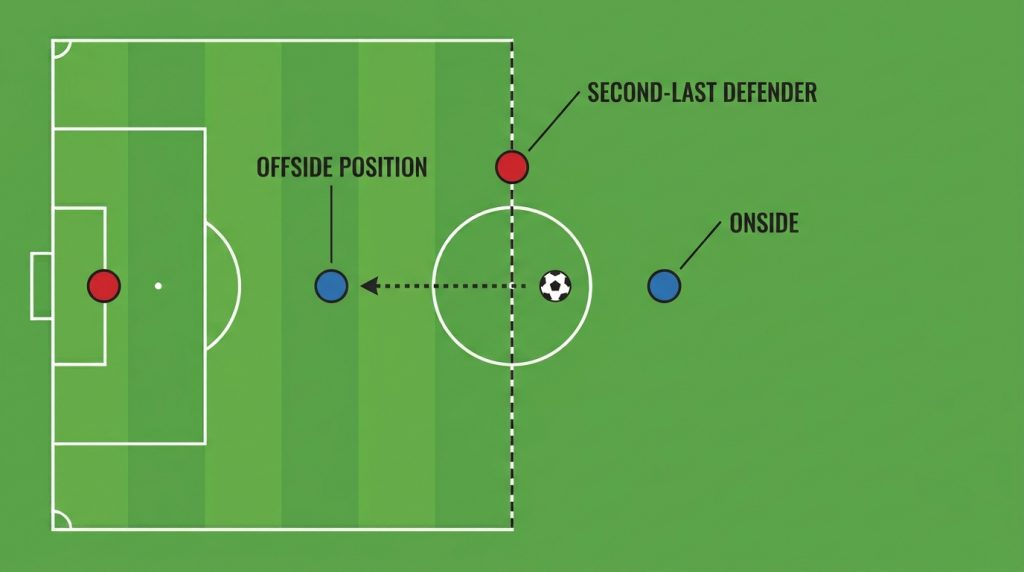
This is the single most misunderstood part.
Offside is judged at the instant the ball is played by your teammate, not when you receive it.
That means a striker can be level with the last defender when the pass leaves their teammate’s foot, then sprint ten metres past that defender to collect the ball, and be perfectly onside. It looks wrong from the stands. It’s correct.
It also means the reverse. A player who was a metre beyond the defender when the pass was struck is offside, even if the defender then runs forward and the player is behind them by the time the ball arrives.
Freeze the moment of the pass. Everything after that is irrelevant.
The Three Exceptions
Offside can never be called when you receive the ball directly from:
- A throw-in
- A goal kick
- A corner kick
That’s the complete list. It’s short and worth memorising, because these situations come up constantly and beginners often stop playing thinking they’ve been caught.
Note the word directly. If a corner is taken, a teammate heads it across, and you’re in an offside position when they head it — offside can be called on that second phase.
You also can’t be offside in your own half, or if you’re level with the second-last opponent, or level with the last two opponents. Level counts as onside.
What Happens When Offside Is Called
The assistant referee raises their flag and the referee stops play.
The defending team gets an indirect free kick from the spot where the offside player was when the ball was played — not from where they eventually received it, and not from where the pass came from.
Indirect means the ball must touch another player before a goal can be scored. You can’t shoot straight from an offside free kick and score.
No card is shown. Offside isn’t a foul and it isn’t misconduct — it’s a restart. Players who get booked in these situations are booked for dissent afterwards, not for the offside itself. This is different from a foul inside the box, which brings a penalty kick and a very different set of rules.
Why the Rule Exists at All
Without offside, the most effective tactic in soccer would be to leave a striker permanently standing next to the opposition goalkeeper and punt the ball to them. Games would be long-range kicking contests.
The rule forces attackers to stay behind the defensive line until the ball is played, which is what creates the shape you see in a match: a defensive line, attackers timing runs, and defenders stepping up together to catch someone out. Every team on the field organises around it, and it shapes what each of the player positions actually does.
That last one is a deliberate tactic — the offside trap. Defenders move up in unison just before a pass is played, leaving the attacker suddenly beyond them. Risky, and spectacular when it fails. It only works if the whole back line moves as a unit, which is why defensive positioning is drilled so heavily.
The rule has been around in some form since the 1860s and has been rewritten repeatedly. The current version is Law 11 of the Laws of the Game, maintained by IFAB.
VAR and the Millimetre Problem
Video review changed how offside feels without changing what it says.
Before VAR, an assistant referee judged the moment with the naked eye and a margin of error of maybe half a metre. Marginal calls went either way and everyone accepted it.
Now the frame is frozen and lines are drawn, so an armpit ahead of a defender’s knee is an offside. Technically correct under the rule as written — the rule has always been about any part of the body that can legally play the ball. But the outcome feels absurd, and that’s a genuine tension the sport hasn’t resolved.
Some competitions have introduced semi-automated offside technology to speed the process up. It doesn’t change the rule; it just decides faster.
At amateur level none of this applies. There’s no VAR, often no assistant referees at all, and the offside call is a judgement made by a referee running to keep up with play. Expect it to be imperfect, and don’t argue with the referee about it — no team has ever had a goal reinstated that way.
Common Situations, Answered
A teammate shoots, the keeper parries, you tap in from an offside position. Offside. Playing a rebound off a save is explicitly “gaining an advantage”.
A defender deliberately passes the ball back to their keeper and you intercept from an offside position. Not offside. A deliberate play by an opponent resets it — you weren’t put onside by a pass from your own team, so the offside position doesn’t apply.
You’re offside but a teammate onside collects the ball instead. No offence, provided you didn’t interfere with an opponent. Standing there isn’t enough.
You’re standing in front of the goalkeeper in an offside position when a shot comes in. Offside, if you obstructed their view or made an action that affected them. This is the “interfering with an opponent” clause and it’s the most subjective part of the rule.
A defender knocks the ball to you while you’re in an offside position. Depends on whether it was deliberate. A deliberate pass resets it; a deflection off a defender doesn’t.
How to Not Get Caught Offside
For attacking players, it comes down to timing rather than speed.
Start your run from behind the ball carrier’s eyeline. If you’re already level with the defenders and waiting, you have no margin. This is why a forward who can receive and control a ball at speed is worth more than a faster player who needs two touches.
Time the run to the pass, not to the space. Beginners look at the gap and go. Good attackers look at the passer’s body shape and go a fraction later.
Bend your run. Arriving diagonally from deeper keeps you onside longer than running straight forward alongside the defender.
Check the linesman’s flag position in your peripheral vision, not the defenders. Beginners stare at defenders and lose track of the ball entirely.
This is one of the reasons position choice matters — strikers live with this rule constantly, midfielders less so, and defenders essentially never. Our position self-assessment covers what each role actually demands.
Common Questions
Can you be offside in your own half? No. Being in the opponents’ half is a requirement, and being exactly on the halfway line counts as being in your own half.
Can you be offside from a throw-in? No. Throw-ins, goal kicks and corners are the three exceptions.
Is a player offside if they don’t touch the ball? They can be, but only if they interfere with an opponent — blocking a keeper’s view, for instance. Simply standing in an offside position while a teammate plays the ball elsewhere is not an offence.
Does the goalkeeper count as the last defender? Usually, but the rule doesn’t say “goalkeeper” — it says second-last opponent. If the keeper has come out of position, two outfield defenders become the reference points.
Do arms count for offside? No. Head, body and feet only, because those are the parts you can legally score with.
What’s the punishment for offside? An indirect free kick to the defending team, from where the offside player was standing when the ball was played. No card.
Why is it called “offsides” sometimes? “Offsides” is common American usage; “offside” is the official term in the Laws of the Game. Both refer to the same rule and nobody will misunderstand you.
When was the offside rule introduced? Versions of it date to the 1860s, and it has been revised many times since — most significantly in 1925, when the number of defenders required between attacker and goal dropped from three to two, and goalscoring immediately rose.
If you’re new to the game and this is one of several rules you’re still working through, our beginner’s guide to playing soccer covers the eight rules that actually come up in your first match.
Anthony Molina writes about soccer technique, gear and coaching at FOOTBOLNO.